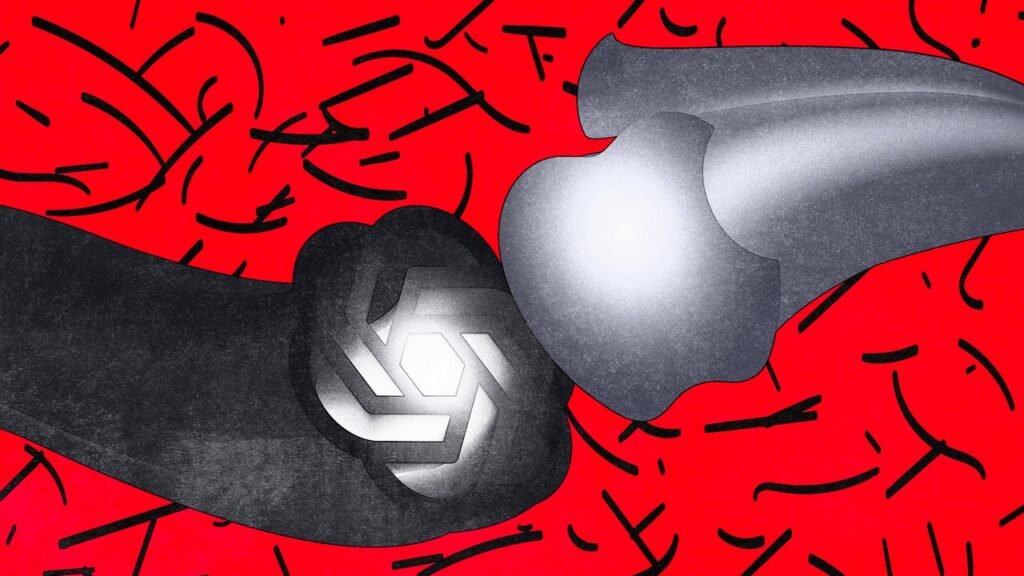
OpenAI, the artificial intelligence pioneer, is trying on a new public image: the scrappy underdog David defending itself from Apple’s creaky Goliath. It’s an understandable strategy, but making that image stick won’t be easy.
The root of the dispute is OpenAI’s plan to develop its own AI-centric devices. Last month Apple sued OpenAI, alleging that it has stolen trade secrets. This has quickly morphed into a battle in the court of public opinion—and that battle has high-stakes implications for both brands.
Most notably, in a snarky blog post this week, OpenAI mocked Apple and its lawyers for a “careless, aggressive and oddly personal lawsuit,” sharing texts and email excerpts seeming to show Apple’s outside counsel emailing the wrong employee (with a similar, Asian name) and other sloppy-sounding missteps. The subtext isn’t (just) dunking on Apple; it’s the suggestion that Apple—legendary innovator and “think different” tastemaker—has lost a step or two.
“We do not have, nor want, any of their trade secrets,” OpenAI’s post zings. “We’re much more interested in building innovative products and technologies that push the frontier.”
The core accusation of Apple’s snarling brief is that key ex-Apple employees, among the hundreds who have decamped to OpenAI, took along confidential information that could help its plans to create proprietary hardware. “At every level,” the suit charges, “OpenAI has been stealing Apple’s trade secrets and confidential information.”
Previously, the companies seemed to have a cooperative relationship, including a deal that made OpenAI’s ChatGPT technology help power the Siri voice assistant. That arrangement fizzled out, and Apple’s newly announced SiriAI will instead use Google’s Gemini AI technology. More recently, OpenAI has announced it would start producing its own, nonphone devices, involving the former Apple design superstar Jony Ive. There have been few details, and the suit does not cite Ive, but the possibility of an AI-powered device to rival the iPhone ecosystem clearly hovers in the background. In the latest development, Apple this week sought a preliminary injunction that would force OpenAI to pause work on such devices.
It makes sense that OpenAI would try to paint Apple as a villainous tech Goliath that has been long out of touch with its rebel-creator legacy and instead relies on raw market power to squelch the innovations of bold upstarts. It’s possible that Apple is, to some extent, vulnerable to that critique.
What sounds a lot more challenging than implying that Apple is a fading Goliath, however, is convincing anyone that OpenAI is a sympathetic David. OpenAI styles itself as a kind of populist source of human-centric empowerment, perhaps even anti-elite, at least according to Silicon Valley insider types. But to the mainstream, the company has become almost synonymous with AI, or at least a massive force in what is being sold as the most powerful technology in generations.
CEO Sam Altman is arguably the single most familiar face of the AI revolution, and has long since entered the rarified air of elite tech executives who show up before congressional committees, at big conferences, and in profiles in prestigious media outlets. After all, OpenAI is likely to IPO as one of the world’s most valuable companies. It seems less an underdog than practically the Coca-Cola of AI.
And while a subtext of Apple’s suit is to refresh its innovator rep, it also speaks directly to a different narrative around OpenAI, which is that there’s something nefarious or at least untrustworthy about the company. (Altman’s trustworthiness has been a theme of those profiles, and he at times makes hype-y statements that don’t help—and neither does his weird parenting advice.) Its chief rival, Anthropic, has overtly positioned itself as more thoughtful and protective of its users. On a more practical level, OpenAI hasn’t had time to build consumer trust and familiarity that an Apple, however Goliath-like, still enjoys.
It will be a while before we can know enough to judge whether Apple’s accusations are an overreach. But by then the specifics of the lawsuit may be overshadowed by events. Altman, with typical flair, has mused to staff about selling 100 million of whatever device Ive is working on. Both Apple and OpenAI are already working to influence the verdict on that, right now.