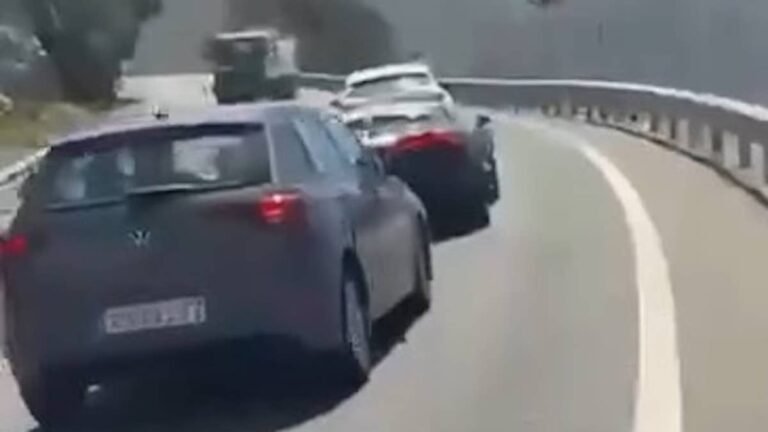
I don’t think this was the mashup Bugatti wanted for the Tourbillon. A routine high-altitude test run recently resulted in a substantial financial liability when a Volkswagen Polo rear-ended a Bugatti Tourbillon prototype. The crash took place on a winding mountain road in the Sierra Nevada region of Spain, violently contrasting a subcompact commuter vehicle with a highly anticipated hypercar valued at 3.8 million euros before options.
Bugatti was conducting extreme weather evaluations when public traffic intervened. Video footage uploaded to social media captured the precise moment the affordable German hatchback failed to stop in time, striking the handcrafted French test mule. The incident brings a sharp focus to the staggering wealth gap on the tarmac and the realities of testing invaluable platforms on public roads.
Expensive Brakes Did Their Job
The mechanics of the crash were straightforward. The Bugatti was trailing a white Kia through an active construction zone. When the Kia abruptly stopped for a red light, the Tourbillon stopped at a dime; the Volkswagen could do no such thing. The trailing Polo was following too closely at speed and simply lacked the stopping power to avoid the impact.
From an engineering perspective, the accident demonstrates the massive braking difference between standard hatchbacks and modern hypercars. The Bugatti scrubs off immense speed using gargantuan carbon-ceramic brakes and bespoke Michelin tires engineered to handle extreme friction. In stark contrast, the Polo relies on standard steel brakes and narrow rubber prioritized for daily efficiency rather than high-performance braking.
The hardware at risk in this collision is extensive. Beyond the carbon-fiber aerodynamic diffuser damaged in the strike, the Tourbillon houses an 8.3-liter Cosworth V16 engine paired with three electric motors. This complex 1,775-horsepower hybrid system produces a distinct motorsport engine sound under heavy acceleration. Replacing even a single handcrafted rear panel will easily exceed the entire retail price of the Volkswagen.
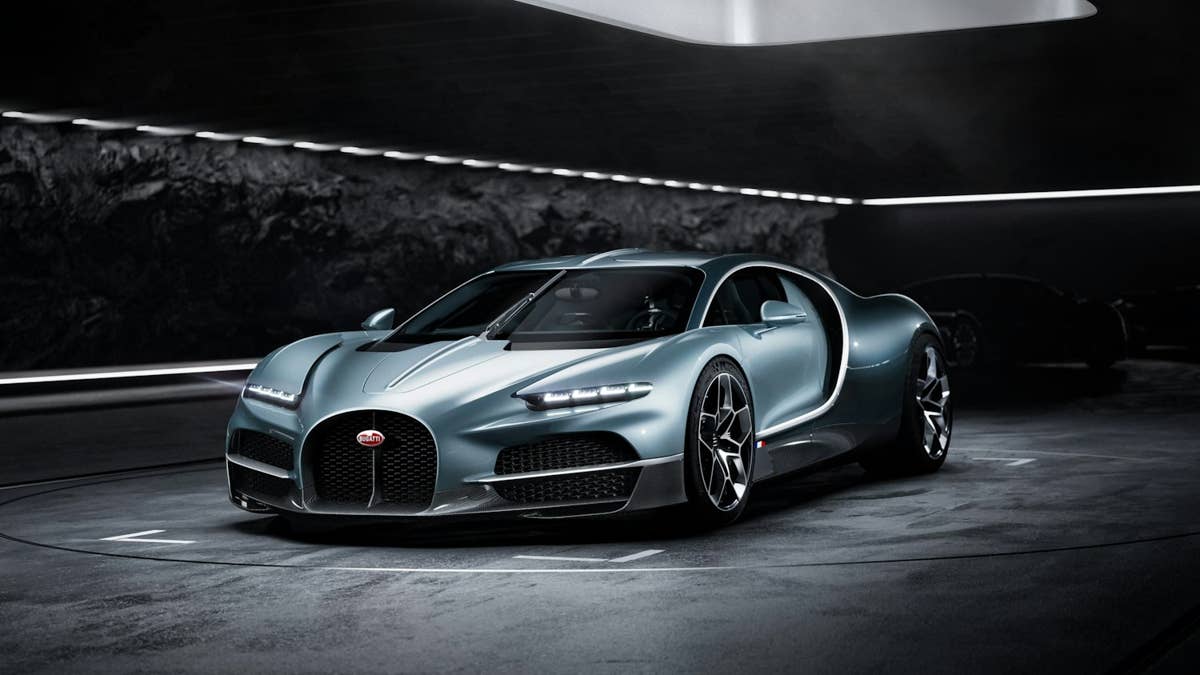
Bugatti
Always Risk with Public Testing
Fielding invaluable prototypes on public roads exposes automakers to unpredictable everyday drivers. Insurance adjusters will undoubtedly face severe sticker shock when processing a claim involving bespoke carbon-composite bodywork rather than standard mass-market components. This expensive mishap highlights the inherent risks manufacturers accept when validating next-generation platforms in real-world environments.
Ultimately, this incident reinforces the absolute necessity of maintaining a safe following distance, regardless of the vehicles involved. The Volkswagen driver learned a difficult lesson about tailgating a hypercar through a congested area. The situation clearly demonstrates that standard commuter vehicles cannot defy physics when the traffic ahead comes to a sudden halt, emphasizing basic road safety over aggressive driving.