You probably know friends or family members who didn’t vote in the last election. Patagonia wants to offer you $100 to nudge three of them to vote in November.
The company is investing $11.2 million in the nontraditional get-out-the-vote campaign. The dollar amount (you get your money as a credit, not in cash) was inspired by a startling fact: An estimated 11.2 million environmental voters—Americans who see the climate and environment as a top priority—don’t vote.
“We couldn’t believe that,” says Corley Kenna, who leads Patagonia’s communications and policy team. “We thought, okay, if we know these people, we maybe can help get them out to vote in this election when the state of our planet, things have never been so dire. We need as many people who care about the health of our planet to vote. And so we want to do what we can to get those people out.”
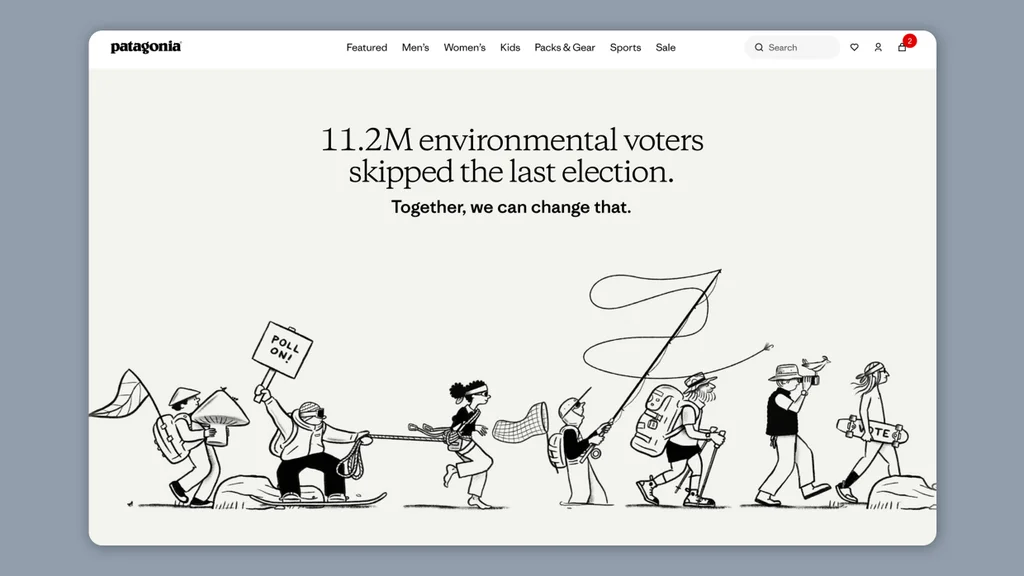
Anyone who’s interested will be able to sign up beginning September 26 via a platform called Relentless embedded on Patagonia’s site. After you enter the details for three people who you want to encourage to vote, the platform creates a voting plan based on their address, including information about where they can vote, whether they can vote early or by mail, and whether they’ll need to show an ID.
You can text or email them the information. Once you say that you’ve done that, you can choose between a $100 credit at Patagonia or a $100 donation to the League of Conservation Voters. (The incentive doesn’t depend on whether or not your friends end up voting; it’s just meant to get you to take the first step.)
A legacy of action
The outdoor retailer has always been known for its environmental protection work. And it has a history of encouraging people to vote that goes back to 1978, beginning with a local newspaper ad in Ventura, the company’s California hometown, that argued for pro-environment candidates and ballot measures. In the 2024 election, the company succeeded in getting around 5,000 people to vote and volunteer, Kenna says. Now, as the Trump administration has taken hundreds of anti-environmental actions, Patagonia wanted to go further.
Instead of traditional advertising, it chose to put money into relational organizing—asking Patagonia’s community to mobilize their friends, families, and neighbors.
An organization called the Environmental Voter Project, which focuses on encouraging environmentalists to vote, calculated the 11.2 million number through detailed research on voters. There are multiple reasons why someone who cares about climate and the environment might not be voting, says Nathaniel Stinnett, founder and executive director of the nonprofit.
“First, people who care deeply about climate are more likely to be young, people of color, or lower income Americans,” he says. “And it’s just harder for those people to vote because of voter suppression efforts.”
There’s another, hidden reason. “Our research shows that Americans view the climate crisis as a series of personal failings as consumers or commuters rather than as a systemic problem that should be addressed through political action,” Stinnett says. “And so political solutions don’t even occur to many environmentalists. They’re thinking about the recycling bin instead of the ballot box.” (That’s partly thanks to decades of efforts by the fossil fuel industry, which created concepts like the personal carbon footprint.)

Peer pressure can help nonvoters change their minds. Kenna, who started her career as a paid organizer before joining Patagonia, says she’s seen firsthand the difference between knocking on strangers’ doors and persuading your own friends or neighbors to vote. It’s also potentially more effective than traditional ads.
“We’re living in a world with just a lot of money in politics, and a lot of traditional ads on television, digital ads—we’re bombarded with them,” she says. “ I think the best way to break through with that is a text or an email or a phone call from a friend. An actual conversation with a friend.”
Patagonia is already involved in fighting the Trump administration to protect environmental policy, with a focus on public lands. Since January 2025, the company says that it has engaged hundreds of thousands of people on public land and climate issues. In early September, it joined a lawsuit to protect Bears Ears National Monument, a public space in Utah that Trump plans to shrink by around 90%.
Mobilizing voters is a natural extension of that work, says Kenna. “This is sort of the culmination,” she says. “If you care about these issues, you need to get your friends and family to make a plan to vote.”
If more environmentalists vote, it could make a material difference. In the last presidential election, for example, Trump won Pennsylvania by about 120,000 votes. But around 300,000 environmentalists in Pennsylvania sat the election out. “It is clear that climate voters could easily swing elections if they flood the polls in November,” says Stinnett.