Vladimir Putin is learning again, on Ukraine, an important cautionary lesson: Be careful what you wish for.
His first major miscalculation was in believing that getting a green light from President Biden for “a minor incursion” into Ukraine in February 2022 would all but ensure the success of his full-scale invasion.
He was not alone in that view — global expectations, including those of the Biden administration, were that Ukraine would collapse immediately under the Russian onslaught. But the U.S. and the West had already accepted Putin’s invasion and occupation of eastern Georgia in 2008 during the administration of George W. Bush, who had just persuaded NATO to commit to eventual membership for Georgia and Ukraine. Bush had said he had “looked into Putin’s eyes and saw his soul,” and he did nothing to reverse Russia’s aggression.
This pattern of acquiescence to a new world order modeled on the old, pre-WWII order that might makes right was repeated in 2014. Russia invaded eastern Ukraine and Crimea to collect on President Obama’s 2012 promise to Putin of more U.S. “flexibility” once he had been safely re-elected. Putin clearly expected Biden as president would follow the model that he and Obama had already established in 2014 — that major parts of Ukraine are expendable in the cause of “peace” and avoiding World War III.
But President Volodymyr Zelensky and the Ukrainian people understood the reality that Russia’s invasion was ultimately existential. They resolved to resist and sought the West’s help — not in fighting forces, but in diplomatic, intelligence and weapons support. Today, after three and a half years, Russia has suffered a million deaths and injuries, lost billions of dollars’ worth of equipment, and crushing Western sanctions, without significant territorial gains beyond the 20 percent of Ukraine it seized with its initial blitzkrieg. Worse in Putin’s worldview, Russia now faces a revived and strengthened NATO, with two new members, Sweden and Finland, close to its borders.
After outlasting the Biden administration, which had (accurately) called him “a thug” and “war criminal,” Putin has found a more congenial and cooperative negotiating partner in Donald Trump, whose admiration bordering on adulation has been palpable. But, once again. over-reliance on an initially pliable American president has seduced Putin into overplaying his hand.
After Trump, following the lead of his vice president, JD Vance, disrespected and humiliated Zelensky in their White House meeting, former Russian President Dmitry Medvedev applauded the disgraceful performance. “The insolent pig finally got a proper slap down in the Oval Office,” he wrote on X. “Donald Trump is right: The Kiev regime is ‘gambling with WWIII.’” From that point on, Putin felt empowered to slough off Trump’s repeated overtures and deadlines to end the carnage.
The much-touted Alaska summit was supposed to be a showdown, with “severe consequences” threatened if Putin failed to agree to an immediate ceasefire. Instead, the Russian leader yet again defied Trump, smugly dominating the high-visibility meeting he had demanded — all while intensifying his bombing of Ukrainian civilians. Putin’s international isolation for aggression and war crimes ended with Trump’s effusively warm, red-carpet welcome on U.S. — formerly Russian — soil and without a single public concession.
In some ways, the summit was the converse of the bullying put-down of Zelensky by Vance and Trump. But this time the American president was the diminished participant, and it was carried out not with angry scowls but with Putin’s sly smiles.
After the false start in Alaska, the next step in Trump’s epic effort to end the war and boost his chances for a Nobel Peace Prize was an invitation to Zelensky to return to the White House to hammer out the details of an overall peace agreement, including land swaps that Putin wants and issues that Zelensky has raised, such as security guarantees. Considering the tawdry history of past guarantees — the Budapest Memorandum of 1994 when Ukraine surrendered its nuclear weapons, the Minsk I and Minsk II ceasefires and numerous other aborted pauses in fighting — Ukraine will want assurances more reliable and akin to formal security treaties like Article 5 of the NATO Treaty. Trump’s team says Putin has now agreed to an “Article 5-like” security guarantee to Ukraine.
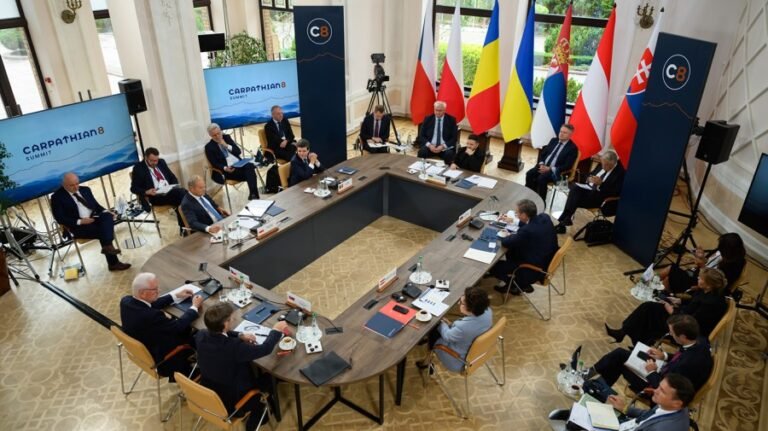
NATO members have begun stepping up to meet their own obligations to individual and collective self-defense against the common danger Putin poses. As a result, the heads of six European governments joined Zelensky’s visit at the White House yesterday, with the intention of forging a collective Western response to the most dangerous security challenge since the Second World War.
The U.S. and European democracies need to fashion a collective strategy for Ukraine’s victory that includes the following:
- the security guarantee that Zelensky and Europe agree is essential for peace;
- an increased volume of arms transfers to Ukraine with enhanced range and lethality;
- diplomatic declarations of the sovereignty and political independence of Ukraine;
- stronger direct economic sanctions against Russia and secondary sanctions on countries funding Putin’s war, such as China; and
- seizure of Russian assets for the reconstruction and partial healing of Ukraine, including reparations for families of victims of Russian war crimes.
After the failed Alaska summit, retired Gen. Philip Breedlove said, “Russia has never been interested in peace in Ukraine, is not now interested in peace in Ukraine, and will never be interested in peace in Ukraine,” except after its own total victory. If Putin’s regime will not change its aggressive behavior, the U.S. and Europe must undertake a campaign for regime change in Russia.
Joseph Bosco served as China country director for the secretary of Defense from 2005 to 2006 and as Asia-Pacific director of humanitarian assistance and disaster relief from 2009 to 2010. He is a nonresident fellow at the Institute for Corean-American Studies, a member of the advisory board of the Global Taiwan Institute and member of the advisory board of The Vandenberg Coalition.