Editors’ Highlights are summaries of recent papers by AGU’s journal editors.
Source: Earth and Space Science
Space missions are risky: even when every single detail has been carefully studied over years of testing, things can (and often do) go wrong. Loss of communication with spacecraft is not uncommon. Reestablishing communication with a “lost” spacecraft requires knowledge of its position and attitude.
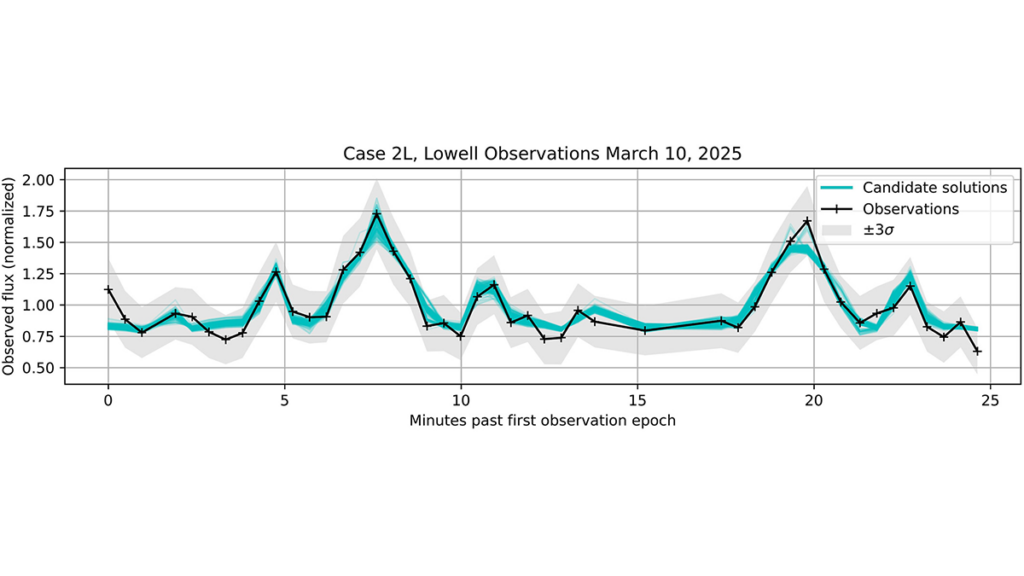
Light curves represent the variation of observed brightness of an object moving in space, relative to time. Borrowing from techniques utilized to track asteroids, light curves produced by the reflectivity of the materials of which a spacecraft is made, its shape, and moment of inertia, are inverted and matched to ground-based optical observations to estimate position, orientation, and other spacecraft parameters. Standard inversion is usually based on material parameters from the literature, which do not account for time spent in space and material erosion that may significantly alter the light curves.
The Lunar Trailblazer, launched on Feb 27, 2025, lost contact with Mission Control the following day. Attempts by the multi-institution mission science team to reestablish communications started immediately, and optical observations by the Lowell Discovery Telescope and Gemini South Observatory were acquired.
In this paper, Robinson et al. [2026] account for propagation of material parameter uncertainties in the inversion of light curves, informed by the specific photometric and spectral characteristics of the spacecraft materials (Steckel and Ehlmann, 2026) rather than guessed from literature. The authors are thus able to reduce ambiguity and improve the reliability of light-curve orientation estimates.
This work demonstrates that future missions that will integrate laboratory characterization of materials and analysis of uncertainty propagation, will have better chances of spacecraft recovery and mission success.
Citation: Robinson, L., Steckel, A., Frueh, C., & Ehlmann, B. (2026). Material property sensitivity of light curve attitude estimation for the Lunar Trailblazer. Earth and Space Science, 13, e2025EA004733. https://doi.org/10.1029/2025EA004733
—Graziella Caprarelli, Editor-in-Chief, Earth and Space Science
Text © 2026. The authors. CC BY-NC-ND 3.0
Except where otherwise noted, images are subject to copyright. Any reuse without express permission from the copyright owner is prohibited.