Editors’ Highlights are summaries of recent papers by AGU’s journal editors.
Source: Geophysical Research Letters
Headwater streams are the small channels where river networks begin. Much of our understanding of these systems comes from historical studies of steep, forested landscapes, leaving other settings less understood.
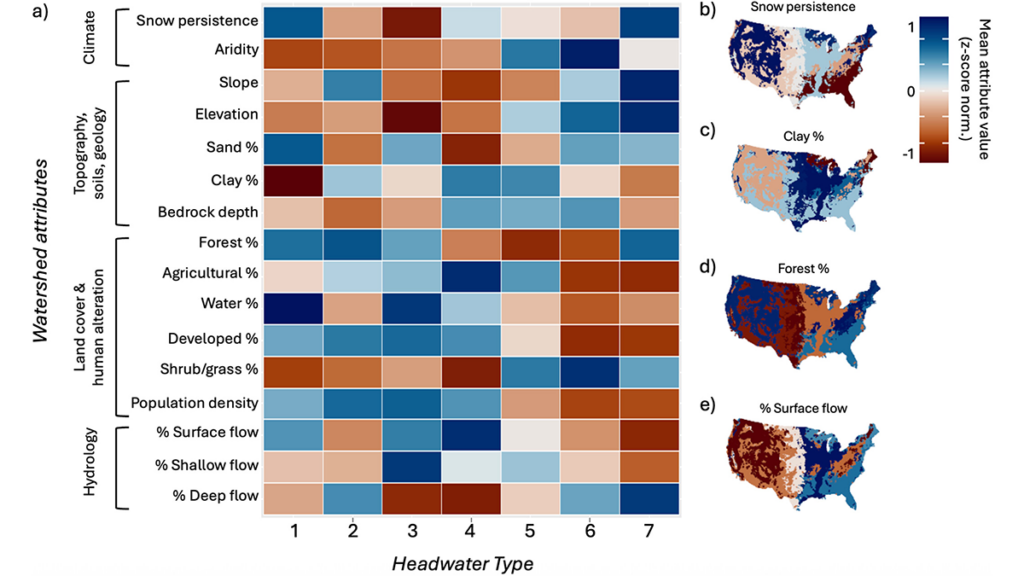
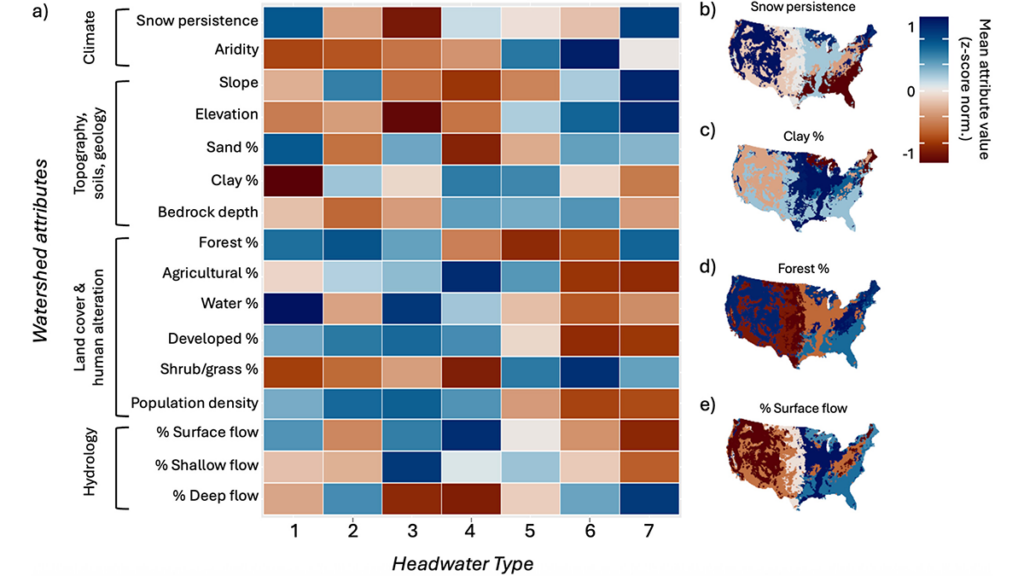
Seybold et al. [2026] analyze climate, terrain, soils, and land cover across more than 82,000 watersheds in the contiguous United States to develop a classification of headwaters. They identify seven distinct types, spanning snowy mountain forests, lowland forests rich in wetlands, agricultural landscapes, grasslands, and arid shrublands. Only about 30% of headwaters belong to the two types that most closely resemble the familiar steep, forested setting. Comparisons with downstream areas also reveal consistent differences, with terrain indicators of potential water pathway depth providing the strongest distinctions.
These findings suggest that knowledge and management practices developed in well-studied forested watersheds may not transfer readily to much of the country. The classification offers a framework for targeting monitoring gaps, improving watershed models, and tailoring conservation and management to the diversity of places where rivers begin.
Citation: Seybold, E. C., Hammond, J., Husic, A., McMillan, H., Golden, H. E., Christensen, J. R., et al. (2026). Emergent headwater types for watershed monitoring, research, and planning. Geophysical Research Letters, 53, e2026GL123244. https://doi.org/10.1029/2026GL123244
—Valeriy Ivanov, Editor, Geophysical Research Letters
Text © 2026. The authors. CC BY-NC-ND 3.0
Except where otherwise noted, images are subject to copyright. Any reuse without express permission from the copyright owner is prohibited.