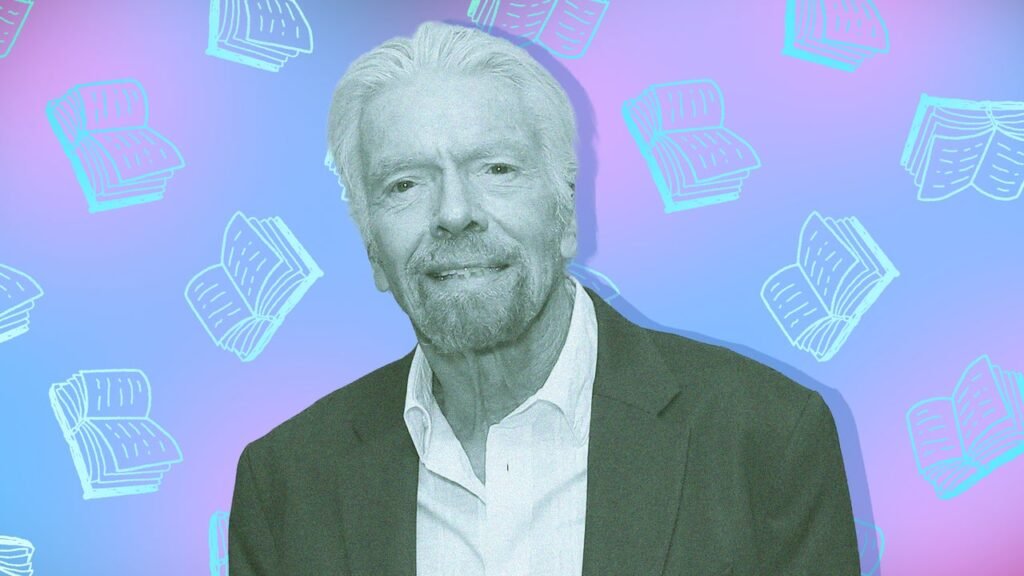
Many entrepreneurs credit strategy, timing, or gut instinct for their success. For one billionaire, a cult novel about surrendering control to a dice roll was an unlikely early influence.
Richard Branson is the founder of Virgin Group, the conglomerate behind more than 400 companies including Virgin Atlantic and Virgin Galactic. Known for his adventurous personality and his business acumen, he is also an avid reader and created a Literati book club called Read Like An Artist in 2022—a reflection of his long-held belief that reading is one of the most powerful tools an entrepreneur can have.
“Reading and understanding the media landscape is important for everyone, and it is especially important for entrepreneurs,” he wrote. “You need to be able to spot opportunities where others see challenges. You need to solve problems. To do this, you must understand the problems of the world, and find new ways to solve them.”
Branson told CNBC that he first read The Dice Man by Luke Rhinehart just before starting Virgin Records in 1972, a year after the book’s release. The timing was not incidental. As a young entrepreneur on the verge of building what would become one of the most recognizable brands in the world, Branson was finding his entrepreneurial footing.
He has credited the book’s “dice-rolling” strategy as part of his decision-making process when signing artists to his record label. “This meant compiling a list of potential actions, rolling dice, and going along with whatever number the dice landed on,” Branson said.
In The Dice Man, the protagonist surrenders his decision-making to the roll of a die, letting chance dictate his actions, choices, and behavior. The dice-rolling philosophy operates on one non-negotiable rule: Whatever the die says, goes. This practice Rhinehart frames as liberation from routine, obligation, and the weight of personal desire.
The provocative thought experiment at the center of the book helped it develop a cult following, with Branson calling it “a very entertaining read that has always stayed with me.” London’s Time Out called it “the most fashionable novel of the early 1970s,” and in 1995 a BBC production named it “one of the 50 most influential books of the last half of the 20th century.”
Branson is the first to admit the experiment had its limits. “Safe to say, I didn’t keep using the book to influence my decisions for long,” he said. But the underlying lesson—that relinquishing control, even briefly, can provide new perspectives—is one that has quietly shaped his approach to risk and decision-making.
For an entrepreneur who has never shied away from a bold bet, knowing when to embrace uncertainty may be one of his most underrated tools.
—Amaya Nichole
This article originally appeared on Fast Company’s sister website, Inc.com.
Inc. is the voice of the American entrepreneur. We inspire, inform, and document the most fascinating people in business: the risk-takers, the innovators, and the ultra-driven go-getters that represent the most dynamic force in the American economy.