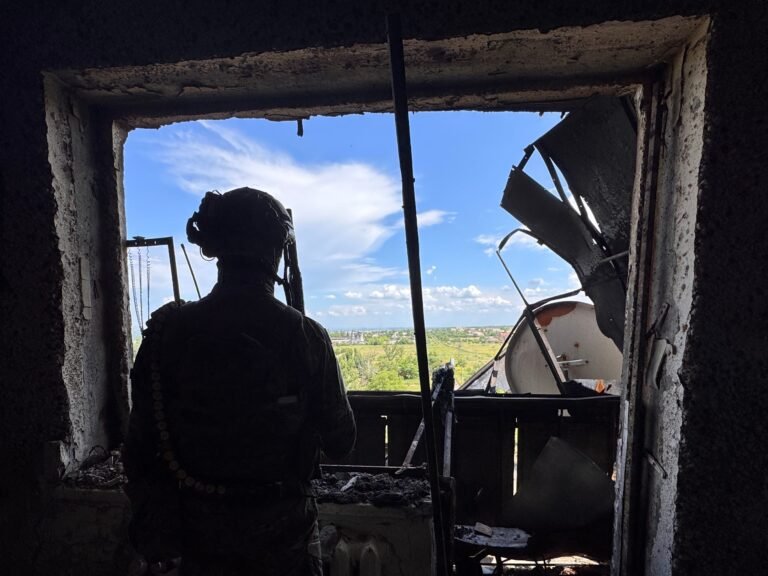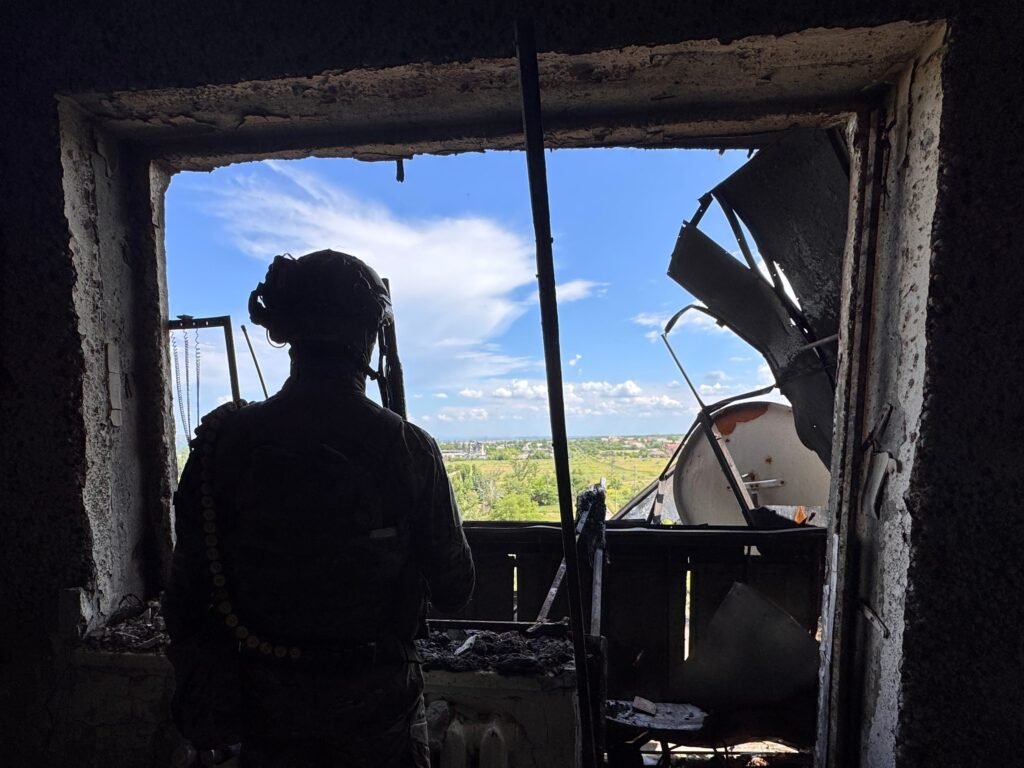
Alex Nikitenko/Global Images Ukraine via Getty Images
- Russia is advancing slowly through the Donbas as Ukraine prepares to defend its last major strongholds.
- Ukrainian commanders say the fight for Kramatorsk and Sloviansk could become brutal battles of attrition.
- Analysts warn the outcome may hinge on Ukraine’s ability to keep troops supplied under relentless drone and air attacks.
There is a moment before the camera begins rolling when the young Ukrainian commander says, “History is repeating itself for us in the Donbas. Unfortunately.” Then he falls silent.
A few minutes later, the man, known by the call sign “Fleshka,” takes a seat on a weight bench in the garden of a house in an eastern Ukrainian village, just a 30-minute drive from the nearest Russian troops. Every morning, he benches 80 kilograms here before returning to the screens where he coordinates the destruction of Russian assault units through the live feeds from his drone operators.
“I hope it will be a long fight. This is our land, and we will fight for every meter of it,” Fleshka says once the camera is rolling. A few meters away stands his comrade “Sascha,” another unit commander with the 33rd Brigade. “It’s going to be a brutal meat grinder,” he predicts, describing a bloody war of attrition. “But I’m glad to be part of it.”
Fleshka, 24, and Sascha, 26, belong to a new generation of young Ukrainian commanders helping lead the defense of the last Ukrainian-held bastions in the Donbas. Both have spent years fighting on the front lines. They were involved in the drawn-out Battle of Bakhmut in 2023 and later took part in Ukraine’s offensive in Russia’s Kursk region at the end of 2024. Today, each man is responsible for more than 80 soldiers serving in a combined drone-and-infantry unit.
Lysenko/WELT
The Donbas is comprised of the Luhansk and Donetsk regions. Russia has captured almost all of Luhansk, while Ukraine controls just under one-fifth of the Donetsk region, an area of roughly 5,000 square kilometers, about five times the size of Berlin.
The question is increasingly not whether Putin’s army will seize the remaining Ukrainian-held territory in Donbas, but when.
According to information obtained by WELT from conversations with representatives of a leading European intelligence service, Russian forces could reach the outskirts of Kramatorsk and Sloviansk by early 2027. The two cities form the center of the last major Ukrainian defensive belt in the Donbas.
Intelligence officials predict that Russian troops could complete the conquest of most of the region by next year. The human cost of that campaign, however, would likely be staggering. Hundreds of thousands more Russian soldiers could be killed or seriously wounded in the process.
Since the start of the war in 2022, Russia’s military has suffered around 1.4 million casualties, according to estimates by analysts at the Center for Strategic and International Studies, including up to 450,000 dead and nearly one million wounded.
Military analyst Franz-Stefan Gady, author of Attack: When War Comes to Us, offers a somewhat more optimistic assessment for Ukraine. Russia’s advance, he argues, is progressing at its slowest pace since winter. “At the current rate, Donetsk region would not be fully captured until the early 2030s,” he says.
Alex Nikitenko/Global Images Ukraine via Getty Images
A slowdown, however, should not be mistaken for a stabilization of the front lines. In some sectors, Kyiv’s military position is deteriorating. Russia enjoys local superiority in first-person-view drones on certain stretches of the front, in some cases by a ratio of 10 to one. Meanwhile, 3,000-kilogram guided glide bombs continue to inflict heavy losses on Ukrainian forces in front-line areas.
Gady believes it’s possible that Russian troops could reach Kramatorsk and Sloviansk as early as spring or summer 2027, but only under one condition.
“Russia needs mobilization if it wants to sustain or increase the current pace,” he says. “Moscow is unlikely to do this before the elections, and if it does, Ukraine has no equivalent response available.”
According to Gady, Russia’s General Staff estimates that newly mobilized troops need around four months before they can have a meaningful impact at the front. A mobilization this autumn could therefore begin to shape events during the first half of 2027.
Col. Markus Reisner of the Austrian Armed Forces says Russia’s summer offensive has so far fallen well short of Kremlin expectations. Nevertheless, Putin’s troops continue to advance “slowly but steadily”.
The decisive factor in the battle for the Donbas, he argues, will be Ukrainian logistics.
“The single most important capability influencing the fight for the Ukrainian defensive belt around Kramatorsk and Sloviansk is the ability to supply the defenders in those cities. If Russian forces succeed in disrupting those supply routes, Ukrainian defenders will be able to hold out only for a limited period.”
Pierre Crom/Getty Images
Already, much of the resupply effort relies on heavy multicopter drones and uncrewed ground vehicles. Russian forces are systematically targeting these systems while simultaneously attempting to prevent the reinforcement and rotation of Ukrainian troops.
Reisner’s warning is stark: “If the Ukrainians fail to break this vicious cycle, the defensive belt will fall.” Ukrainian brigade commanders also acknowledge that Russia ultimately possesses the resources required to conquer the Donbas.
“Of course, Russia has the potential,” Vadym Krykun, commander of the Lubart Brigade, told WELT earlier this year. “It remains the second-largest army in the world. The question is how far Russia is willing to go, how much further it is prepared to mobilize its economy and its population.”
Krykun has been fighting in Donbas for more than a decade. Russian troops first entered the region in 2014, and fighting has continued ever since.
As recently as last year, there were hopes that a settlement over eastern Ukraine might pave the way for a ceasefire or even peace. At the end of 2025, Ukrainian President Volodymyr Zelenskyy proposed withdrawing Ukrainian troops from parts of the Donbas as part of a peace initiative, on the condition that Russia also withdraw and that the area be converted into an internationally monitored demilitarized zone, or “free economic zone.” The Kremlin rejected the proposal, which was also supported by the United States.
The troops led by Fleshka and Sascha operate heavy “Vampire” and “Nemesis” bomber drones in the Donbas that can strike targets up to 50 kilometers away. They are complemented by reconnaissance drones, drone-based mine-laying systems, and ground robots.
“Our primary focus right now is eliminating their drone operators,” Sascha says. “We located the enemy, bombed the position, and mined the area around it. So I would advise them to leave their foxholes and get as far away as possible.”
Lysenko/WELT
His soldiers, he says, are doing everything they can to keep Ukrainian infantry alive. “The longer the infantry survives, the longer the cities hold.”
Fleshka explains that the so-called “death zone,” the area in which soldiers must expect drone attacks at any moment, has expanded dramatically in recent months.
The kill zone now stretches 20 kilometers deep in some places, and up to 50 kilometers in others.
“When they use small groups and start moving, and we detect them, nobody wants to let them get away,” Sascha says. “Our priority is to eliminate them. There are so many Russians that they simply do not care. I don’t know, it’s a complicated subject. We eliminate them without much difficulty, but there are just so many of them.”
Sascha then describes the Russian tactic in greater detail.
“The enemy sends people forward one at a time. Ten groups essentially means ten individuals.”
If one reaches the designated position, another ten groups are sent forward. Eventually, one gets through, then another, then another, until six soldiers have assembled and can continue advancing together.
“Well, let’s put it this way: it’s a good tactic. An interesting tactic. I haven’t come across anything quite like it before,” he says.
According to Gady, this method of gradual infiltration and attrition is central to Russia’s approach. “Cities do not fall through breakthroughs or house-to-house combat. They fall through exhaustion.”
Fleshka fears that Druzhkivka could be the next city to come under serious threat.
“They have shifted their focus toward Sloviansk. They are already fighting in Mykolaivka.”
Francisco Richart Barbeira/NurPhoto via Getty Images
Sascha also expects a fierce battle for Sloviansk. He insists that his men are ready. “It will be like Chasiv Yar. But how long did they assault Chasiv Yar? About a year, if I remember correctly.”
He points to the terrain surrounding Kramatorsk and Sloviansk. “The landscape here works in our favor and against theirs. We hold the high ground and have cover. It will be a brutal meat grinder.”
Experts doubt that a complete Russian conquest of the Donbas would necessarily persuade the Kremlin to enter serious ceasefire negotiations. “Putin will adjust his war aims depending on the condition of Ukraine’s defenders,” says Reisner.
Russia is presently targeting what he describes as one of Ukraine’s Achilles heels: the critical shortage of air-defense ammunition, particularly for Patriot systems.
“The first major attacks indicate that Putin plans to subject Ukraine to sustained large-scale strikes this winter. He is following a strategy of exhaustion inspired by Svechin, the well-known Soviet military theorist.”
Gady argues that, from Moscow’s perspective, the Donbas may represent only an intermediate objective.
“The Donbas is an interim goal, not the final one. Russia’s strategic objective remains bringing Ukraine back into its sphere of influence. According to Ukrainian intelligence, planning already exists for future operations toward Mykolaiv, Kherson, and Odesa, even if no timelines have been defined.”
A genuine de-escalation, he adds, is politically difficult for Moscow.
“It would require scaling back Russia’s war economy and explaining to the population why the war is being brought to an end.”
This story, which first ran on WELT, comes courtesy of the Axel Springer Global Reporters Network, which harnesses the resources of the company’s newsrooms to publish ambitious scoops, investigations, interviews, opinion pieces, and analysis. It allows journalists — including those from The Telegraph, POLITICO, Business Insider, WELT, BILD, Onet, and Fakt — to collaborate on major stories for an international audience of hundreds of millions across platforms.