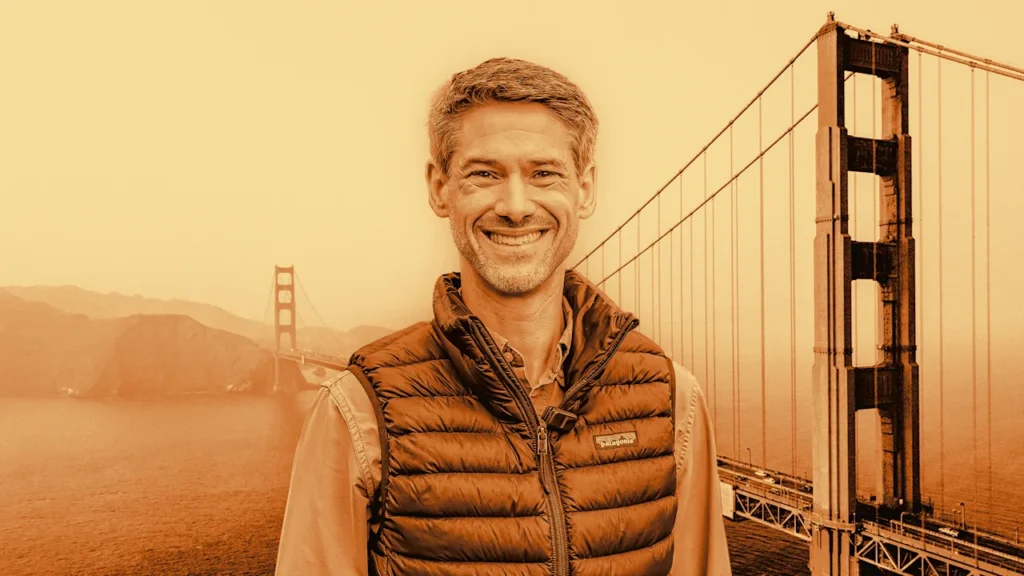
San Jose mayor Matt Mahan had been in The Daily Show hotseat all of 30 seconds when Jon Stewart asked about his startup days.
At any other period in recent California history, this question might have been a layup for the California gubernatorial hopeful, a chance to talk about Causes, the app he grew to nearly 200 million users across more than 150 countries, or Brigade, the voter activism platform he subsequently cofounded with Napster’s Sean Parker.
But this was March 2026, at a time of apex anti-tech sentiment. So rather than boasting about his business chops, Mahan blinked slowly and attempted his best politician’s pivot.
“I was in the startup world,” he said. “Before that though I was a public school teacher.” The crowd applauded, and Mahan shot them a winning smile.
He said he taught 7th and 8th grade English and history. “That’s wonderful,” Stewart responded, laying a trap. “And you left there . . . when?”
“Teaching? 2008,” Mahan replied, stiffening slightly.
“Interesting,” Stewart nodded, feigning naivete. “To do what?”
Mahan conceded. “To get into the tech world,” he said laughing. “You got me.”
“You son of a bitch,” Stewart chided him, flogging Mahan with his notecards.
When I ask Mahan later whether there was a bit of an apology in all his bobbing and weaving, he insists there wasn’t. But he says his backstage conversations with Stewart did make him wary of being typecast. “There was just sort of this pigeonholing of ‘Oh, you Silicon Valley guys,’” Mahan tells me over Zoom, sitting in a freshly pressed button-down in front of a half-wiped whiteboard. “I wanted him and his audience, and everyone who cares and is paying attention to this governor’s race to know that those stereotypes are huge oversimplifications.”
That may be. But the fact that a 43-year-old candidate for California’s highest office would sooner tout his post-undergrad Teach for America fellowship than his 11-year career as an entrepreneur says a lot about how toxic Big Tech has become in Democratic politics. It also helps explain what makes Mahan—who counts Mark Zuckerberg an old Harvard buddy —a particularly unusual fit for the moment.
His campaign burst onto the scene in January, with maximum donations from the likes of Google co-founder Sergey Brin and Trump supporter and Palantir co-founder Joe Lonsdale. By February, a slew of venture capitalists and CEOs backing Mahan’s independent expenditure committee ran a 30-second ad on his behalf during the Super Bowl.
Mahan casts this support as a function of geography. “It’s not shocking that as the mayor of the capital of Silicon Valley, my early donors would disproportionately come from Silicon Valley,” he tells me. “It doesn’t mean that, in any way, I’m catering to the interests of the industry.”
Still, the depths of Mahan’s billionaire backing, coupled with his business-friendly policies like a no new taxes pledge and firm opposition to a California billionaire tax, have made the “Silicon Valley guy” reputation particularly tough to shake. Even Tom Steyer, one of the race’s frontrunners—and an actual billionaire himself—has sought to cast Mahan as being in the pocket of the ultrarich. “Californians deserve a governor who will stand up to corporate power, not bend the knee to it,” Steyer said in a statement following Mahan’s first campaign finance report.
All of this has made it challenging for Mahan to break out of a crowded field of candidates. On June 2, California voters will have a chance to decide which two voters make it to the general election in November. For Mahan, the primary will be a test of whether the same interests that can make a candidate can break one too.
A ‘performance management’ approach to government
Mahan grew up about an hour south of San Jose, but for all practical purposes, it was a world away. His hometown of Watsonville is California farm country. His mom worked as a teacher and his dad as a mailman. It was only thanks to a work-study program for low-income kids that he wound up commuting hours a day to a swanky San Jose private high school.
In college at Harvard, he ascended the ranks of student government, eventually succeeding Rohit Chopra—the future chair of the Consumer Financial Protection Board—as president of the student council. Nick Josefowitz, a friend from that period, remembers Mahan as an idealist who took his responsibilities to the student body seriously, whether that was negotiating with the school to expand the number of emergency phones around campus or fighting to extend dorm parties until 2 am. (On that latter point, he succeeded.)
Josefowitz, who is now CEO of the energy affordability non-profit Permit Power, says Mahan’s upbringing in an agricultural community far from Harvard’s hallowed halls was a motivating force behind his work ethic. “He was acutely aware there were many, many kids who were his neighbors growing up and his friends growing up, who didn’t have those same opportunities,” he says.
One profile in the Harvard Crimson from that time depicts Mahan’s growing disillusionment with the privilege surrounding him toward the end of his time at the school. “I think it’s so sad that the vast majority of Harvard students will go into a very lucrative profession, do a little bit of community service on the side to feel better about their lives, [and] do nothing to change the underlying structures that have produced them,” he told the paper in 2005.
Initially, at least, Mahan avoided that path, opting instead to spend two years teaching in East San Jose. He’s since said it was Zuckerberg, his dormmate, who diverted him from law school. “He said, ‘If you want to change the world, don’t be a lawyer. Go into tech,’” Mahan once told KQED.
Within three years of graduation, he did, taking a job at Causes—an app that allowed people to start their own petitions and fundraisers on Facebook. Mahan went on to become its CEO, until 2014 when Causes was folded into Brigade, another startup launched by Parker and Mahan, which set out to be a social network for civic discourse. Parker funded the company in a $9.3 million Series A round, and Mahan served as CEO.
The common thread between these ventures was giving people power over the political and social causes that mattered to them “without having to go through all these intermediaries who had their own agendas,” says Josefowitz, who has remained close with Mahan and volunteered as a policy advisor on his campaign.
By 2020, Mahan and Parker had sold Brigade, and Mahan and his wife, Silvia, a fellow Harvard graduate, were settling down with their first child. Like a lot of new parents, Mahan began turning his attention to his own backyard—the high cost of living, the traffic, the homelessness. “You just start to wonder: What has gone wrong?” Mahan says.
When a seat opened on the San Jose city council that year, Mahan ran and won. Less than two years after that, he was elected mayor in an upset victory, after campaigning on a promise to bring accountability to local government.
From the outset, Mahan’s tech roots were obvious both in the way he ran the city and the policies he embraced. As Mayor, Mahan launched a slew of public-facing dashboards that track the city’s progress on things like housing production and community safety—the first step toward what he describes as a “performance management” approach to government.
These days, he often touts his success in making San Jose the safest big city in the country and reducing unsheltered homelessness. But the tactics he’s deployed to achieve those results have also drawn vehement backlash, as with a policy that allowed police to arrest homeless people for repeatedly refusing shelter.
Mahan also quickly gained a reputation for his bullishness on AI. In 2023, Mahan launched the GovAI coalition, a national group representing hundreds of government agencies working on the responsible use of AI. In San Jose, he has deployed AI tools to speed up city buses and identify potholes on city streets. And he’s embraced the kind of data center development that other communities have rejected, criticizing what he sees as a kneejerk impulse to blockade the industry.
“Technologies come along and just completely remake labor markets over time,” he tells me, likening AI to the invention of the tractor. “It is a fool’s errand to go out and try to stop it from happening. We need to shape it.”
The ‘wooden spoon’ candidate?
Mahan was a last-minute entrant to the governor’s race, throwing his hat in the ring only after a number of his donors—furious over the proposed California billionaire tax—tried unsuccessfully to recruit Mahan as a congressional challenger to Rep. Ro Khanna. In announcing his candidacy for governor, Mahan criticized other candidates’ “tired playbook.” “They’re either running against Trump or they’re running in his image,” he told Politico at the time.
He charted a course as the field’s moderate option, who believed Democrats have only fueled Trump’s fire by failing to deliver on their promises. “The best resistance is delivering results,” he tells me. “When you lead the country in most expensive housing, second most expensive energy, highest rates of homelessness and overdose, highest level of retail theft, at some point, you are enabling this would-be dictator.”
But the tech money fueling Mahan’s campaign put a target on his back. Democratic Assemblymember Ash Kalra told the San Jose Spotlight that Mahan was “handpicked” by the tech elite. “They want someone who is going to be obedient to them,” Kalra said.
Lorena Gonzalez, president of the California Federation of Labor Unions, told Bloomberg that Mahan would be a “disaster” as governor. Though his own father was in a union, in San Jose, Mahan has repeatedly butted heads with local unions over contract negotiations, among other things. On social media, the Federation has cast Mahan as “just more AI BS.”
Despite the initial burst of enthusiasm, Mahan‘s momentum soon flagged as polling failed to deliver the bump that donors were promised. Today, few polls have shown Mahan attracting even 10 percent of the vote share. According to one Silicon Valley donor familiar with Mahan’s campaign, the gap between Mahan’s traction and his campaign’s promises fostered a sense of mistrust among some of his early donors. “You can make whatever promises you want, but if it’s not followed up with reality, then people lose confidence in you,” the donor says. “Once you lose credibility, it’s a death spiral.”
In a sign of its mounting challenges, in just a few short months, the campaign has undergone significant restructuring, with Mahan and his former advisor, Eric Jaye, parting ways in April. Meanwhile, some of Mahan’s early proponents have gone quiet. According to The New York Times, Brin, for one, has not followed up on his $1 million donation to Mahan’s independent expenditure committee. He has, however, sent $40,000 to Steve Hilton, the leading Republican candidate. (As the Times noted, Brin’s girlfriend, the influencer Gerelyn Gilbert-Soto, has compared Mahan to “a wooden spoon” online. Mahan later tried briefly to own the label, saying in his own post that he “won’t melt under pressure.”)
Mahan has also caught flack for his ties to Republicans, including Lonsdale, who one Democratic operative in California referred to as a “boogeyman on the left.”
“That money is pretty much worthless because of all the shit you’re going to get for it,” the operative says. “You’re trying to win a Democratic primary here.”
When I ask Mahan about this critique, he defaults to a version of his stump speech. “I jumped into this race because Californians shouldn’t have to choose between more MAGA or more of the same,” he says.
He also deflects against critics’ claims that he’s too cozy with tech by casting himself as “the only candidate in the race who has actively regulated tech.” By that, he means he has regulated how his own government uses tech. San Jose, he says, deletes license plate data and camera footage within 30 days and doesn’t use facial recognition technology as part of its object detection pilots to spot potholes.
But setting a city’s privacy policies is a far cry from the weighty decisions about tech—and other matters—that the next governor of California will undoubtedly have to make. It was California, after all, that passed the country’s first privacy law and, more recently, passed the country’s first major AI safety law. Governor Gavin Newsom signed both bills despite furious opposition from the tech industry, and in the midst of persistent inaction in Congress. During his tenure, California has emerged as a de facto tech regulator, writing many of the rules of the road that govern tech across the country, even when the tech industry has resisted them. One question facing voters is whether they believe Mahan, with all his industry ties and support, would be prepared to do the same.
For now, Mahan remains an underdog when compared to his fellow Democrats Xavier Becerra and Steyer, and his Republican opponent Steve Hilton. But his campaign has become something larger than a longshot bid for governor. It is also a referendum on whether a Silicon Valley pedigree remains an asset in California politics—or a liability.