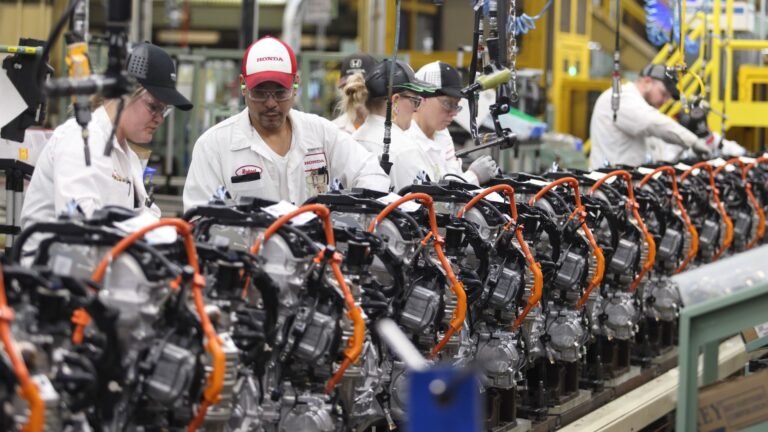
When President Trump, in his first term, placed “Made in America” at the center of his economic vision, it was not merely a slogan. It was a promise to American workers that manufacturing — once the bedrock of the nation’s prosperity — would return home, revitalizing communities hollowed out by decades of outsourcing.
From his first term and into his second, Trump has consistently emphasized that restoring America’s industrial base is essential — not only for economic growth but also for national security and the welfare of the working class.
Yet recent developments, most dramatically the raid on Hyundai’s Georgia battery plant, have laid bare one of the most pressing predicaments in America’s manufacturing revival: the desperate shortage of skilled workers needed to build factories, train local labor and sustain production.
The U.S. today faces an existential workforce gap. Tariffs on imports may protect American producers from foreign competition, but tariffs alone cannot create the skilled workforce required to power advanced manufacturing.
Training Americans to operate new manufacturing systems is a long-term endeavor. In the short term, the only way to bridge this gap is to bring in skilled specialists from abroad — engineers and technicians who understand the equipment, the technology and the processes.
The Hyundai raid dramatized this challenge. Nearly 500 South Korean nationals were detained for working on improper visas, revealing how rigid and outdated the current visa has become. Trump publicly acknowledged the underlying reality by declaring that skilled foreign workers are “welcome” in the U.S., provided they train Americans and eventually return home. His statement captured both the need for temporary skilled labor and the tension within America’s immigration and industrial frameworks. It was an admission that the success of “Made in America” depends not only on tariffs and incentives but also on people — particularly the specialists who can turn plans into production.
Foreign nationals who come to work on U.S. industrial projects rely mainly on four visa categories: B-1, H1-B, EB-3 and L-1. Among them, only the L-1 visa is genuinely designed for short-term, specialized transfers, allowing engineers and managers from a company’s foreign operations to temporarily assist U.S. affiliates.
In contrast, the H1-B visa, while essential to America’s high-tech ecosystem, is ill-suited for manufacturing projects that require rapid deployment of skilled teams. The H1-B cap, limited to roughly 85,000 new visas a year and distributed through a lottery with about a 30 percent success rate, makes it nearly impossible for manufacturers to plan or scale projects requiring dozens or hundreds of specialists on short notice. Even when granted, H1-B visas are structured for long-term employment, not short-term industrial rotations.
For companies eager to invest billions in new U.S. factories, this mismatch creates a bottleneck. The problem is not that foreign firms are unwilling to comply — it is that the system itself fails to provide a lawful, efficient pathway for the kind of skilled, temporary labor that modern manufacturing demands.
Foreign firms are, in fact, leading the charge in America’s manufacturing renaissance. Hyundai is investing billions in its Georgia battery complex. Canadian Solar has been building facilities in Texas, Indiana and Kentucky. Samsung, LG, SK, Toyota, and others are pouring tens of billions into electric-vehicle and semiconductor manufacturing. These projects represent not just foreign direct investment but the creation of tens of thousands of American jobs.
Canadian Solar’s Texas plant offers a telling illustration. During early operations, around 250 foreign engineers were on site to install and calibrate advanced machinery and train local workers. Today, more than 98 percent of the +1,600 workforce are local Texans, with only a small team of expatriates remaining to oversee quality and technology transfer. The pattern is clear: foreign specialists are indispensable at the outset, but their numbers decline sharply once American workers are trained.
These skilled foreigners are not taking American jobs — they are creating the conditions for Americans to fill them.
Scaling this model nationwide would require tens of thousands of additional short-term visas. If one company’s $2 billion investment requires 200 engineers, the full wave of new U.S. manufacturing investments could easily require 50,000 or more temporary specialists. Without a mechanism to supply this workforce, America’s manufacturing revival risks stalling at the starting line.
The L-1 visa provides a practical, lawful and immediately available framework to meet this need. It allows multinational companies to transfer employees with specialized knowledge or managerial experience to their U.S. operations for limited durations. There is no annual quota, making it scalable, and the category fits naturally with the three- to six-month rotations typical in new factory construction.
Historically, the U.S. has issued around 70,000 to 80,000 L-1 visas annually. With streamlined procedures and policy guidance, that number could safely expand to 120,000 or more without legislative overhaul.
The obstacles are not legal but administrative. Inconsistent adjudications, excessive scrutiny and lengthy processing times discourage compliance and drive some firms to improvise arrangements, as the Hyundai case revealed. A clear directive from the White House, tasking the State Department and U.S. Citizenship and Immigration Services with prioritizing industrial L-1 applications, could transform this situation.
Senior commercial officers at U.S. embassies could vet projects, coordinate with state-level economic-development agencies, and process group visa requests for major manufacturing investments. Companies could submit periodic progress reports and pay modest oversight fees, perhaps $1,000 per worker per month, to ensure transparency and accountability while generating federal revenue.
The Hyundai raid was a wake-up call: it exposed the contradiction between America’s ambition to lead a manufacturing renaissance and its outdated visa framework. Trump’s instinct — to welcome skilled workers while emphasizing their temporary, training-focused role — captured the necessary balance.
Policy must now catch up with vision. Expanding and streamlining L-1 visas for manufacturing specialists would send a powerful signal to investors and allies that the U.S. is serious about rebuilding its industrial base on lawful, sustainable foundations. It would assure communities that new plants will be staffed, not stalled. And it would give American workers the training they need to sustain “Made in America” for the long run.
If tariffs are the hammer of America’s industrial policy, skilled labor visas are the nails that hold the house together. Without them, the structure risks collapsing under its contradictions. With them, the United States has a real chance to turn the promise of a manufacturing revival into reality.
Jianli Yang, a research fellow at Harvard Kennedy School of Government, is founder and president of Citizen Power Initiatives for China.