China is quickly closing the gap on Elon Musk’s reusable rockets in a way that should worry him more than any single competitor has before.
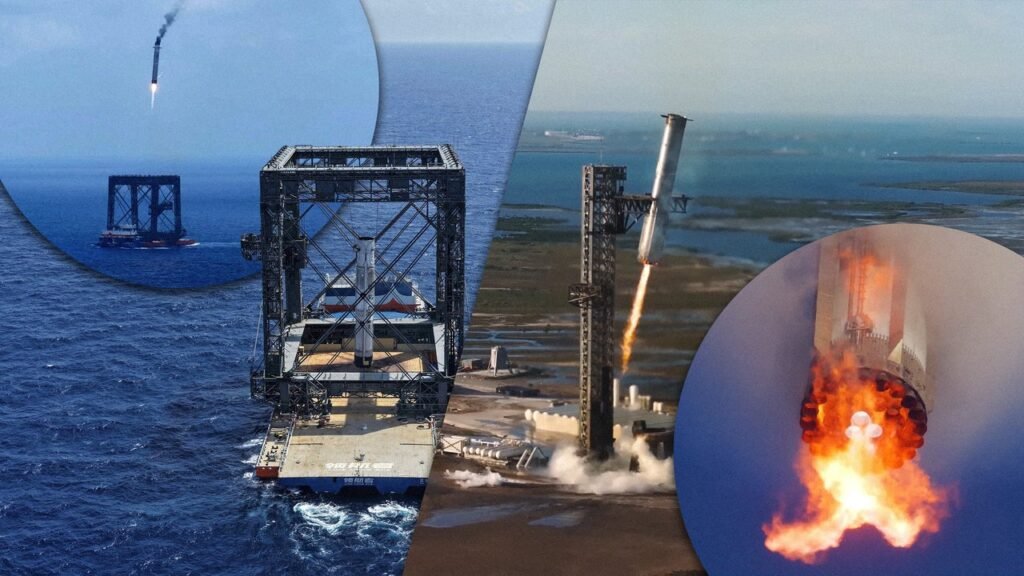
On July 10, China Aerospace Science and Technology Corp. (CASC)—the state-owned contractor that builds nearly all of China’s rockets and satellites—launched the Long March-10B rocket on its first flight. It successfully placed its payload into orbit, and then did something that only SpaceX has managed to do: get back to Earth and dance softly, catching it midflight like SpaceX does with Starship’s Super Heavy booster.
However, instead of using the huge mechanized “chopsticks” on the launch tower at Starbase, the Chinese used a radically different system that nobody has seen before.
CASC caught the falling rocket in a moving net mounted on a ship floating offshore, making it the second country ever to recover an orbital-class booster and the first in the world to do it with a sea-based net instead of legs or a tower.
That distinction matters. It shows, once again, that China has developed solid space chops.
China’s aerospace industry is poised to build hardware at a scale and cost few competitors can match, and a working, reusable rocket is key to challenging SpaceX’s grip on the commercial launch market.
Both systems are designed to cut the dead weight of landing legs—typical of reusable rockets like the Falcon 9—to carry more cargo. Landing legs are simply too heavy to justify flying on every mission, so both organizations deleted them entirely.
From there, though, the two programs split into fundamentally different systems: one relying on a fixed tower at the launch pad and the other on a mobile ship at sea, each with its own trade-offs in cost, precision, and how quickly the booster can fly again.
The Chinese solution
The Long March-10B is a two-stage, liquid-fueled rocket with a core diameter of 16 feet. Its first stage runs on seven YF-100K engines built around an oxidizer-rich staged combustion cycle, burning a mix of rocket-grade kerosene and liquid oxygen. This booster pushes the second stage to high altitude, releasing it so the cargo continues its way into orbit.
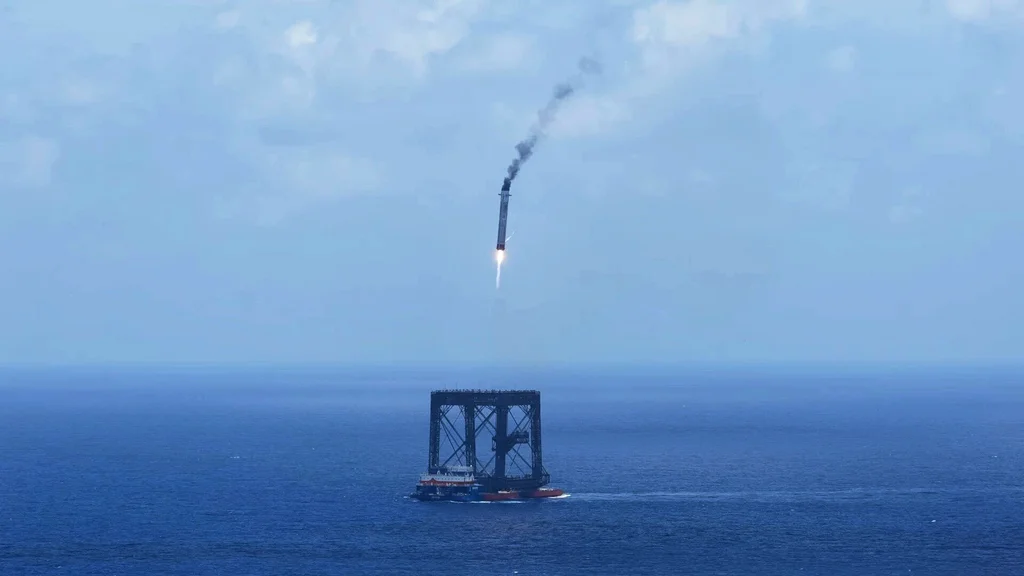
About six minutes after the two stages separate, the first stage begins a controlled return, adjusting its pitch and using its grid fins to steer through the atmosphere toward the landing zone over the South China Sea. To slow down for the final approach, the booster reignites at least one of its restartable YF-100K engines, then descends vertically to meet the sea platform.
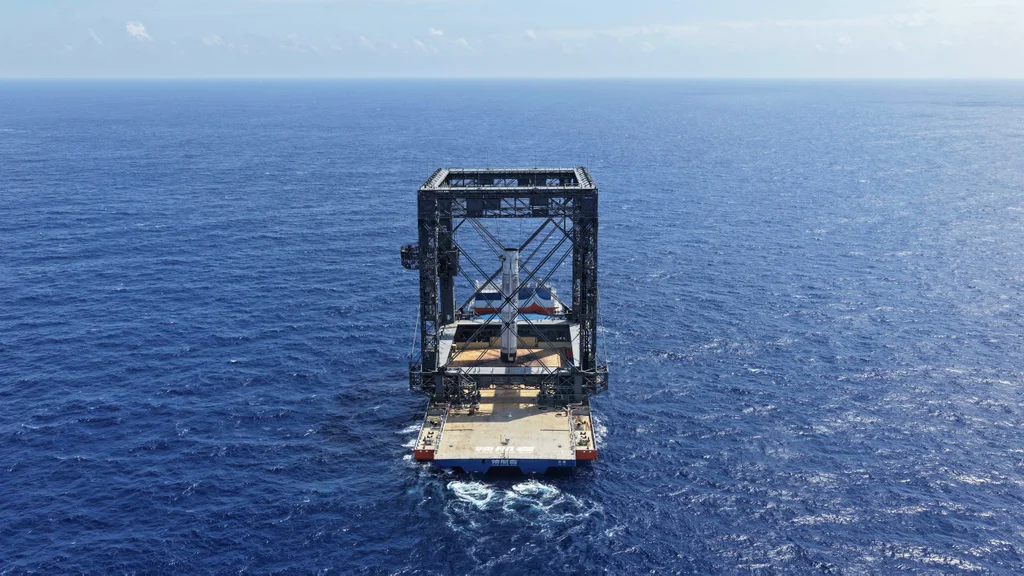
That sea platform is a dedicated net-capture ship called Linghangzhe (“Navigator” in English) that is 472 feet in length and 164 feet in width. The ship holds its position using dynamic positioning technology, which keeps it stable against ocean wave disturbances throughout the recovery sequence.
Most of the platform’s surface is used by a huge metallic structure in the shape of an open-faced cube that has a movable capture mechanism made of four high-strength steel cables. Two of these cables go from one top side of the cube to the opposite top side. The other two cables run between the other two top cube rims. The cables intersect in the middle of the cube, forming a square. As the rocket enters the space of the cube, an electronic system tracks the rocket hovering down, moving the cable toward the middle of the cube to snare the rocket’s four hooks.
It’s a concept very similar to the arresting cables used on aircraft carriers. As the rocket slowly descends into the cube from the top, a fully automated system moves the four cables from the sides of the cube to the center until the rocket’s hooks catch the cables. The cables yield smoothly to gently absorb the booster’s remaining momentum, leaving the 230-foot rocket suspended in midair above the vessel without any stress whatsoever.
The SpaceX solution
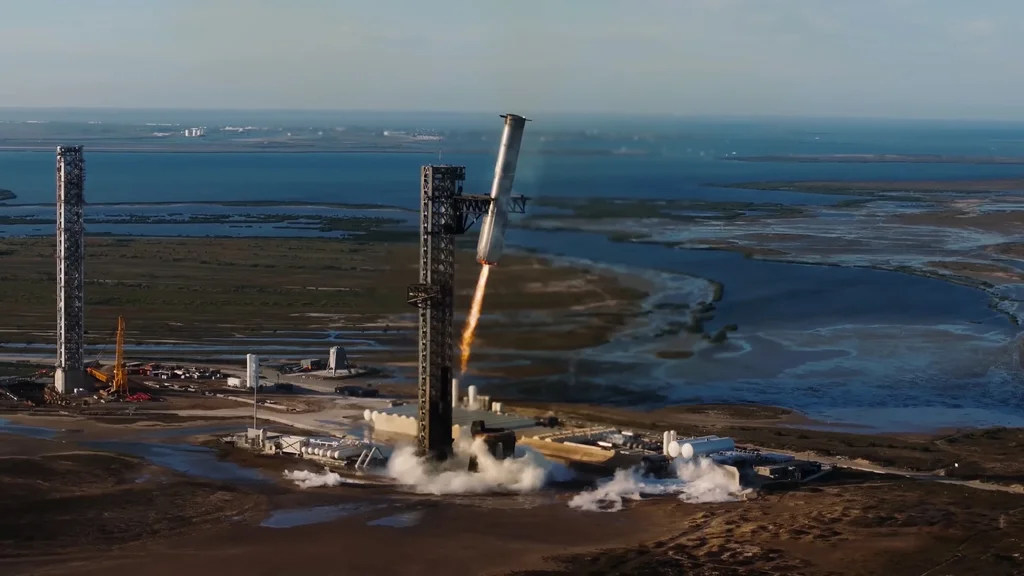
The Super Heavy booster serves as the first stage of SpaceX’s fully reusable Starship launch system, which the company tests and launches from its Starbase facility in South Texas. Like the Long March-10B, it carries no landing legs.
The booster relies entirely on a midair capture performed directly at the same pad where it launches from, a method SpaceX has been refining since it first caught a Super Heavy booster with Mechazilla’s arms in October 2024.
It has since gradually worked the maneuver from a rare, high-risk feat into a routine part of Starship’s flight cadence. Musk decided to go with this approach after 11 years of using landing legs, which are still the way the boosters of the Falcon 9 land.
Standing 233 feet tall and equipped with 33 Raptor engines burning liquid oxygen and liquid methane, Super Heavy depends exclusively on reinforced structural hardpoints for recovery instead of any kind of landing gear. Those hardpoints sit near the top of the booster, just below its four aerodynamic grid fins.
After releasing the Starship’s upper stage, the booster redirects its flight path back toward the launch facility, using its grid fins to steer through the atmosphere during reentry, then fires a subset of its Raptor engines in a landing burn as it nears the ground, slowing itself into a controlled hover next to the launch infrastructure.
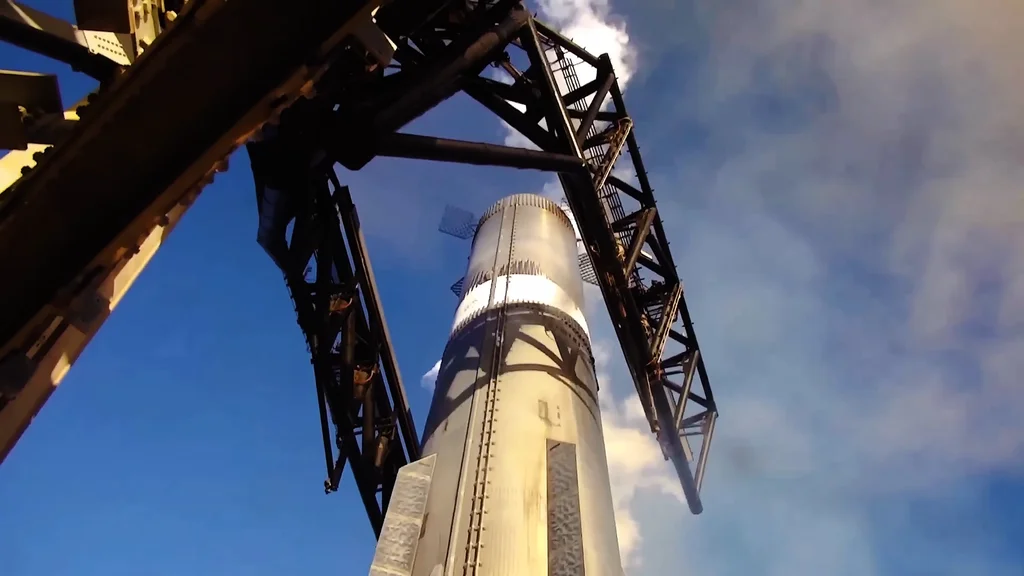
At the top of the launch tower, nicknamed “Mechazilla,” sit two massive mechanical arms colloquially referred to as chopsticks. The arms extend outward to wait until the booster is in position. These arms ride on a vertical track system lined with shock-absorbing rails designed to manage the severe physical stress of the catch (during a midair suspension they transfer more than 200 tons of mechanical force into the catching structure).
As Super Heavy hovers alongside the tower, the chopstick arms pivot inward and close around the rocket’s upper chassis, aligning precisely beneath the reinforced hardpoints.
Once the arms lock under the load-bearing pins, the booster shuts down its Raptor engines, and the tower’s shock-absorbing rails compress to dissipate the booster’s remaining kinetic energy and prevent structural buckling from the sudden weight transfer. The booster then stays suspended by the arms, ready for rapid turnaround procedures such as postflight inspections or being remounted directly onto the orbital launch mount.
Fight!
Both systems have pros and cons, but the elegance and flexibility of the Chinese method is rather surprising when you compare it to the brute force approach of SpaceX’s Mechazilla.
The latter demands massive, permanent ground facilities capable of absorbing immense kinetic energy, safely funneling more than 200 tons of force into the tower structure; and it requires centimeter-scale positioning precision from the descending booster. China’s Long March-10B system instead shifts all of that interception hardware onto a mobile maritime platform, using an interwoven, high-tensile cable network.
For SpaceX, the booster also carries the full burden of executing a nearly perfect descent into a tightly constrained catch window, and missing that window risks destroying launch infrastructure worth billions of dollars.
Chinese developers argue their offshore net offers a wider safety margin, since the flexible cables can adapt to minor trajectory deviations and effectively enlarge the target zone, yielding dynamically to disperse the booster’s downward force rather than holding it against a rigid structure.
The two systems also diverge sharply on turnaround speed and cost. Here SpaceX wins. It designed its tower catch to mimic the fast turnaround of commercial aviation, with the goal of refueling and relaunching a caught booster within hours, on the spot.
China’s maritime net recovery rules out anything that fast, since the booster has to be secured at sea and shipped back to land before it can be refurbished. The counterargument is that with China’s manufacturing capability, it may compensate by numbers, producing many boosters that could guarantee constant launches.
Price-wise, a mobile barge is a cheaper alternative to building towering capture facilities at multiple launch sites. SpaceX accepts substantial risk to its ground infrastructure in pursuit of unprecedented launch frequency. Musk himself admitted that his biggest concern ahead of a Starship launch was a rocket fireball melting and destroying the launchpad, a scenario that would have taken SpaceX months to rebuild from.
SpaceX also wins the cool factor, of course. Those arms look like industrial sci-fi manga material. But Musk’s team designed and built a system that works only if it works perfectly, every single time, for years, without a single tower-wrecking mistake.
China built a system that tolerates human and mechanical error, is cheaper to replicate at multiple coastal sites, and is backed by an industrial base that can mass-produce hardware faster and cheaper than almost anyone on the planet. The countdown clock is now running on a race SpaceX no longer runs alone, and every additional Long March-10B that comes home safely to that net is another sign that the head start Musk built with Falcon 9 and Starship is shrinking.