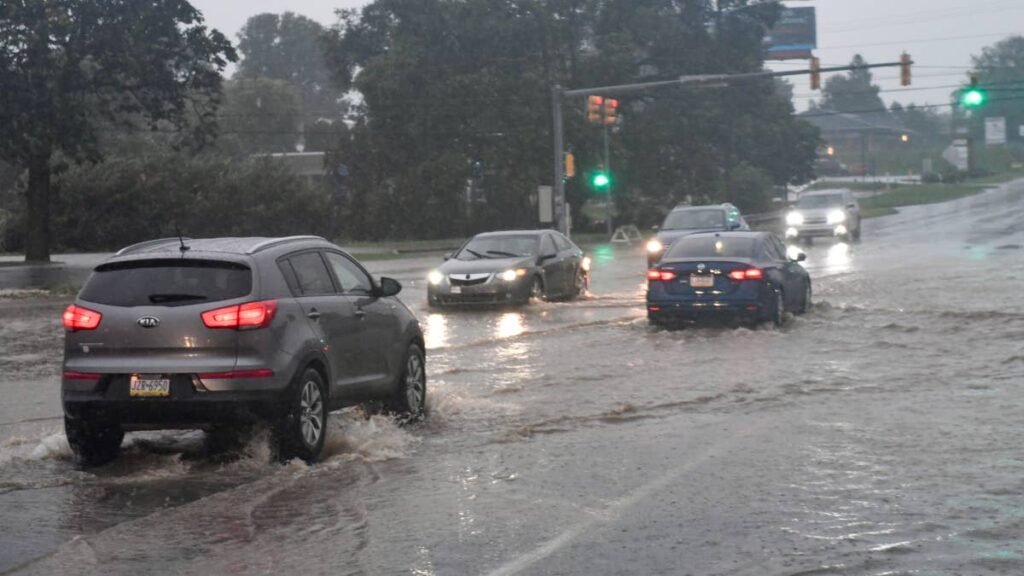
A regional severe-weather outbreak that the Storm Prediction Center flagged at Moderate Risk verified hard across the central Plains and mid-Missouri Valley Monday, leaving 39 NWS tornado warnings, downed timber on feeder routes into I-70 and I-29, and a flash flood threat that carried into today, Tuesday May 19, 2026. Damage surveys are now underway in Nebraska, Kansas, and Missouri as the storm engine shifts east toward the Ohio Valley.
Peak Driving Danger Window
The worst window for highway travelers was the 6 to 11 p.m. CDT consolidation phase Monday evening, when discrete supercells across central and northeastern Kansas collapsed into a north-south squall line that swept the I-70 belt with embedded 75 mph gusts and brief QLCS tornadoes across western Missouri and southwestern Iowa.
What to Expect
- Tornado warning count: 39 NWS warnings across IA, IL, KS, MN, MO, and NE on Monday alone
- Peak wind gusts: Severe gusts over 50 knots measured along the squall line per the SPC mesoscale discussion, with sustained 60 to 75 mph corridors after dark
- Worst corridors: I-70 in central Kansas, I-29 from Topeka to St. Joseph, I-35 north of Kansas City, I-44 toward Springfield, I-80 across southwestern Iowa
- Confirmed strong tornadoes: A classic stovepipe tornado in Richardson County, Nebraska; a tornado emergency in Pawnee County; structural damage south of Plattsmouth and in Belton, Missouri
The setup combined a sharpening dryline, a triple point in central Kansas, dewpoints in the upper 60s pushing north, and a 55-knot low-level jet feeding instability after dark. NWS Topeka and NWS Pleasant Hill issued back-to-back tornado warnings from mid-afternoon into the late evening as supercells trained over the same I-70 corridor.
Road Conditions
Hardest-hit segments overnight included Interstate 70 between Salina and Topeka, where an afternoon supercell carried a tornado warning across mile marker 229 east of Lincoln, Kansas. Secondary highways feeding I-29 north of Kansas City saw downed trees and power-line debris, with MoDOT crews clearing US-47 near Warrenton, Missouri before dawn. Drivers should still expect saturated shoulders and reduced visibility on overpass approaches today; check the MoDOT Traveler Information Map and KanDrive before heading out.
Severe Storm Driving Tips
Tread depth matters as much in a downpour as a snowstorm: anything under 4/32″ is marginal in flash-flood conditions, and 2/32″ is the legal-but-not-safe floor. Hydroplaning can start near 35 mph on a worn tire, and the rear axle breaks loose first. Slow progressively, avoid hard braking, and ease off cruise control. Autoblog’s primer on hydroplaning and wet-weather control and our breakdown of all-weather versus all-season tires cover vehicle setup in detail. If a tornado warning posts while you’re driving, abandon the vehicle for a low-lying ditch away from the road; never shelter under an overpass. The NWS thunderstorm safety page lays out the specifics.
Where the Storm Heads Next
The same frontal system that ignited Monday’s outbreak is pivoting across the lower Missouri Valley toward the Ohio River Valley today.
The SPC Day 2 outlook places a severe-weather corridor along the cold front from the Great Lakes south through the Ohio Valley and into the southern Plains, with damaging wind gusts and isolated large hail as the primary hazards.
The WPC has Slight Risks of excessive rainfall over both the central Texas Hill Country and the Ohio River Valley.
For drivers, the corridors to watch through Tuesday evening are I-70 east of St. Louis, I-44 across southern Missouri, I-64 through southern Illinois and Indiana, and I-40 between Little Rock and Memphis, with NWS St. Louis and NWS Paducah likely to drive the warning cadence as the dryline punches east this afternoon. By Wednesday the threat consolidates into a damaging-wind line across the Mid-South.