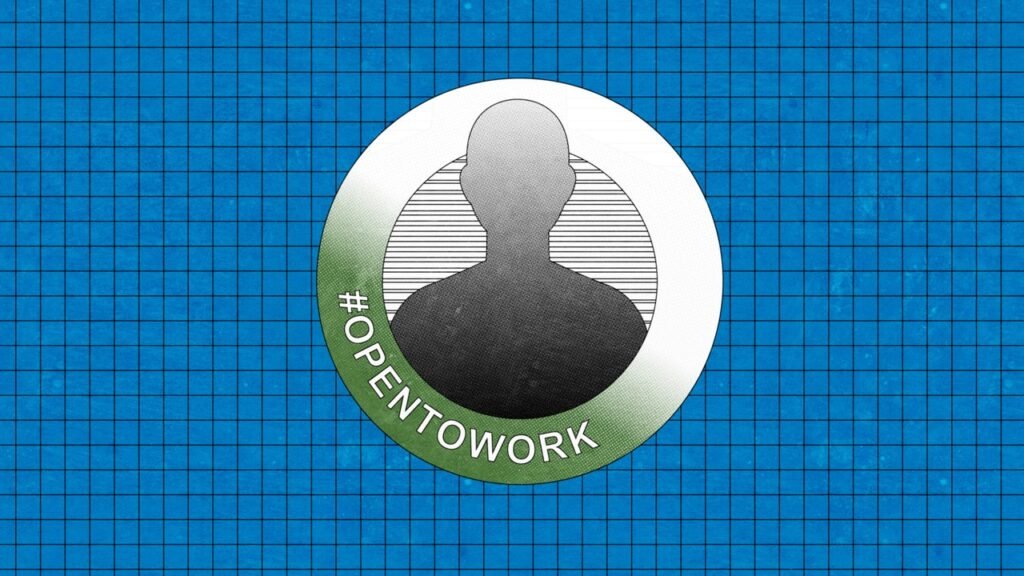
If you’re a LinkedIn user, you recognize it instinctively: Anyone with a green ribbon around their profile picture is in the market for a new job, and they want everyone to know it.
LinkedIn’s “Open to Work” badge, which has now been part of the platform for six years, has become a distinct visual shorthand for frequent posters on the platform. Recently, however, its merits have come under fire.
On July 19, Ben Lang, an engineer at the AI coding platform Cursor AI, took to X with a message for his followers. “Tip: never use the green Open to Work badge on LinkedIn,” the post reads. “Negative signal for hiring managers and recruiters.”
The post has since amassed more than a million views and hundreds of comments, and notched a featured post under X’s trending topics.
This isn’t the first time LinkedIn’s Open to Work badge has attracted debate. In fact, the discourse has been ongoing for years, with commenters generally falling into two camps: One side argues the design of the badge gives off an “air of desperation” to recruiters; the other views the badge as a crucial tool for grabbing recruiters’ attention on the crowded platform.
According to LinkedIn, more than 60 million users currently have the public #OpenToWork frame on their profile pictures. Those members, it says, are nearly two times as likely to get a message from a recruiter than those who don’t. They’re also finding jobs more than 20% faster than job seekers who don’t display the Open to Work badge.
LinkedIn’s data appears to show that the Open to Work profile badge does its job—but its enduring negative reputation signals that it might still be time for a redesign.
Why the Open to Work badge looks “desperate”
LinkedIn first introduced the Open to Work badge back in 2020, when pandemic-related layoffs and hiring freezes were resulting in a surge in new job seekers. At the time, the feature was billed as an extra step beyond LinkedIn’s existing recruitment settings, which allow users to privately flag their availability to recruiters. The badge takes that setting to the next level by placing the “Open to Work” status directly next to the user’s profile pictures in a green swoosh.
Earlier this month, the company published a video with LinkedIn career expert Catherine Fisher acknowledging that users might be “embarrassed” to turn the feature on due to social stigma, but advocating for its efficacy in the job hunt, noting that people who turn the feature on tend to get more outreach from recruiters and folks in their networks.
Still, the badge has drawn continuous skepticism from some users since its launch. One 2023 TechCrunch article explained that the badge can be a useful signal on one hand, but on the other, it can be seen as a negative sign: You know, a version of the quote often attributed to Groucho Marx: “I don’t want to belong to any club that would accept me as a member.”
On Reddit, a post in r/jobsearchhacks with more than 1,000 upvotes and 200 comments claims, “I know the green banner is supposed to help but I have talked to a few high level headhunters who say it is a massive turnoff. It is the classic dating rule where people want what they can’t have.”
And, in 2024, career coach and business consultant Olivia Johnson told Fast Company that many people subscribe to the adage that it’s hard to find employment when unemployed, and the badge openly flags unemployment. Still, she added, the visibility benefits of using the badge tend to outweigh its risks.
Under Lang’s recent post, those same to-badge or not-to-badge arguments are playing out once again. One top comment from tech entrepreneur Ben Vinegar reads, “Random data point but while I was a VP at Sentry I couldn’t walk down the street without being offered a job. Then when I was unemployed for ~6 months (after 9+ years!) suddenly nobody gave a shit lol.”
Another from engineer Claire Vo counters, “alt: be kind and empathetic to people seeking work & trying to use the tools available to them on the #1 networking site for finding professional jobs. I hope recruiters are not so dumb that being secretly unemployed is somehow higher status than being transparently unemployed.”
Vo later followed up with her own mock-ups of potential new designs for the badge, accompanied by the caption, “what if the bare minimum effort was put in so job seeking didn’t seem cringe?”
How design could improve the badge’s reputation
Regardless of how well the Open to Work badge actually functions, it’s clear that the feature has developed a difficult-to-shake reputation for potentially damaging job search prospects. According to Hillel Hurwitz, CEO and founder of the branding agency Bald, that’s a design problem.
From a pure attention standpoint, Hurwitz says, the badge works. He believes that’s actually an issue. “It pulls nearly all the attention away from the person and onto a status marker, which defeats the entire purpose of a profile picture,” Hurwitz explains.
The photo, he says, is the one place on the platform designed to showcase personality and humanity—but the Open to Work badge wraps it in “cold UI green” and makes employment status the focal point of the user’s face.
“Steve Jobs famously obsessed over the design of screws inside the iPhone that no one would ever see, because he believed everything about a brand imbues meaning,” Hurwitz says. “Personal brands work the same way, and right now, the ‘Open to Work’ ring is sending a message of ‘I’m going through it’ at the moment someone most needs to project confidence.”
Andres Nicholls, chief creative officer at the branding agency Prophet, believes the main issue with the badge goes deeper than its design.
“The challenge isn’t really the badge itself,” Nicholls says. “It’s that it exists within a culture that still places enormous value on status and perceived success. We often assume someone who is already employed is somehow more desirable than someone actively looking, even though there’s little evidence that’s true. In many ways, the badge simply exposes that bias.”
From a design perspective, he adds, the real opportunity isn’t to make the badge louder or quieter, but to use it as a space to normalize what has become a “very human and increasingly common” aspect of modern careers. “Great design doesn’t just make information visible,” Nicholls says, “it also shapes how that information is interpreted.”
As an alternative, Javier Bidezabal, chief creative officer of the agency Unusual LA, suggests users take the power back into their own hands.
“We like finding ways to use design not only for function, but also to tell a story differently,” Bidezabal says. “Today, everyone is a brand. So why not design your own badge? Make it personal. Put a joke on it. Use it to show what makes you different: ‘Open to do cool sh*t.’”
His parting tip? “Don’t use green.”