Swifties will buy anything related to Taylor Swift: a CD or a vinyl—even if they listen on Spotify anyway—a cardigan or scarf inspired by her songs, and yes, even garbage.
Taylor Swift and Travis Kelce tied the knot on July 3 at New York City’s Madison Square Garden (MSG), gathering A-list celebrities from across industries.
But as fans flocked to the venue for a chance to peek inside the secretive event, at least one person turned his attention to the floor—picking up trash to package and sell to fans eager to score a souvenir from the party.
The New York-based artist Justin Gignac made his way to MSG the night of the celebrity wedding, wearing the same tuxedo he used at his own wedding, paired with thick gloves and a trash pickup stick.
The venue’s perimeter was filled with around 40 fans in each corner, Gignac says, as he circled the arena and picked up garbage from the floor before packaging it and selling it online—something he has done before.
“I’m always trying to find these big cultural moments in New York City,” Gignac tells Fast Company. “I’ve done New Year’s Eve in Times Square and I’ve done the championship parades for the Yankees, Giants, and Liberty . . . but this was such an interesting one.”
Come as you are
The trash was not actually from inside the wedding, but from the edge of the venue, hence the name of the series, “Not Invited Edition.”
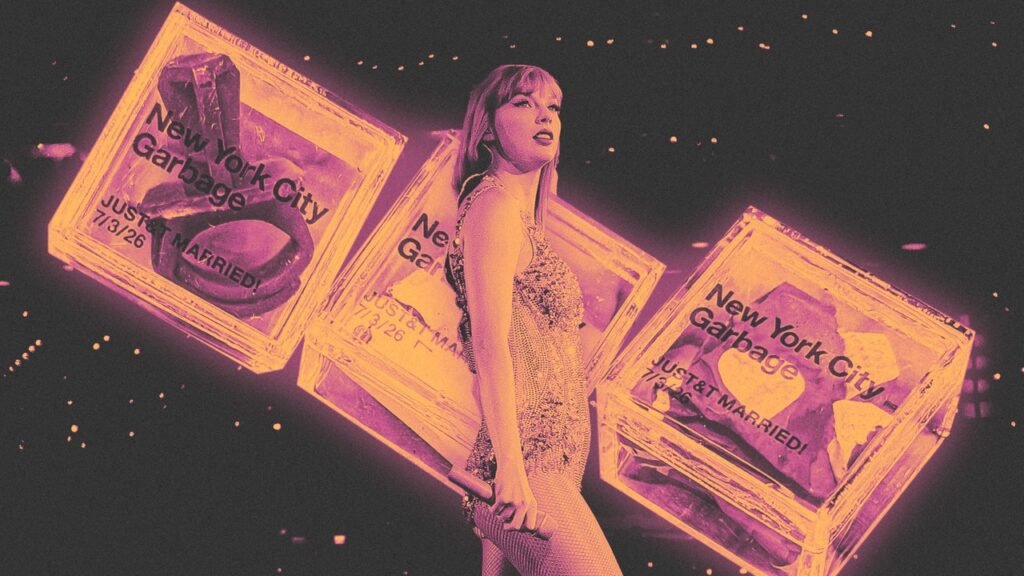
Anything from a stray Airpod to a can tab was collected and packaged in clear boxes measuring 1 by 1 by 0.75 inch, just small enough to carry around in one’s pocket. The near-cube is marked with the wedding date, the same day the garbage was picked up, and the phrase “JUST&T MARRIED!” a nod to the message that filled the MSG screens after the celebrity couple tied the knot.
Gignac has been collecting trash and selling it in sealed acrylic cubes for almost 25 years—he calls his art project and business New York City Garbage—although the regular cubes are much larger (3.5 by 3.5 by 4.5 inches).
In planning for the project’s anniversary, Gignac had ordered the smaller cubes, but opted to turn them into a Swiftie-inspired drop when he heard about the wedding.
The 50 limited cubes were priced at $25 each, selling out in 24 hours and 8 minutes, although he is hoping he has enough trash to complete 39 more—bringing the total to 89, a tribute to Swift’s birth year, 1989.
While the 50 boxes for Swifties are bringing Gignac a renewed wave of popularity, the drop is just one small piece of the decades-long project.
New York City Garbage
The project began back in 2001, when Gignac was a 21-year-old intern at MTV. He debated with a coworker who argued that packaging design was not important. To prove him wrong, Gignac decided to package the thing he couldn’t image anyone wanting to buy: garbage.
Packaging it in clear boxes with a sleek typeface that read “New York City Garbage”—which would become the name of the business—Gignac set up a small stand in Times Square, persuading passersby to buy his creation.
And it worked. Not only did he prove his coworker wrong, but he began a small business that would lead to more than 1,700 garbage cubes sold around the world.
“I went out on the streets of Times Square with a little cardboard box that I spray-painted ‘Garbage for Sale’ on it,” he says. “Finally, after eight hours, a gentleman from Ecuador who barely spoke English—but he connected with it—bought the first one.”
The first few were priced at just $10, eventually going up in price from $25 to $100. This was to discourage people from buying them, as Gignac was too busy to meet the demand while he tried to kick-start his career in advertising.
Still, people kept buying.
“It’s interesting how people’s perspective shifts,” Gignac says. “When it was $10, people thought it was a funny joke. When it was $25, people considered it like a cool souvenir. And at $50, people started calling it art. So it’s amazing how you change the price and it changes people’s perception of it.”
Top of the heap
As the business grew, so did Gignac’s professional ambitions, and in 2012 he decided to shut down New York City Garbage to start his own business and pursue other creative projects—including the popular Elf Yourself app.
It wasn’t until 2024, when too many of his friends asked him to resume the business, and he was ready to slow down and focus on raising his 2-year-old daughter, that he reopened the store.
The first drop sold out faster than his Swift-inspired collection—50 cubes priced at $100 selling out in just 90 minutes.
“Had about a decade more of people waiting for them,” he says. “Since then, the other drops haven’t sold out as quickly, but they sell out fairly quickly, usually like a couple days or a week.”
Now that his focus is back on trash, Gignac has a renewed inspiration for what New York City Garbage is and can be.
“I think it blurs the line between art and business, and I think all good things do. It is the art of the sale,” he says. “The art happens in that exchange. I like that. It’s the story that we tell.”
With this new phase, Gignac wishes to explore the affection that individuals can attach to trash and their connection with special moments; for instance, he is interested in collecting trash from locker rooms of teams as a memento for fans.
“People are always like, ‘Why would you pay for garbage?’ And I’m like, I don’t know, but would you pay for garbage from your first date or your kid’s last Little League game?” he says. “It’s not just garbage. It’s stuff that has meaning.”