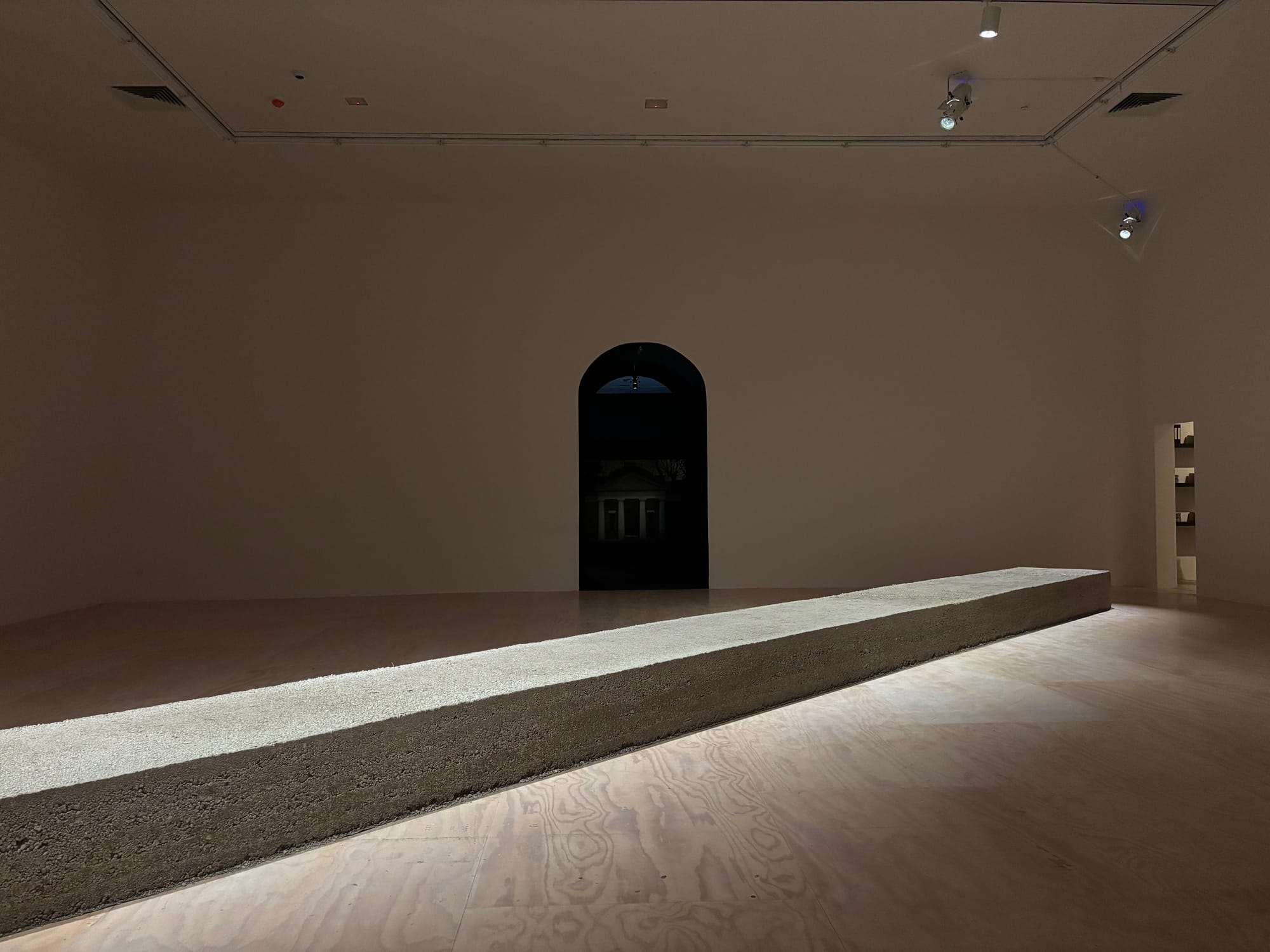
Minimalism’s potential lies in compressing a complex idea or feeling into a visually “simple” gesture — distilling its essence into an experience that cuts away the excess. In Teresa Margolles’s work, this unsparing trim attempts to show us something about ourselves: a system of violence so destructive that it reinforces and codifies notions of “us” and “them” across artificial borders, all in the name of capital.
Margolles’s first large-scale museum exhibition in the United States, En el lugar de los hechos (At the Scene), hosted by both MoMA PS1 and the Museum of Modern Art, showcases over 30 years of work by the artist. Born in Culiacán and based in Mexico City, Margolles addresses the heightened violence at sites along the US-Mexico border, specifically Ciudad Juárez and El Paso, Texas, but her examinations also mirror other sites of brutality.
The first room in the third-floor galleries at MoMA PS1 is marked by absence, repetition, and a sense of futility. Projected on a large wall, El agua de la ciudad, Dallas (The Water of the City, Dallas) (2016) is a video compilation of people methodically scrubbing the ground at different sites across the city where someone has been shot. Each scene begins with a title card with the victim’s name, age, date of death, and address. The video itself is 296 minutes long and feels infinite, underscoring the magnitude of the bloodshed and its senselessness — one title card explains, “victim shot while accidentally trying to enter the wrong apartment.”
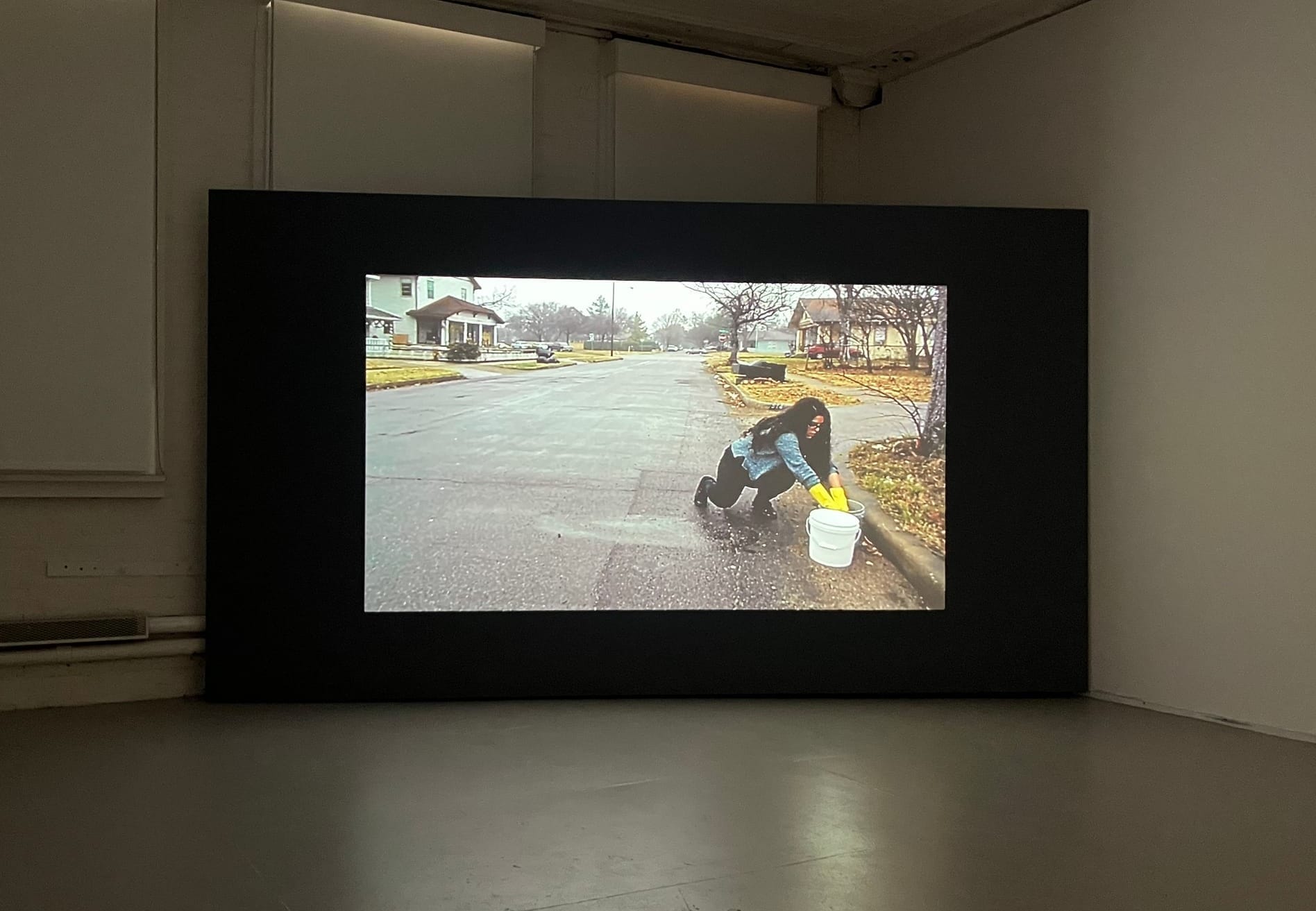
On a smaller screen, “La nieve (The Snow)” (2015) shows a man in Staten Island shoveling snow in front of the altar memorializing Eric Garner, who was killed by police in 2014. In both of these videos, a small rectangle of surface area on the street is demarcated through cleaning or shoveling its traces, acts that the artist refers to as “señalizaciones” or “signalizations.” By contrast, the surrounding landscape feels unruly and chaotic, reflecting the unknown and what cannot be contained within the rectangle’s controlled environment.
I had never previously thought about Margolles’s work in terms of control as a coping mechanism for the inevitable shock of death, despite its universality. In this exhibition, Margolles presents “Aire (Air)” (2003), in which two humidifiers release water collected from sites of violence in New York City into a room behind vents. This more subdued work follows the well-known installation “Vaporization” (2001), a room filled with vaporized water collected from morgues, originally shown at MoMA PS1 in 2002. As Inés Katzenstein, one of the exhibition’s curators, explained in the press preview, “we don’t need the beauty of the steam anymore” — we still breathe it every day, all the time.