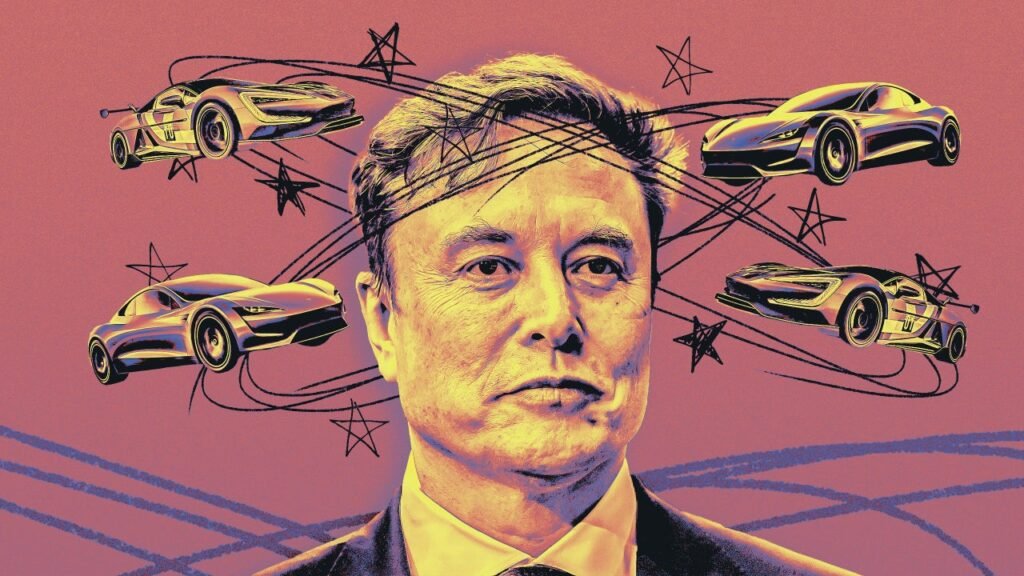
Elon Musk is reportedly going to launch a “flying car.” Not a flying taxi like those oversized drones that want to take rich people from Manhattan to JFK laughing at us peasants traveling in regular cabs. Not another old Tesla Roadster mounted atop a Falcon 9. No. This will be a next-generation Tesla Roadster that can fly on its own using cold gas thrusters developed by SpaceX. Like Nick Fury’s flying car.
For the umpteenth time, Musk will try to overexcite fans and Tesla bulls with yet another epic announcement, demoing this fantastic car this month, sources tell The Information. Three people with knowledge of the car claim that the incoming show-n-tell will have “the vehicle racing onto a magnetized roller-coaster–like ramp and driving upside down before righting itself and hovering in the air.” The demo and the new Roadster, if it works—remember the Cybertruck bulletproof windows?—want to restore Tesla’s initial design allure, which has been gone for years now.
The reality is that, even if it wows the world with some amazing design, the alleged flying car already comes with a load of problems, starting with the fact that its flying nature—only available in a limited-edition model, if it really happens—doesn’t bring any real useful innovation to the industry. Meanwhile, Tesla ubernemesis BYD has been shipping a real ‘flying car’ designed to jump 20 feet over obstacles like an 8.2-foot-wide pothole since February 25, 2024.
And Musk needs to steal back the thunder from the Chinese cars that have been consistently destroying his company’s market share worldwide, especially the Shenzhen-based carmaker. Tesla has been struggling with poor sales for years now, caused mainly by stale design, technology, and a poor image after its CEO’s handiwork in the second Trump administration.
Design crisis
Things are getting so bad that, earlier this year, Tesla killed the Model S after 14 years without ever designing its replacement, and the Model X died right alongside it, leaving the Model Y—a stretched Model 3—as the company’s only SUV. The 3 and Y got refreshes, but new bumpers and ambient lighting don’t change what they are: the same car, photocopied and airbrushed. Back in 2012, Tesla’s “blandly handsome” design was a feature—the conservative silhouette that reassured buyers nervous about unproven battery tech. The market caught up years ago, and that doesn’t cut it anymore.
Musk tried to correct course with the Cybertruck, going from bland to brutal—a garish design that has managed to become more broken than its critics predicted. It’s been recalled dozens of times, for everything from stainless trim panels peeling off at highway speed to stuck accelerator pedals to, this past spring, wheels that could literally detach.
It’s a bird! It’s a plane! It’s a… Roadster?
Which brings us to his latest occurrence: a flying car!
According to The Information‘s sources, the propulsive lift comes from cold gas thrusters engineered jointly with SpaceX’s Starship propulsion team, including Starship engineering VP Bill Riley. Beneath the thrusters sits a clean-sheet carbon fiber tub hypercar, internal code name A-71. Chief designer Franz von Holzhausen evaluated design themes inspired by the Lamborghini Countach and the Lockheed SR-71 Blackbird spy plane—themes that gave the program its code name. In late 2025, Tesla reportedly completed a functional prototype with two seats and butterfly doors.
The demonstration is planned for SpaceX’s rocket testing complex in McGregor, Texas. Three sources told The Information‘s Grace Kay that Tesla is preparing an unveiling featuring a live or recorded stunt showcasing the flight capabilities of a limited-edition Roadster developed with SpaceX. Tesla already postponed the demonstration after previewing it to Musk, and subsequently reduced the scope of several stunt elements.
Even if Musk and his team pull the demo off, we really don’t know if the car will ever materialize as a real commercial product. There’s the issue of the cold gas thrusters, which release high-pressure gas that creates extreme acoustic noise and severe vibrations, professor of aerodynamics and aeroacoustics Jae Wook Kim told Kay. Extreme enough that spectators at McGregor will be positioned several hundred yards away to prevent acoustic damage to their eardrums. Extreme enough that the demonstration vehicle will be remotely operated with an empty cabin. No human rides in Tesla’s flying car. The flying limited edition will not be street legal, and it’s estimated to cost hundreds of thousands to millions of dollars.
Tesla has evaluated selling the SpaceX-branded demonstration variant to select superfans under a supervised, closed-circuit track format modeled after Ferrari’s XX Programme: You’d own a car you can’t drive on the street—only on a closed circuit, under supervision, Kay’s sources claim. It may end up being just one costly publicity stunt to get some innovator aura and sell some regular new Roadsters—cars that may look the same without the flying. Tesla took deposits for a next-generation Roadster back in November 2017 with an initial 2020 target delivery date: $50,000 for standard allocations and $250,000 for the Founder’s Series tier. The 2017 design was abandoned entirely and replaced with an unrevealed architecture, and the program has experienced at least eight schedule delays since then.
The real flying car
Compare all this theater to BYD’s Yangwang U9. The approximately $233,000 all-electric supercar from BYD’s ultra-luxury division is a street-legal production hypercar, and its version of flight comes from the DiSus-X Intelligent Body Control System integrated into BYD’s quad-motor e4 powertrain platform. No rocket propellant. No compressed thrusters. No aerodynamic wings. Just high-speed closed-loop of hydraulic actuators, active air suspension, and variable damping. The hardware generates an instant vertical lifting force exceeding one ton per corner, allowing all four wheels to break ground contact simultaneously.
During performance testing, an unoccupied U9 traveling autonomously at 74.5 mph detected an 8.2-foot-wide water-filled pothole and launched itself 20 feet forward through the air to clear the gap. The chassis compresses downward, rapidly extends the front axle actuators, then extends the rear axle actuators, and fully opens the dampers upon descent to absorb the landing force. Peak vertical elevation during the high-speed leap is only about 1.4 inches above the ground. It has also leaped across a 13-foot span of 1.38-inch metal spike strips without tire puncture, as well as distinct colored pavement markings. Sensor suites comprising stereoscopic cameras, accelerometers, and gyroscopes process road surface data 1,000 times per second to trigger launch timing and damping rates without driver intervention.
Those are all extreme demonstrations but, in the end, this jumping suspension is designed to allow the car to drive under extreme road conditions while keeping the passengers safe and comfortable. You can basically drive this car over any bumpy road with a glass of water full to the rim on the dashboard and not a single drop would spill.
When BYD showed the U9 at CES 2025, the internet nicknamed it “flying car.” BYD simply calls it “jumping suspension” but, then again, the company’s CEO is not a hyperbolic trillionaire and the company is shipping a car you can buy, sit in, and drive on public roads today for a fraction of what Tesla’s flying edition is estimated to cost—if Tesla’s flying edition ever sells.