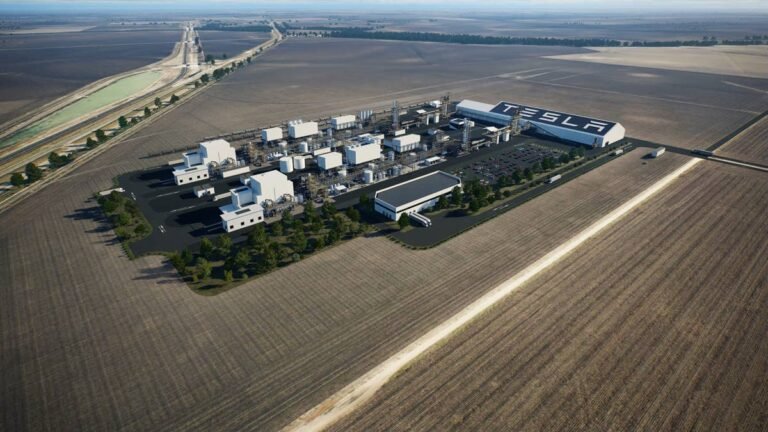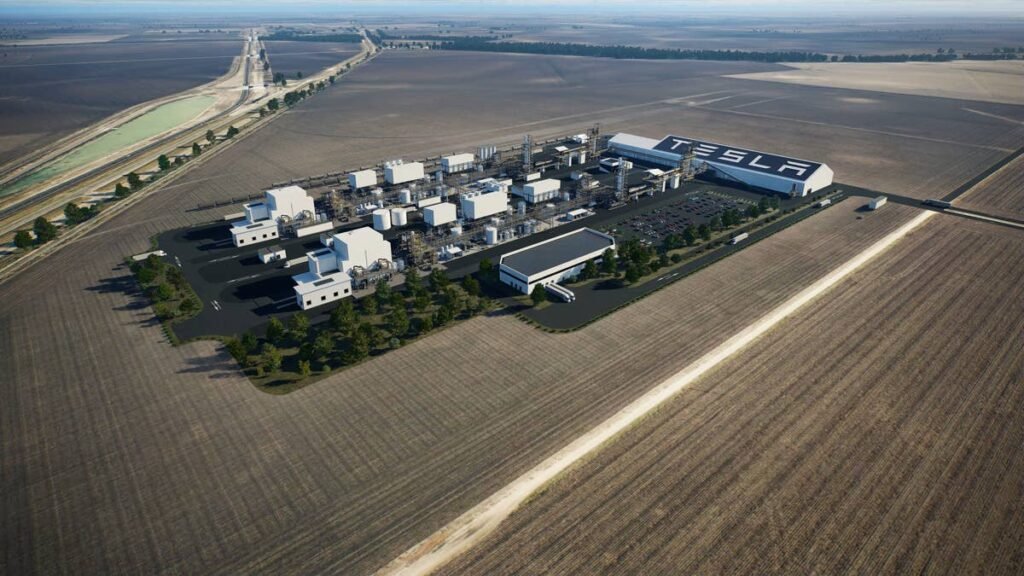
For all the promises of a zero-emission future, the reality of electric vehicle manufacturing remains a dirty business. In South Texas, the consequences are flowing directly into local waterways. Tesla’s billion-dollar lithium refinery outside Corpus Christi—marketed by CEO Elon Musk as a clean, acid-free operation—is now at the center of an environmental crisis. Independent lab tests have detected carcinogenic heavy metals and elevated lithium levels in the 231,000 gallons of wastewater the facility discharges daily into a local drainage ditch.
What’s Your Poison?
The regulatory blind spot enabling this discharge originated when the Texas Commission on Environmental Quality (TCEQ) issued Tesla a wastewater permit in January 2025. Local officials at the Nueces County Drainage District No. 2 were completely unaware of the arrangement until their maintenance workers discovered an unfamiliar pipe expelling black liquid across their easement in early 2026. While the TCEQ conducted a brief investigation in February 2026, state regulators cleared Tesla of any violations because the original permit did not require monitoring for lithium or heavy metals.
The controversy escalated this week following a bombshell report by Eurofins Environment Testing. Commissioned by the local drainage district, the independent lab analyzed the refinery’s wastewater and found distinct traces of toxic metals. The analysis detected arsenic at 0.0025 mg/L and hexavalent chromium—the notorious carcinogen from the Erin Brockovich case—at 0.0104 mg/L. Investigators also identified abnormally high concentrations of lithium, manganese, and sodium, establishing a distinct chemical signature pointing directly back to the battery plant. Armed with this data, the Nueces County Drainage District No. 2 immediately issued a cease-and-desist letter to Tesla.
The Consequence
The environmental and public health repercussions for South Texas residents are immediate and severe. The drainage ditch funneling Tesla’s industrial waste directly feeds into Petronila Creek and ultimately empties into Baffin Bay, a critical ecological zone and longtime fishing destination whose health has already been deteriorating. The chemical discharge creates conditions 10 to 20 times saltier than normal surface water, threatening the ditch’s infrastructure and its ability to protect surrounding neighborhoods from flooding. For the American consumer aggressively pushed toward EV adoption, these statistics expose a grim tradeoff: zero tailpipe emissions at the expense of localized toxic pollution.
Right now, enforcement is a bureaucratic stalemate. Tesla maintains that it operates in full compliance with its state-issued wastewater permit. Because the TCEQ failed to include limits for lithium, arsenic, or chromium in its initial authorization, the state has yet to penalize the automaker or halt operations. The burden of enforcement has entirely fallen on local county officials, whose cease-and-desist order faces an uncertain legal future against the automaker.
Tesla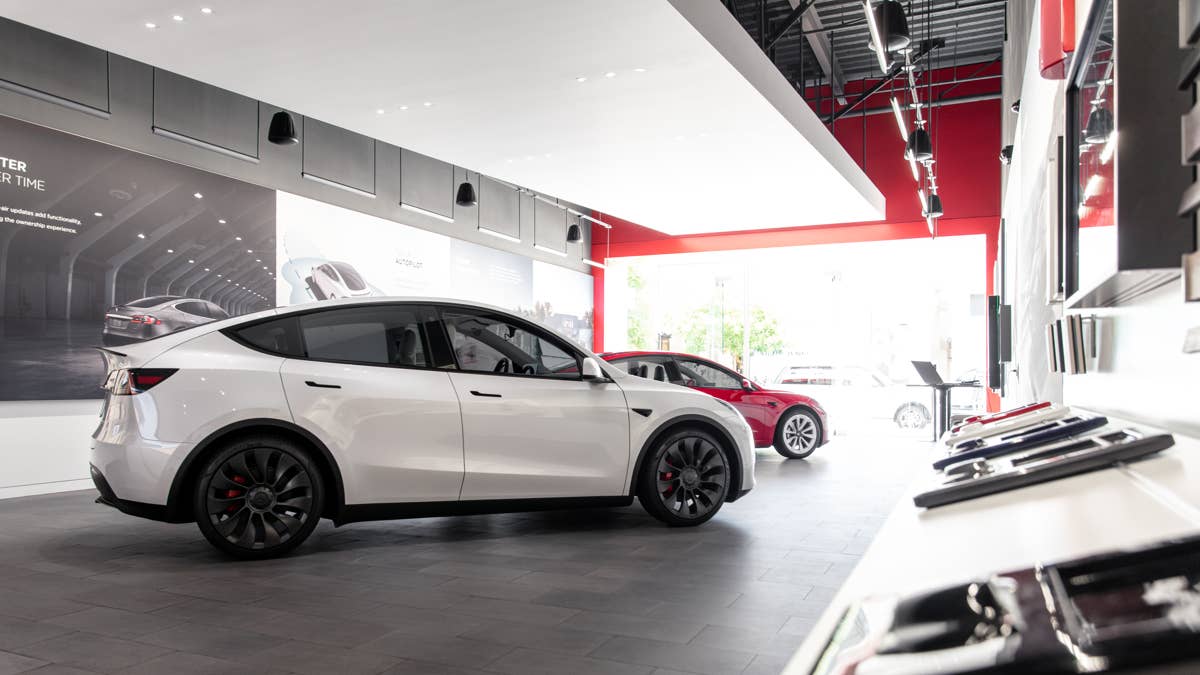
Conscious Choices
The electric vehicle transition cannot run on regulatory loopholes. The next time an automaker touts a multi-billion-dollar manufacturing footprint as a total victory for the environment, verify the permit details. True sustainability means demanding corporate accountability across the entire supply chain, ensuring the water flowing out of the factory is as clean as the cars rolling off the line, because the truth of the matter is the environmental cleanliness of EVs depends almost entirely on the local governance and energy generation.