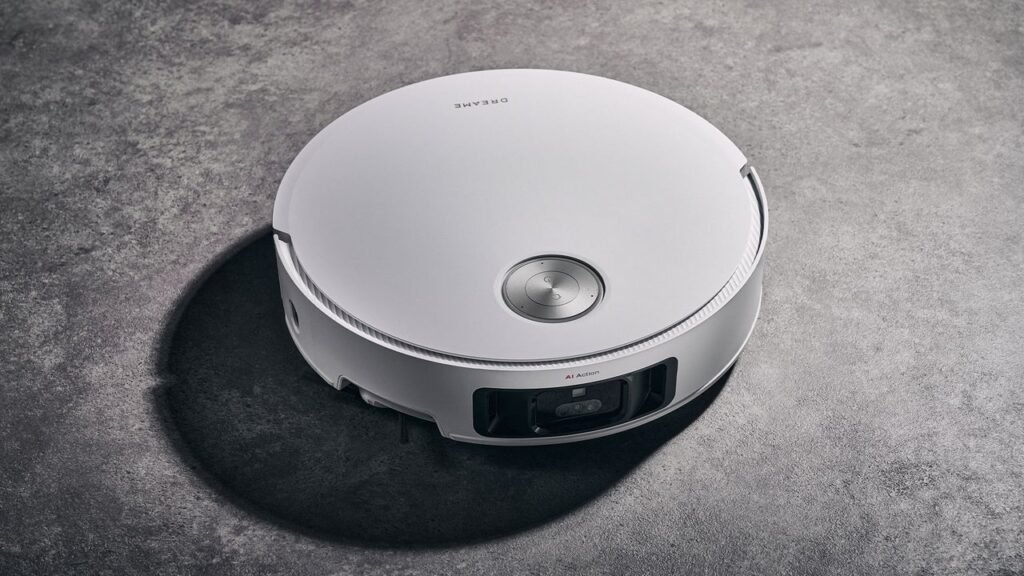
Your robo-vacuum may pose an unacceptable risk to national security — at least, that’s how the U.S. government sees it.
This week, the Trump administration effectively banned the sale of humanoid robots made abroad — a regulatory swipe at China, which dominates the global market for human-shaped machines. The changes specifically target “mobile robots, such as humanoids and quadrupeds,” but the language includes other robots that can move themselves, like the one that cleans your floors so you don’t have to.
In a Q&A section of the FCC’s website, the agency explains that advanced robots impacted by the new regulations include devices “capable of locomotion, obstacle avoidance, navigation, or movement on the ground.” While your Roomba may bounce around aimlessly from time to time, its behavior certainly seems to fit the bill.
The FCC, which issued the new rules, added the robots to its list of communications equipment flagged as too risky to U.S. national security interests. “In their determinations, national security agencies referenced, among other things, unacceptable risks, including that these devices could create supply chain vulnerabilities that could disrupt U.S. economic and national security and could create a cybersecurity risk that threatened American critical infrastructure,” an FCC fact sheet on the changes states.
The FCC also warns of data collection, which it says could be leveraged to “surveil Americans, enhance the capabilities of foreign intelligence services, or to remotely commandeer the robots.” The new ban comes ahead of a planned meeting between Trump and China’s Xi Jinping in September.
Not just humanoid robots
While humanoid robots certainly cut a more ominous profile, the frisbee-shaped automatons that mop and sweep for us are in trouble in the U.S. market unless the FCC issues an exception. The company best-known for its vacuum robots, iRobot, was recently acquired by China’s Picea Robotics following its bankruptcy. Picea Robotics supplies electronics and appliances for other smart home brands including Xiaomi, Haier, and Electrolux.
Humanoid robots, which are taking off in China, are explicitly named in the FCC’s new import ban. By 2024, over two million human-shaped robots were working in Chinese factories and the country accounts for more than 85% of humanoid robots used worldwide. Beyond their uses on factory lines, robots made in China can sort mail, make coffee, and pull off acrobatic stunts. In the UK, major retailers are already leaning on robots made in China to fill labor shortage gaps that leave their warehouses short-staffed.
The FCC’s list of banned tech has seen a lot of updates during the second Trump administration, with some drones, routers, and power inverters made abroad also popping up on the import blacklist. Connected power inverters were added in this week’s update in tandem with robots.
“I welcome these Executive Branch national security determinations, and I am pleased that the FCC has now added foreign produced advanced robotics and power inverters to the FCC’s Covered List,” FCC Chairman Brendan Carr said. “Following President Trump’s leadership, the FCC will continue to do our part to secure America’s critical supply chains and, with today’s action, the FCC is acting in lock step with our national security agencies to do just that.”