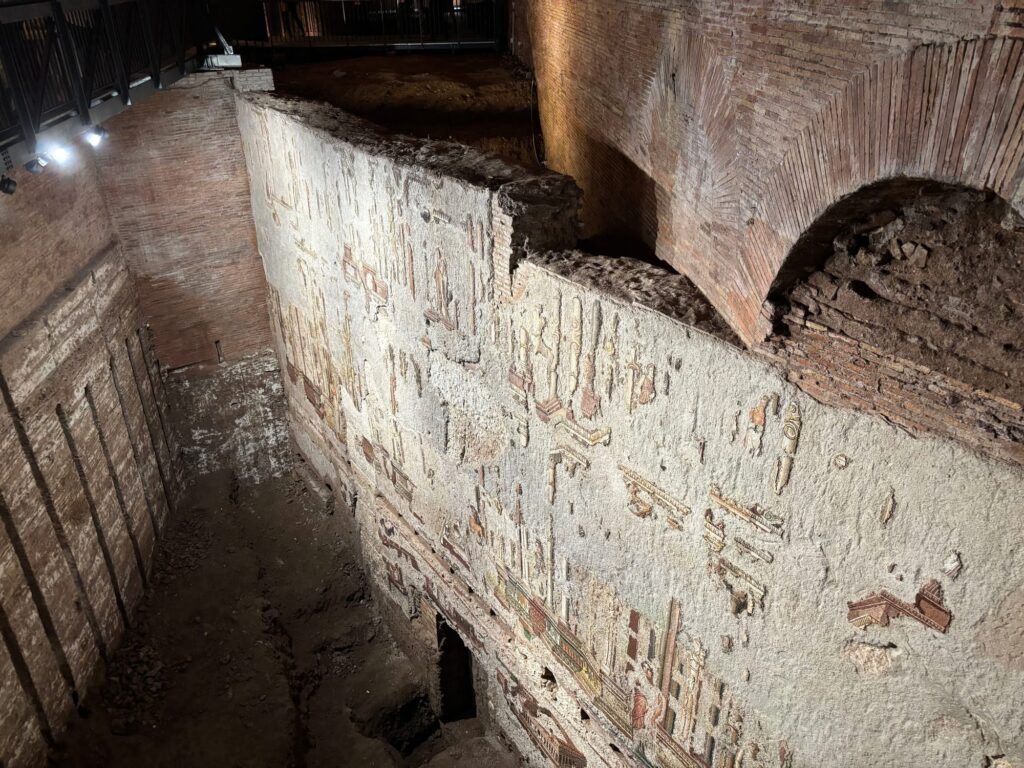
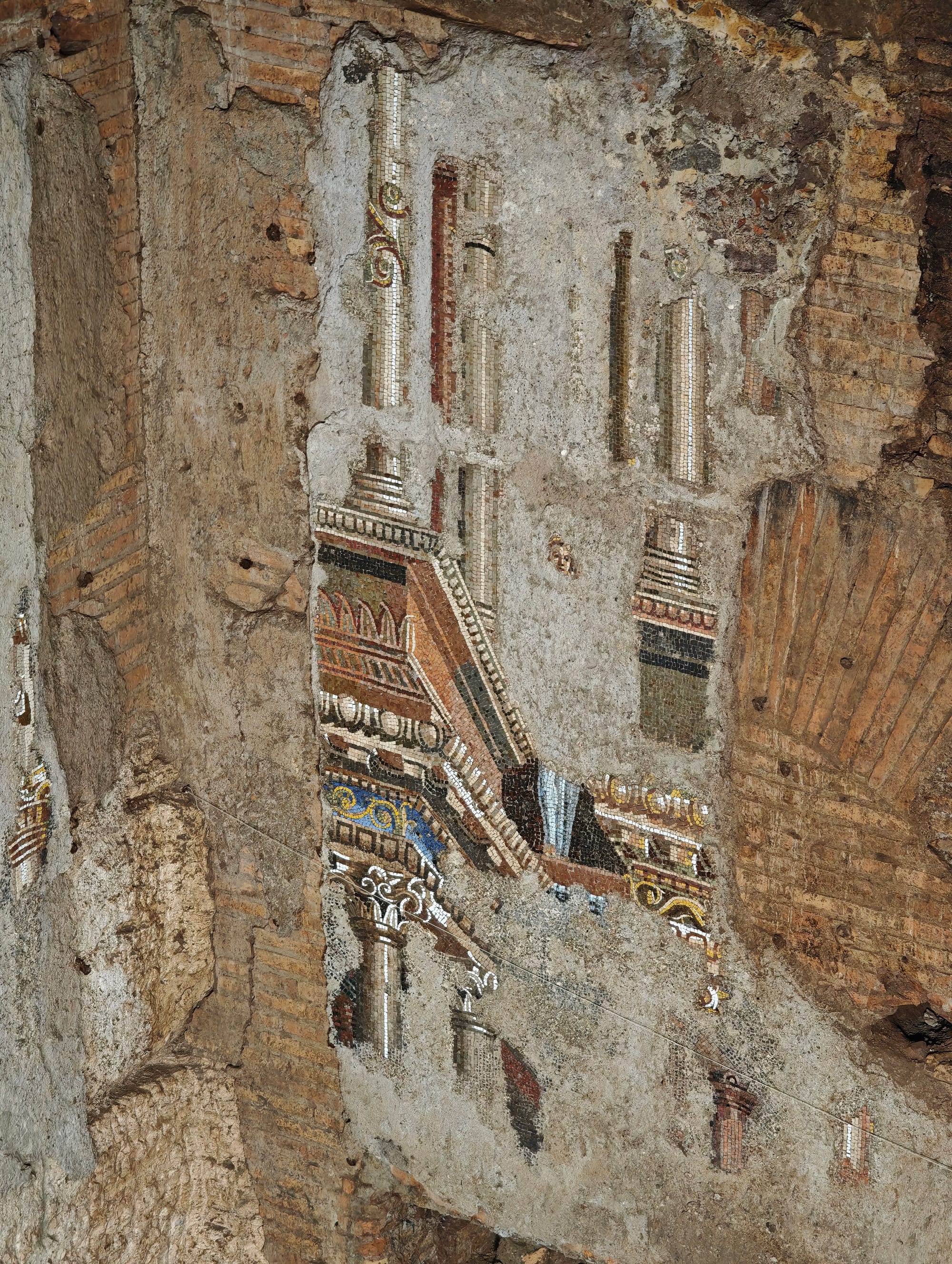
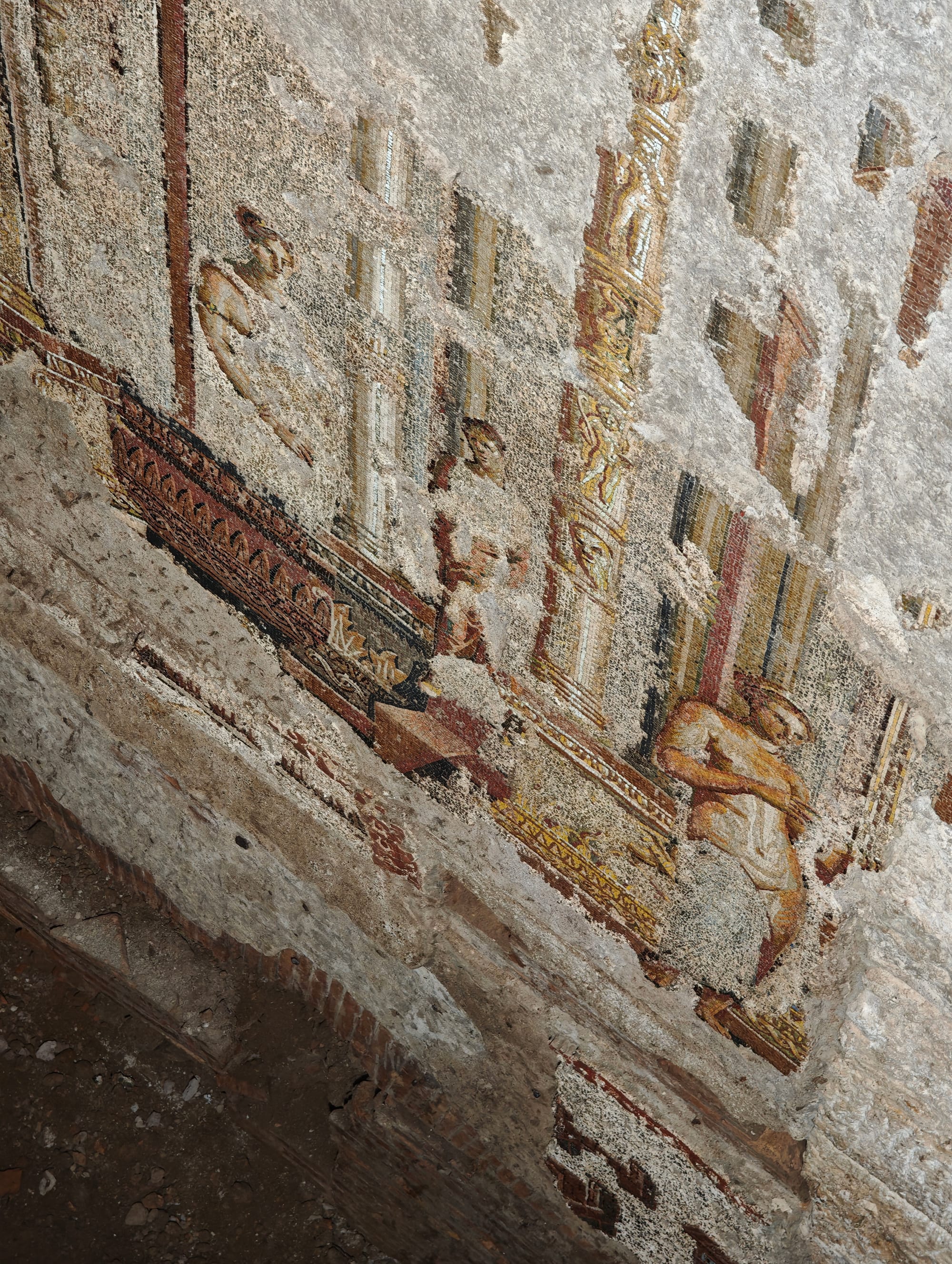
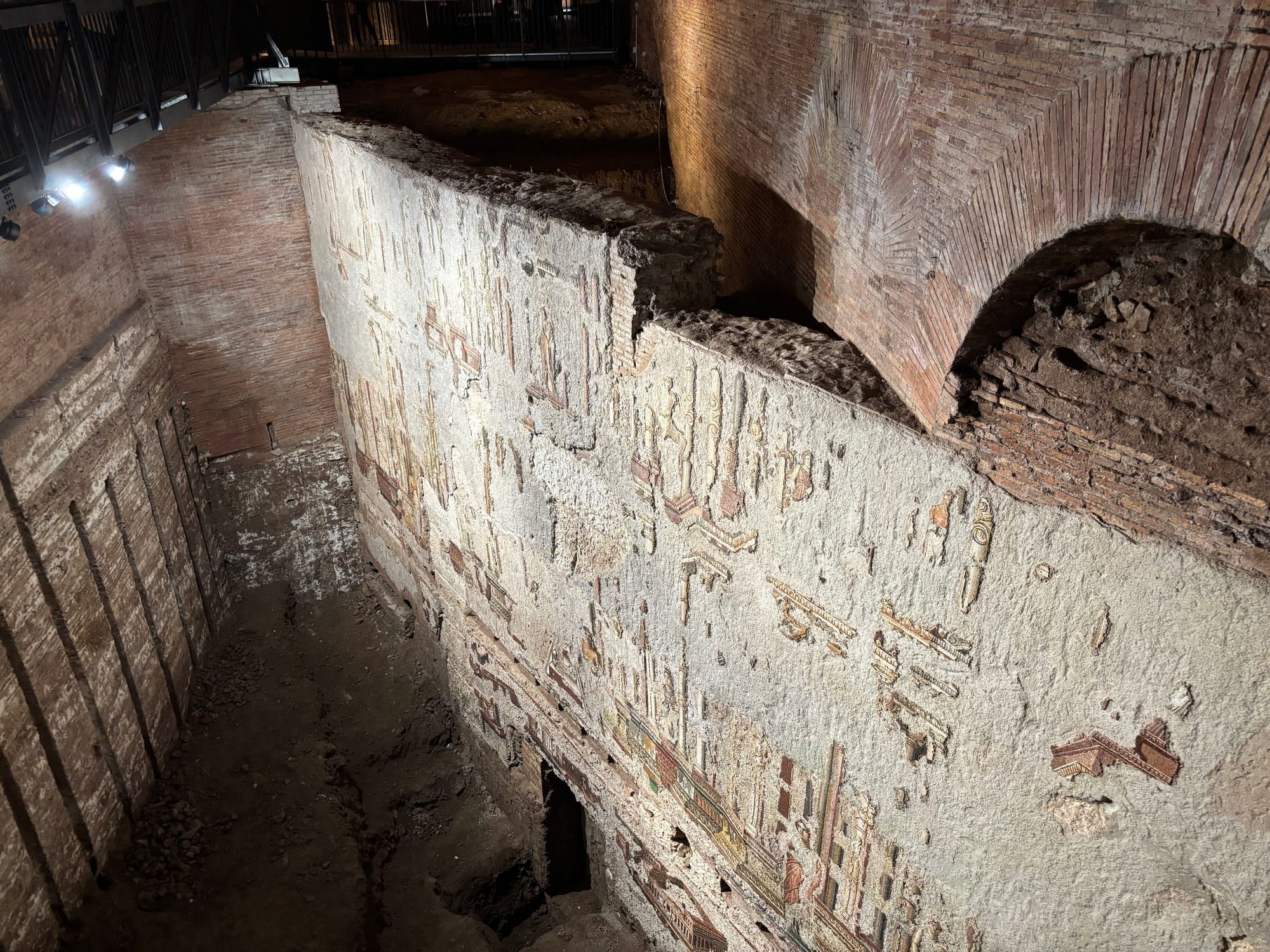
Detail views of a large-scale mosaic on two sides of a hall underneath the Baths of Trajan in Rome (photo Anthony Majanlahti/Hyperallergic)
ROME — In the newly opened Museo delle Terme di Traiano, or Museum of the Baths of Trajan, visitors can now view the largest surviving wall mosaic in the Roman world.
Directly across from the Colosseum in Rome rises the Oppian Hill, 2,000 years ago a densely constructed neighborhood and today a sunny park where immense pieces of the huge public Baths of Trajan still protrude from the earth. It has already produced some of archaeology’s wonders: underneath the Baths, the richly decorated rooms of Emperor Nero’s Domus Aurea, or “Golden House,” can be visited in a not-to-be-missed immersive experience. But when Emperor Trajan leveled the space to build a platform for his Baths, inaugurated in 109 CE, a series of buildings was buried. They came to light in digs between 1997 and 1999, in a 230-foot (70-meter) underground gallery.
Now, the city of Rome has opened this gallery as the slightly misleadingly named Museum of the Baths of Trajan. At the entrance is a small bookshop in a room to the right of the main gallery, and to the left is an irregular ancient room which now houses the only objects pertaining to the Baths: eight huge lead pipes with the words “THERM TRAIANI” cast in relief, astonishing for their size and their survival.
But the rest of the space, almost the whole length of the ancient vaulted gallery, is given over to the in situ display of two unique pieces of art that have no clear relationship to each other, and no other comparable examples in the Roman Mediterranean.
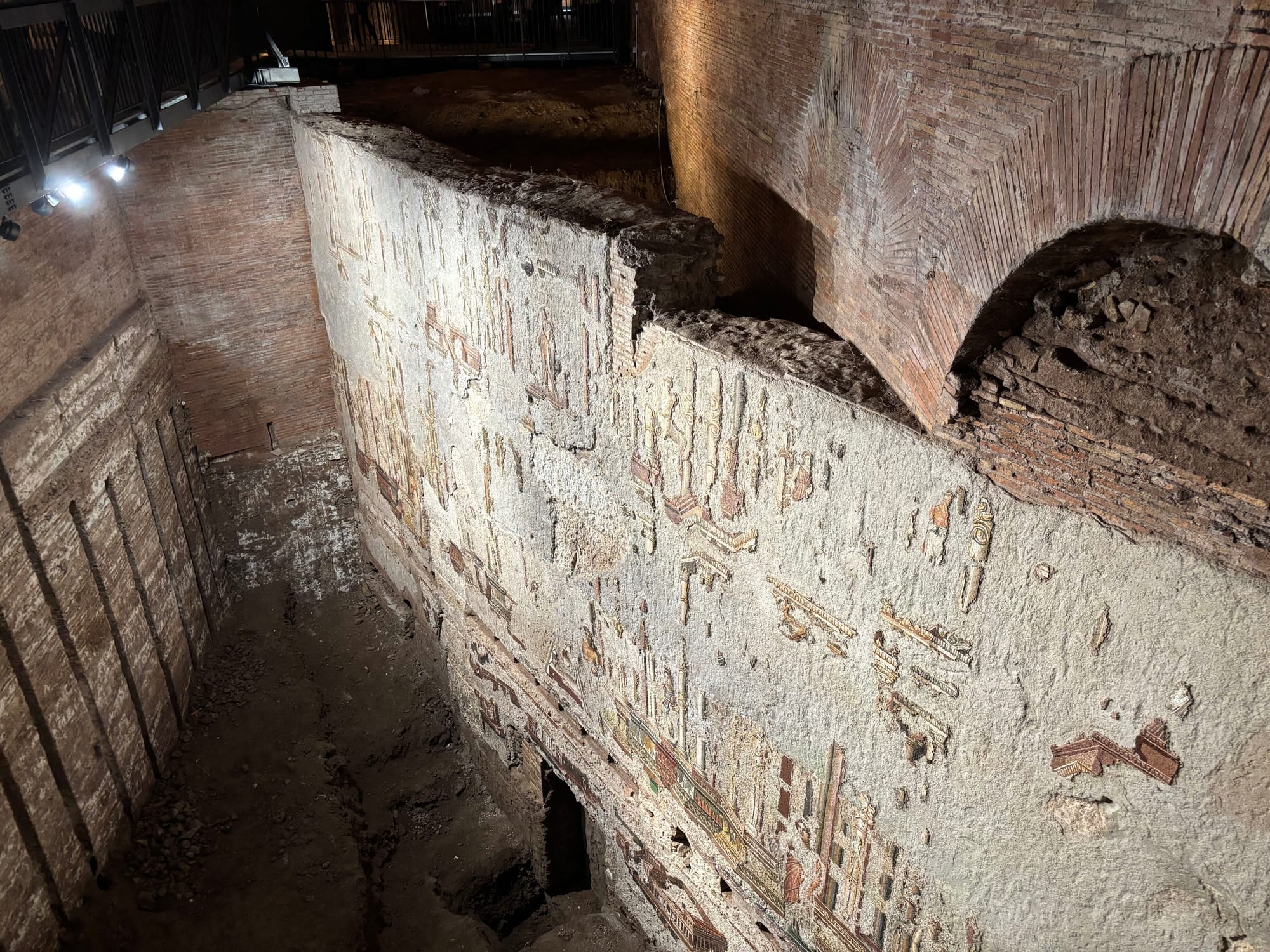
Below the floor level of the gallery, archaeologists discovered a large-scale mosaic on two sides of a hall of gigantic dimensions, about 10 by 15 meters (~33 by 49 feet) based on the lengths of both visible walls, and an astonishing 12 meters (~39 feet) tall. The dig has not yet reached the original floor, but what we can already see is extraordinary. The walls were perhaps part of a nymphaeum or fountain room, with a central niche that once contained a statue. About nine meters (~29 feet) below the modern walkway crossing the space, the huge mosaic is visible — though extremely damaged, as only about 20% survives — with traces on the side wall.
The upper part of the work draws from ancient fresco, with illusionistic architecture, including thin columns with elaborate capitals and Dionysian symbols that hold up platforms on two levels like an ancient stage, a scenae frons. Set into these spaces are two types of figures: imitation statues, like the centaur near the upper part of the mosaic, and a full-colored series of portraits, which often have striking psychological intensity.
Two of these faces, the first discovered by archaeologists digging downward, have inspired the name “Mosaic of the Muse and the Philosopher,” though other were later found grouped toward the lower register of the mosaic.
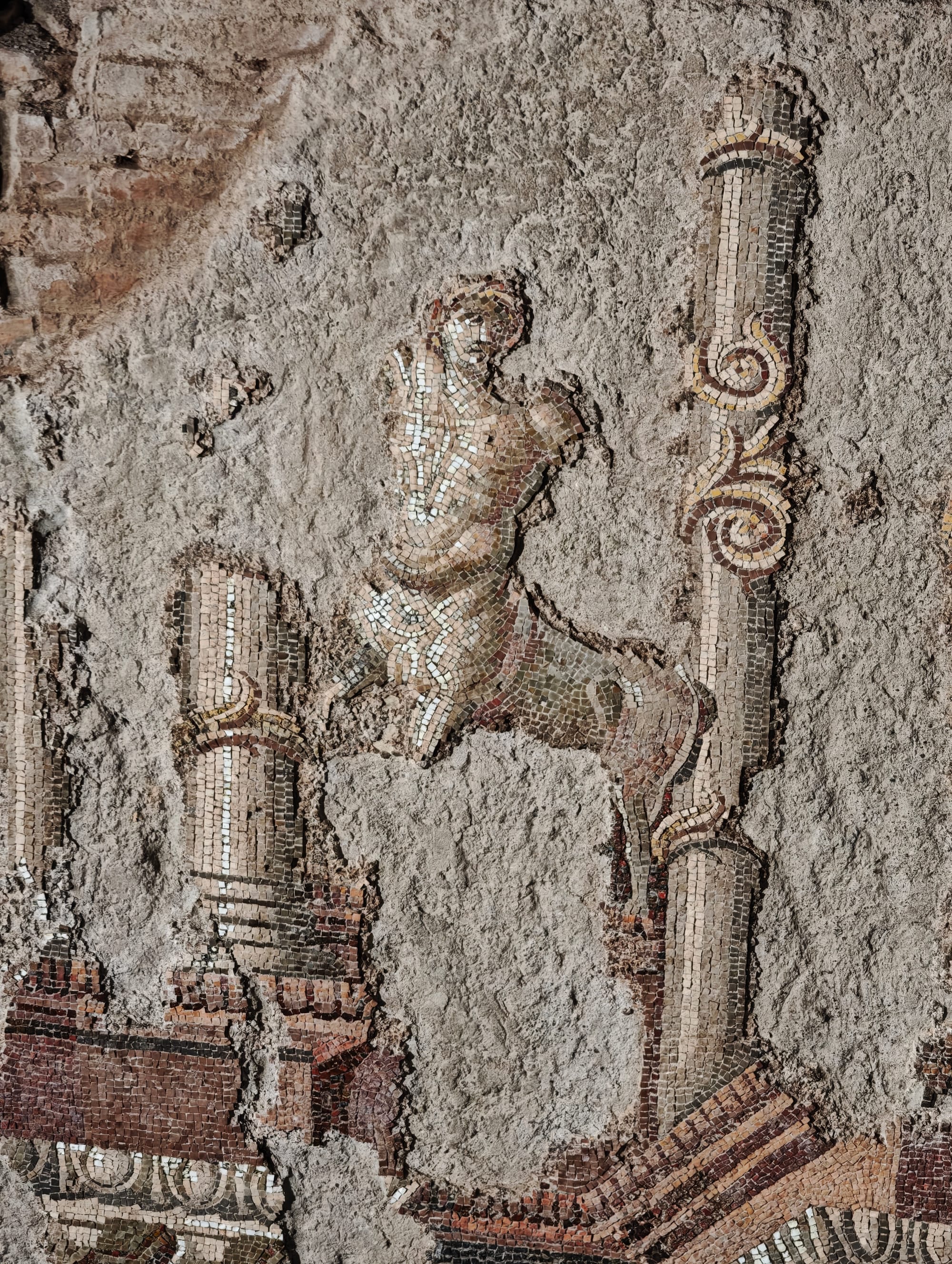
What this room was for is hard to say. It dates from after the Great Fire of Nero in 64 CE to the end of Emperor Domitian’s reign in 96 CE, and it was likely a large imperial reception room, an oecus. The regularity of the missing sections suggests that blue glass mosaic tiles were stripped out from the mosaic for reuse.
At the far end of the Trajanic gallery is another noteworthy discovery: a large fragment of an unusual fresco. Also from after 64 CE and before the death of Domitian, it lies on the ground level of the gallery and was apparently painted on the exterior of a different building that was leveled to build the Baths. The fresco shows a painted city, in a bird’s-eye view, rich in detail. We see the city’s turreted walls and main gateway, with buildings including an Odeon or roofed theater for poetry readings, a temple, a four-sided portico, and many residential buildings. A harbor is heavily fortified. This might be an imaginary city, though it could depict a Near Eastern city on the Mediterranean, or even Londinium.
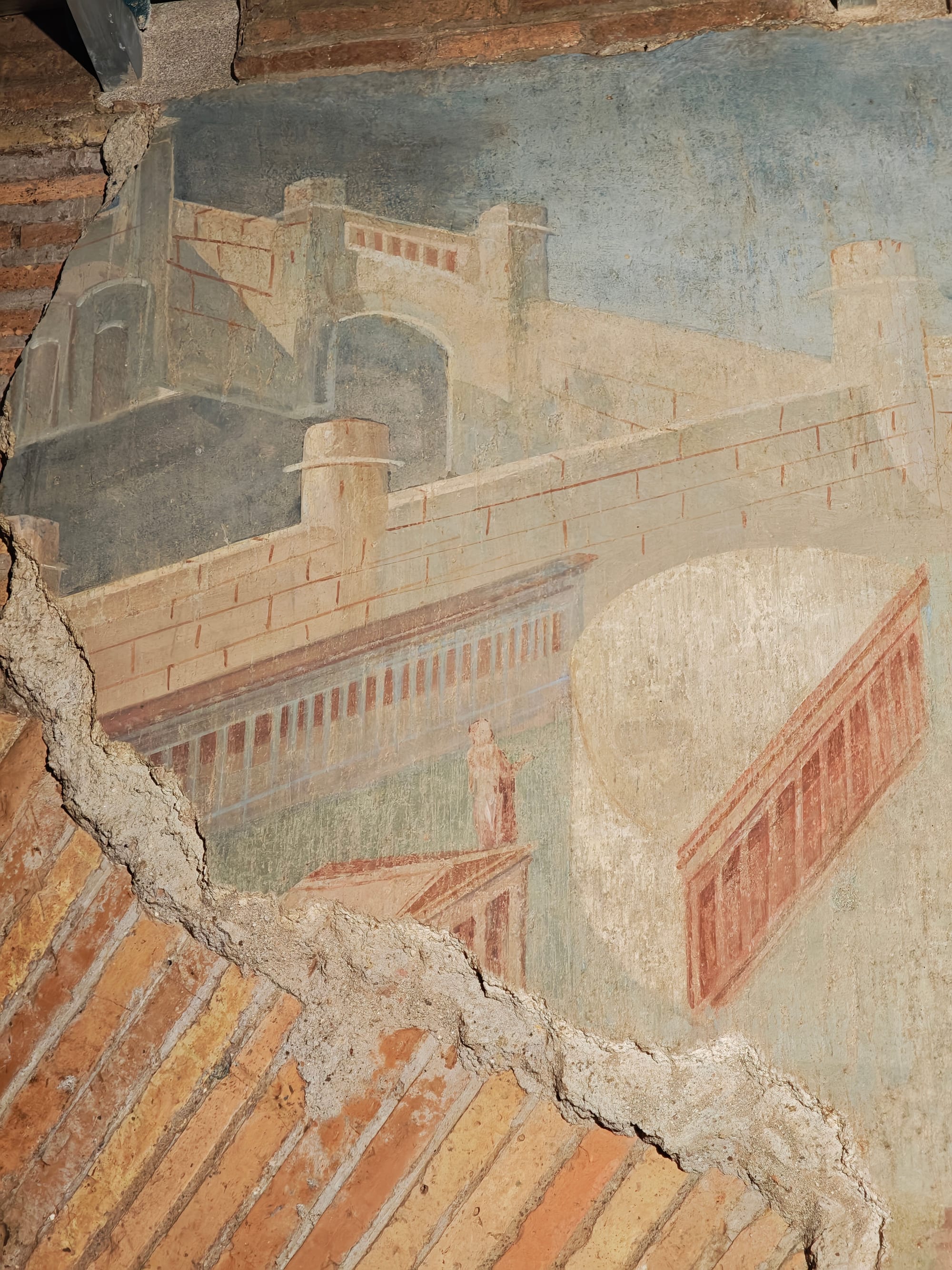
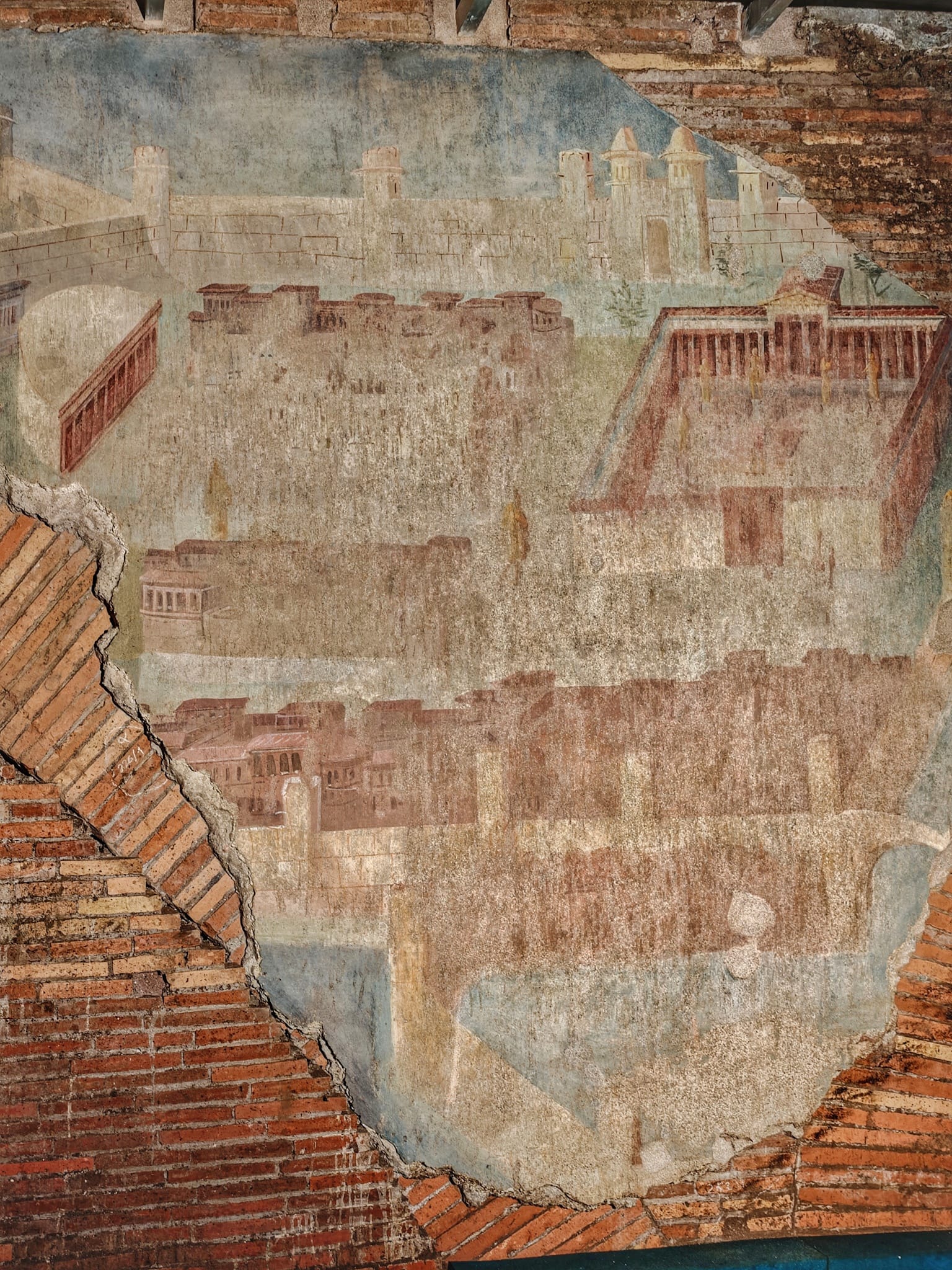
A large fragment of an unusual fresco shows a painted city in a bird’s-eye view. (photo Anthony Majanlahti/Hyperallergic)
Rome Mayor Roberto Gualtieri, in his inaugural press conference, emphasized how the discovery reflects Rome’s endless capacity to reveal its past. “With this intervention, we are returning a wonderful and finally accessible place to the city, recovering unique testimonies of Rome’s history,” Gualtieri said. “The restoration of the ‘Painted City’ and the ‘Great Mosaic,’ along with the new discoveries that emerged from the excavations, also tells the extraordinary nature of a city where every intervention on heritage can bring new fragments of history to light and enrich the knowledge of our past.”
To see these two works of art, similar in time but different in medium and subject, in the same place is a reminder of the continual discovery of the wondrous: Rome’s ongoing lesson.