In British Columbia a CAN$115 million project is almost complete to mitigate the risk posed by debris flows to the town of Squamish.
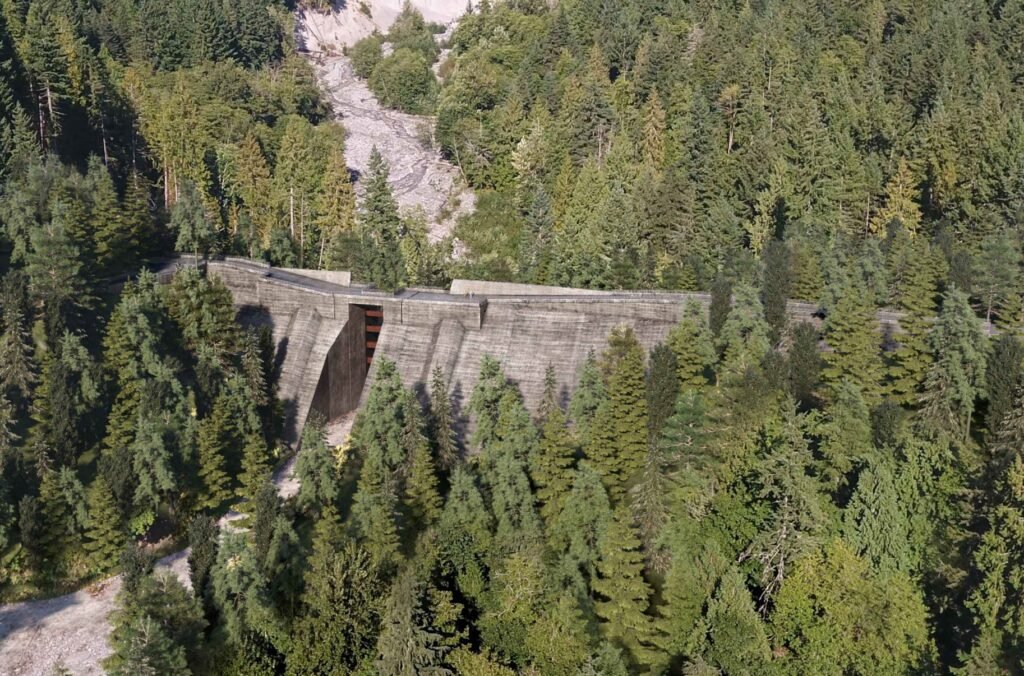
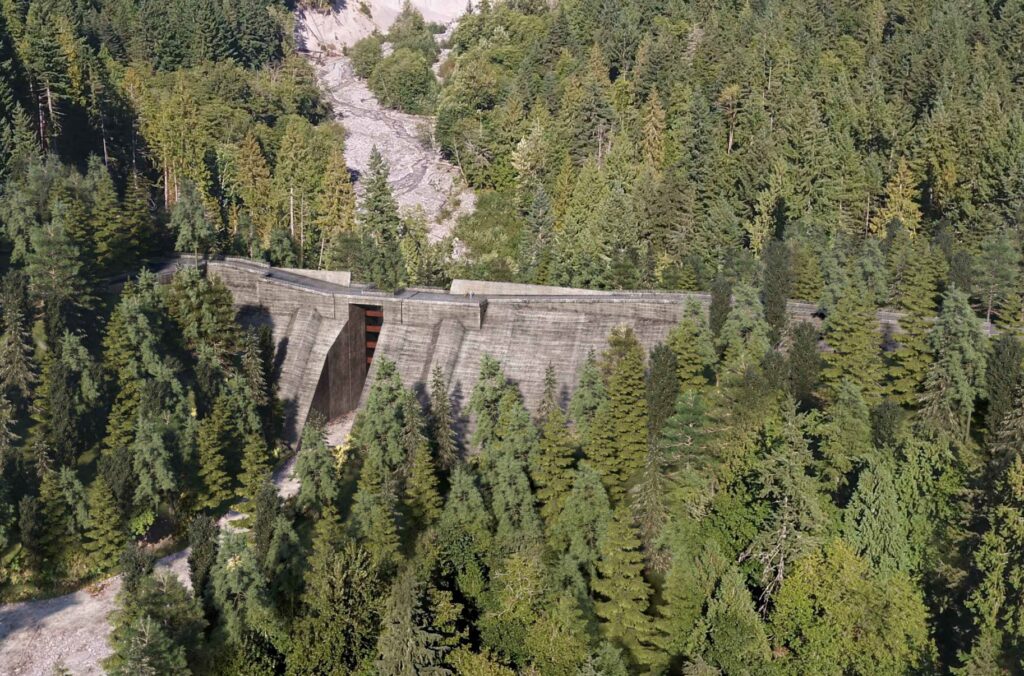
Upstream of the town of Squamish in British Columbia, Canada, an extraordinary project is underway to mitigate the risk of debris flows. Known as the Cheekeye Debris Barrier Project, the scheme involves the construction of a concrete barrier that is 24 metres high across the Cheekeye Fan, designed to catch debris flows with a volume up to 2.4 million cubic metres of debris.
The project is almost complete, with hand-over expected in the summer of this year. There is an excellent article about the project on The Tyee website, which includes some very interesting images of the structure. The estimated cost of the project is around CAN$115 million. The location of the Cheekeye Debris Barrier Project is [49.79417, 1123.10878]. This is a render of the final form of the barrier (but take a look at the images of the almost completed structure too):
This is a fascinating project that makes a great case study for teaching, not least because both the detailed design considerations and the regulatory process for approving the programme are available in detail.
In terms of the detailed design considerations, there is an excellent open access paper in the Canadian Geotechnical Journal (Lesueur et al. 2025) that provides a very comprehensive analysis of the estimation of the potential volume and mobility of the debris flows on the Cheekeye Fan, and of the considerations that went into the final deisign of the structure.
In terms of the approval process, the District of Squamish has an online archive of documents and Council minutes that extends back to 2003.
I would highlight the challenges around determining the optimal size of a barrier of this type. The team has been balancing risk against cost, following the principle as outlined in Lesueur et al. (2025):-
“The local government specifies that tolerable debris-flow risks be reduced “as low as reasonably practicable” (ALARP), defined in this project as the point where the cost of additional mitigation measures is grossly disproportionate to the benefits gained.”
Thus, the barrier is not designed to stop the maximum credible debris flow, which is 5.5 million cubic metres (more than double the design event). This is pragmatic engineering at its best, and the Cheekeye Debris Barrier Project provides the level of detail that allows the decision-making process to be fully understood.
Reference
LeSueur, P. et al. 2026. Risk-informed design of debris-flow mitigation at Cheekeye Fan. Canadian Geotechnical Journal. 62: 1-16. https://doi.org/10.1139/cgj-2023-0008
Text © 2026. The authors. CC BY-NC-ND 3.0
Except where otherwise noted, images are subject to copyright. Any reuse without express permission from the copyright owner is prohibited.