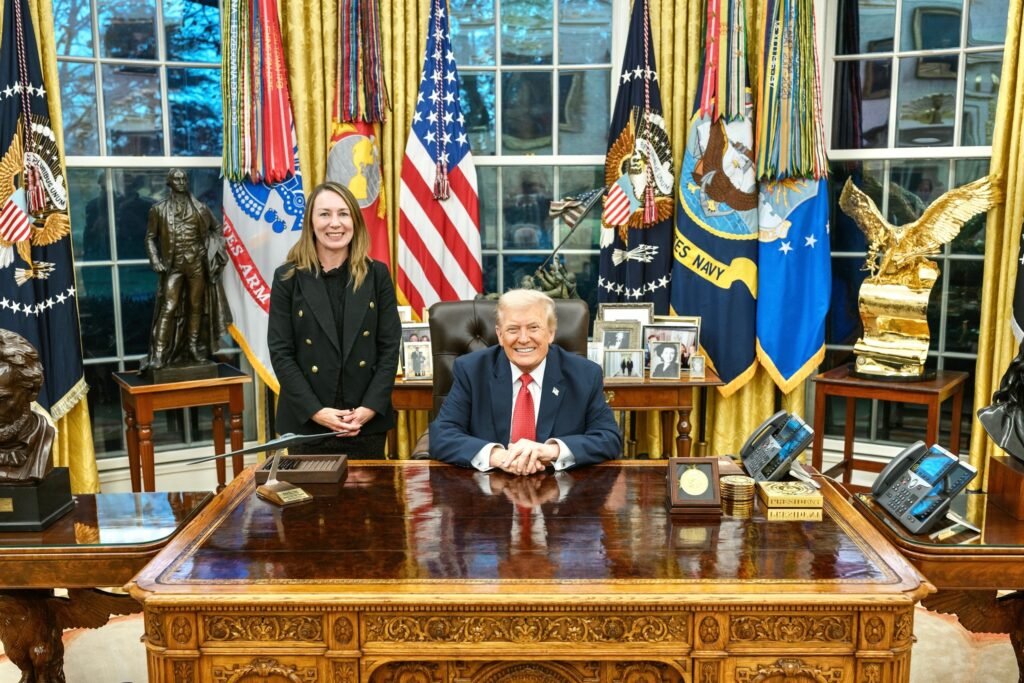
President Donald Trump’s pick for top emissary to Capitol Hill is a longtime former congressional aide with wide-ranging experience in oversight and investigations — a telling choice at a time when Washington could be heading toward divided government.
As the new director of the Office of Legislative Affairs, Katie Bailey will serve as the lead liaison between the White House and Congress. Her first task will be helping navigate a fast-moving, high-stakes “lame duck” legislative session, where lawmakers will be rushing to pass outstanding bills and avoid a government shutdown in the immediate aftermath of the midterm elections.
Bailey is also staring down the possibility of having to advocate for Trump’s agenda on the Hill with one or both chambers under Democratic control.
It’s a job that could require Bailey to strike a balance between standing up for the president with a need to compromise with Democrats on major legislative priorities in 2027. She’ll also have to manage intraparty conflicts among Republicans, including lawmakers with presidential aspirations in 2028.
James Braid, who previously held the role before announcing his departure in August, said in an interview that Bailey is up for that task.
He said his successor — who had previously been leading the Senate side of the White House legislative affairs team — was essential to the White House’s ability to get things done in Congress. He pointed to Bailey’s help in passing a Russian sanctions package and negotiating the terms of a bipartisan deal to overhaul the federal permitting process for energy projects.
And she was critical in advancing key nominations, Braid said — especially in the 18-day sprint to confirm then-Sen. Markwayne Mullin to be secretary of Homeland Security this summer and the scramble to seat Keith Sonderling as secretary of Labor before the Senate left town for the October recess.
“Katie handled those nominations with unbelievable skill, grace, humility, and professionalism in a process that can really have a lot of complicated personalities at stake,” Braid said in an interview.
Bailey, who was not available for an interview, has been with the White House legislative affairs office since June 2026, but got her start in Washington more than two decades earlier as a legislative assistant to former Speaker John Boehner (R-Ohio), then the chair of the Education and Workforce Committee.
She held different jobs in the subsequent years but kept returning to Capitol Hill, with Eric Schmitz, a former aide to Speaker Mike Johnson, noting — with admiration — that Bailey is a “Congress addict” with deep reverence for the institution.
Bailey went to the Senate in 2009 to work for the late-Sen. Tom Coburn (R-Okla.), eventually becoming the governmental affairs director for the Senate Homeland Security and Governmental Affairs Committee that Coburn chaired.
Back on the House side in 2015, she was a senior staffer under then-House Oversight Chair Jason Chaffetz (R-Utah) and then staff director for the Government Operations subcommittee, at that time helmed by Mark Meadows — the North Carolina Republican who would go on to become White House chief of staff at the end of the first Trump administration.
In mid-2017, she moved back to the Senate Homeland Security panel to lead governmental affairs under then-Chair Ron Johnson (R-Wis.) and in 2019 became then-GOP Sen. Mike Braun’s legislative director for six years. She left the Hill to serve a stint as Braun’s federal liaison when he became governor of Indiana.
“She’s going to be well-suited for this particular job in that, if the House or the Senate ends up in Democratic party control, she’s used to dealing and building consensus with her previous jobs,” said one Republican who previously worked with her and was granted anonymity to share details of private relationships.
At the same time, Bailey’s experience working on House Oversight and the Senate Homeland’s permanent select subcommittee on Investigations — the “linchpin of the Senate oversight efforts,” as Braid put it — could give her the tools to push back against a Democratic onslaught of inquiries into the Trump administration should Republicans lose their House or Senate majorities.
“The administration is confident it’s going to be successful in the November elections,” said Braid, when asked about the possibility of a split government. “But in the event that it’s not, dealing with congressional oversight, Katie has perhaps the single best possible resume for that.”
He added that Bailey was “broadly respected by Democrats as a serious person and a serious counterpart, and somebody with whom they can make deals.”
Bailey could be looking at a busy last few months of the 119th Congress — even if the GOP trifecta survives the midterms. Republicans have already pushed several priorities to the post-election legislative session that are looking increasingly likely to get punted again, from a farm bill to a reauthorization of surface transportation programs.
More imminent and non-negotiable deadlines include passing a government funding bill and the annual defense policy measure. There also will be pressure on Bailey to help clear the way for passage of a permitting package and a bill to regulate the college sports industry, where fragile coalitions of Republicans and Democrats supporting both those efforts are eager not to squander the opportunity to notch legislative victories.
Looking ahead, Bailey will play a major role in helping broker a deal between Congress and the White House to increase the debt limit ahead of a deadline expected next summer.
Sen. Bernie Moreno (R-Ohio), who said he knows Bailey “really well,” described her as “even keeled” with a “great temperament” — and, like Braid, not “easily rattled.”
“And believe me,” Moreno said, “if you had been to a few of my Republican lunches, [senators] try to rattle them pretty good. These guys stay pretty steady.”
He also praised Bailey for pitching in to arrange constituent tours of the White House and otherwise going “above and beyond the call of duty.”
POLITICO reported further evidence of that in 2021, when she was spotted bringing an air fryer to work so her staff could enjoy late night mozzarella sticks during a marathon voting session.
“She thinks like a member but acts like a staffer, which is normally very, very welcomed by those that she works with and around her,” said the Republican who once worked with her.