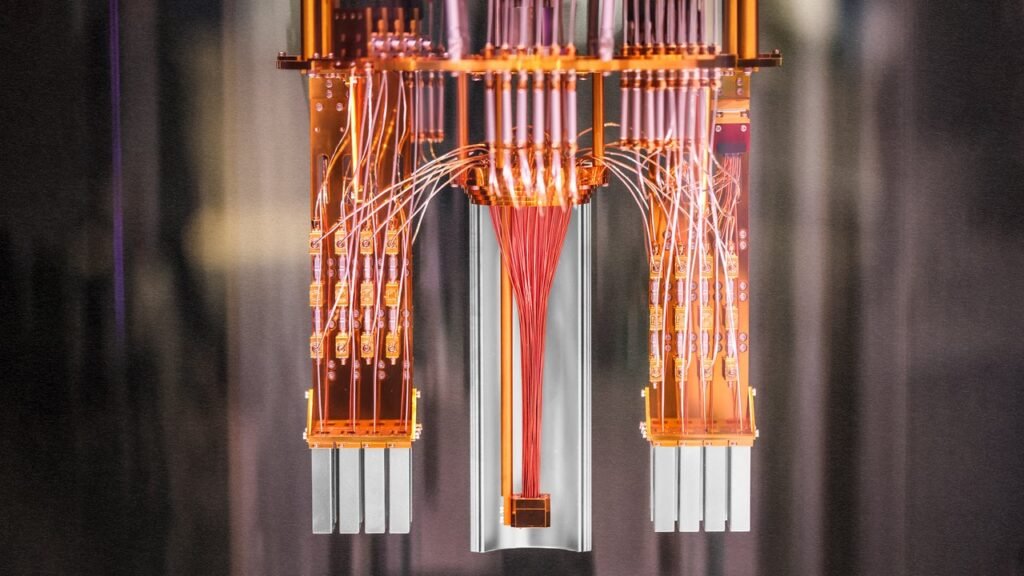
The U.S. Department of Energy is launching a $215 million competition to build quantum computers that are usable in scientific research. Officials are hopeful that early versions of such machines could be operational as soon as 2028.
While ordinary computers famously store data as binary digits that can take on a value of either zero or one, quantum computers harness the laws of quantum mechanics to store quantum bits, or qubits, that can take on more complex states. That means they can theoretically solve complex problems involving cryptography, the simulation of intricate biological and engineering processes, financial modeling, and potentially artificial intelligence and machine learning orders of magnitude faster than classical computers.
But so far, the devices have been more the subject of scientific experimentation than useful tools in their own right. They’re generally difficult to build and sensitive to outside interference, often requiring components to be kept at temperatures close to absolute zero to avoid altering qubit data.
The DOE’s Quantum Genesis Q Competition challenges applicants to deliver what the department calls “the world’s first fault-tolerant scientifically relevant quantum computers,” or SRQCs.
In essence, the Energy Department is seeking to transform quantum computers from lab experiments into lab equipment, while ensuring the U.S. remains at the forefront of their development and application.
The department is inviting private sector businesses to propose computers with at least 100 logical qubits capable of performing hundreds of millions of fault-tolerant operations, an achievement officials say builds on decades of research into quantum technology and computing at large.
“I see it as no different than getting achievements where we could build the first particle accelerators, or incredibly new, capable telescopes,” says Darío Gil, the DOE’s undersecretary for science. “It’s a scientific instrument of the first kind—one that deals with one of the most fundamental building blocks of nature, which is quantum mechanics.”
The competition will be divided into two phases, with fixed awards of up to $1.5 million for meeting early milestones, and a $100 million pool to be split among awardees producing SRQCs that meet various requirements, including handling at least 100 logical qubits.
According to the DOE, the competition also features two additional $50 million prize pools for companies that can demonstrate computers with 150 or 200 logical qubits. (Logical qubits refer to the number of qubits effectively available for computation after error-correction mechanisms are taken into account.)
Various milestone requirements are designed to produce prototypes that can scale into truly scientifically relevant machines, says Tanner Crowder, quantum information science lead and senior technical adviser for advanced scientific computing research in the Department of Energy’s Office of Science.
“Our goal is not to have a bunch of qubits that can’t do much,” he says. “We want to be able to see meaningful scientific calculations done on these quantum computers that are based in the DOE mission space.”
The department’s stated goal is to facilitate quantum computing technology that is useful to scientists as soon as 2028, pointing to potential applications in areas such as drug discovery, astrophysics, and secure communications.
“These capabilities have the potential to accelerate breakthroughs across energy, medicine, advanced manufacturing, national security, and fundamental science while opening entirely new avenues of discovery that cannot yet be anticipated,” a just-released Department of Energy committee report states.
Early awards could be announced as soon as November or December, Crowder says, noting, “We hope to start work as soon as possible. There’s an obvious urgency to us being able to deliver this capability for the nation.”
In recent years, a variety of quantum computing companies have collectively raised billions of dollars in funding, while the federal government has increasingly jumped into the field even before the DOE’s September 17 announcement.
In May, the Commerce Department announced plans to provide roughly $2 billion in backing for nine quantum computing companies, including $1 billion for a new IBM quantum foundry subsidiary.
A pair of executive orders released in June directed the Energy and Defense departments to accelerate their push into the field and commanded efforts to prepare for the prospect that quantum codebreaking technology could make today’s encrypted communications obsolete and even retroactively vulnerable to eavesdropping.
The DOE also announced the Quantum High-Performance Computing Validation and Verification Testbed Lab Call for the department’s National Laboratories, offering a planned $45 million in funding, beginning with $14 million in fiscal 2026, for labs to develop tools to test and validate various layers of quantum computing technology.
“We are going to need to do validation and verification, both of the scientific instrument and what gets run,” Gil says.
The committee report envisions the long-term creation of what it refers to as a “DOE Quantum Computing User Facility,” enabling scientific research and collaborations among quantum computing developers and scientists in a range of fields.
Exactly what form quantum computing may take, and who may deliver the optimal solutions, remains in flux. The report points to the likely importance of mixing cloud-based offerings with on-site systems at national labs, as well as continuing to explore different types of hardware.
Delivering useful quantum computers by 2028 isn’t a certainty, Gil acknowledges, though he anticipates the odds of doing so by at least 2030 are quite high.
“I do think it’s challenging,” he says of meeting the 2028 target. “Do I think it’s possible? Yes, absolutely.”