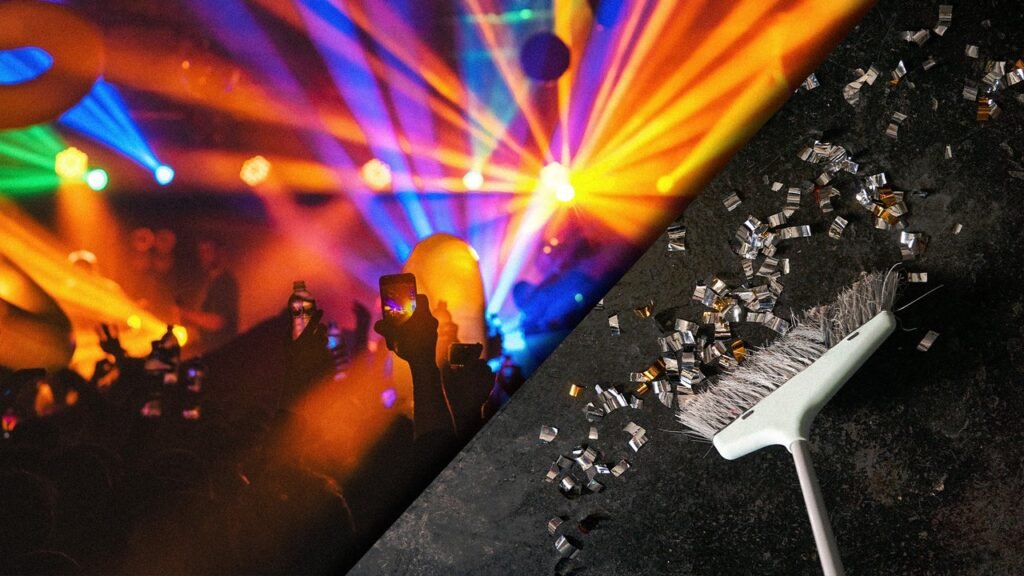
When I was chief business officer at Defected Records back at the start of the decade, the best thing we made in any given week tended to get made on the Monday. Defected is a house music label that also throws parties, so on a Saturday night there would be a few thousand people in a dark room somewhere in the world, dancing to a DJ until the lights came up. Someone would have shot the event on a shaky handheld iPhone. By Monday afternoon the videos would be up and everyone who’d been there would go hunting through them looking for themselves. Then the playlist would land, people would start poring over what had actually happened at 4 a.m., and whether the second record in that back-to-back was as good as everyone was saying. All of it went in the marketing folder and it was used to sell the next Saturday.
I think we had it the wrong way round. Monday wasn’t advertising for Saturday night; it was mostly that part of Saturday night people got to keep. Almost every marketing budget I have seen since is built the other way round, but it’s an expensive mistake to keep making.
The Aftermath Economy
I have been calling this the aftermath economy ever since, and this summer during the FIFA World Cup it got the biggest test ever. England’s team played Mexico at the Azteca Stadium in the round of 16 kicking off at 1 a.m. U.K. time, and then a storm rolled over Mexico City and pushed it back another hour.
Every single person watching in the U.K. had to decide how they were going to do it: Set the alarm for the small hours or stick it out and endure a caffeine-fueled effort to stay up. The pub with a license to stay open late or the sofa with snacks or the phone glowing in a dark bedroom with the volume down (the 2020s version of the transistor radio under the covers?) trying not to wake somebody asleep next door.
Tens of millions of small private decisions, and every one of them became a story that people are still telling.
I think this is something many of the brands in our industry risk missing. Convenience rarely makes much of a story and the tournament’s earlier England games were pleasant, yet largely forgettable. This one though—at 2 a.m. delayed by lightning, at altitude, in the most hostile stadium for visitors in the sport—generated stories everywhere.
What came out of that night was 5 a.m. walks home across northern towns in England with the sun coming up, strangers nodding and singing at each other, taxi videos rolling through East London with people spilling into the street, and celebratory beeping into the dawn. My feed the next day was not performative, for once. It was real people telling each other how they had watched, where they had watched, and what they had felt when they watched it.
And the nostalgia arrived immediately, not in 20 years on some Netflix doc but on the school run the next morning on barely an hour’s sleep, ecstatic and full of afterglow. It was a whole country recounting the night before as though it were already distant history. An event is written by the people who paid for it and then rewritten overnight by everyone who was there. Only this version survives.
None of that is necessarily unusual but what was, is the scale. I take my son to away games and the four hours in the car afterwards are often better than the match. He is putting photographs into an Insta carousel or he’s deep in a group chat with his mates; we’re dissecting a throw-in from the 31st minute like it’s the Zapruder film. The match got us into the car but the long drive home is where it becomes ours.
Raw material
For decades, marketing has treated the live moment as the product and everything that follows as distribution. Highlights. Recaps. Social cuts. CRM. The digital debris left behind by the expensive bit.
But audiences don’t experience events that way now; the event merely gives them the raw material. Afterwards is when they turn it into stories, jokes, photographs, rituals, group-chat folklore, and eventually our new augmented memory. Brands spend fortunes buying access to the first part and remarkably little understanding the second.
There’s a reason any of this should matter to somebody in the industry who doesn’t watch sports. We are living through the most connection-starved stretch of the internet’s existence; Feeds are full of generated slop; AI visuals are converging into the same beige vanilla same-same texture. More and more of what passes through our screens carries no convincing evidence that a human being even experienced anything at all, so this internet thing has become extremely good at producing infinite evidence of nothing having happened.
What people are short of is not more content but goosebumps, feelings, memories, and the sensation of having been somewhere with others and having something left over afterwards. The aftermath is where an event becomes a memory and memory remains one of the few forms of media that is reliably, unmistakably human.
The commercials from this summer suggest nobody has really built for it yet, which is all opportunity for what I think is to come. Meltwater, the media and social intelligence platform, tracked 2.4 million mentions and 1.3 billion engagements across the first half of the year and found that nonsponsors of the World Cup generated close to double the engagement of the official sponsors. Lego had no formal relationship to the tournament at all, yet its World Cup trophy content ran at roughly 12 times the sponsor average per mention. Plenty of genuinely good creative underperformed for no better reason than television cuts being reposted onto social rather than made for it.
What to do
So the three places I would move money now, in a world where the aftermath matters this much, are:
1. Staff the aftermath
Campaigns are staffed heavily up to the event and then everyone goes home. If the two-week period afterward is where the feeling actually forms, somebody good needs to still be at their desk with budget (and the authority to spend it). And they should be booked before the shoot, rather than perhaps found in a panic after the Monday production meeting. Ring any bells?
2. Make something worth keeping
Bank of America handed out customizable Fan Bands across the host cities, beads standing for teams and cities and local landmarks, and people traded with each other and carried them from venue to venue. They worked because they were not merch; they were a way to assemble a little physical record of your own tournament, and the thing kept accruing meaning long after.
When I worked with the superstar dance artist Fred Again for Monkey Shoulder, the whiskey blend, he dropped a folder the morning after a sold-out show including properly shot photographs of the crowd so that nobody had to spoil their night holding a phone over their head to end up with something worth having. The show was the show, and it was amazing and memories were made. Then the folder was what people had to take away and sift through and share the next week.
3. Leave room for what actually happens
Hold back a slice of the budget and tolerate not knowing what you will make with it. Not every asset should exist before the thing it is supposedly documenting has even happened. Some of the most valuable material will really reveal itself only once the crowd has gone home, the group chats have started, and you know what people actually cared about. I think that uncertainty is the potentially beautiful price of our admission now.
Live has never been healthier. Experiential agencies are the new creative powerhouses. Escaping algorithms feels like coming back from lockdown. Stadiums are full, festivals sell out, and people will cross countries to feel something together. Yet the industry still spends almost everything on getting people to the moment and remarkably little on what happens to that feeling afterwards.
Memory is the only medium nobody has worked out how to sell you space in.