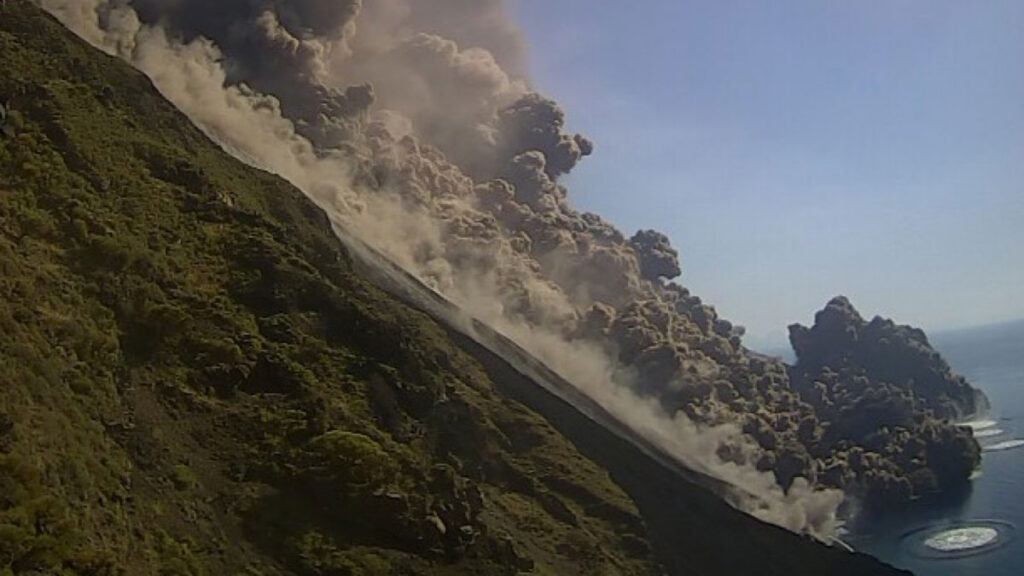
Source: Journal of Geophysical Research: Oceans
Tsunamis triggered by volcanic eruptions are poorly understood because of the complex dynamics governing how falling rocks and ash interact with seawater to generate waves. As a result, it is difficult to anticipate whether a volcanic flow will trigger a tsunami and, if so, how big it will be. Researchers have used laboratory experiments to study this process, but little is known about how well these models mimic reality.
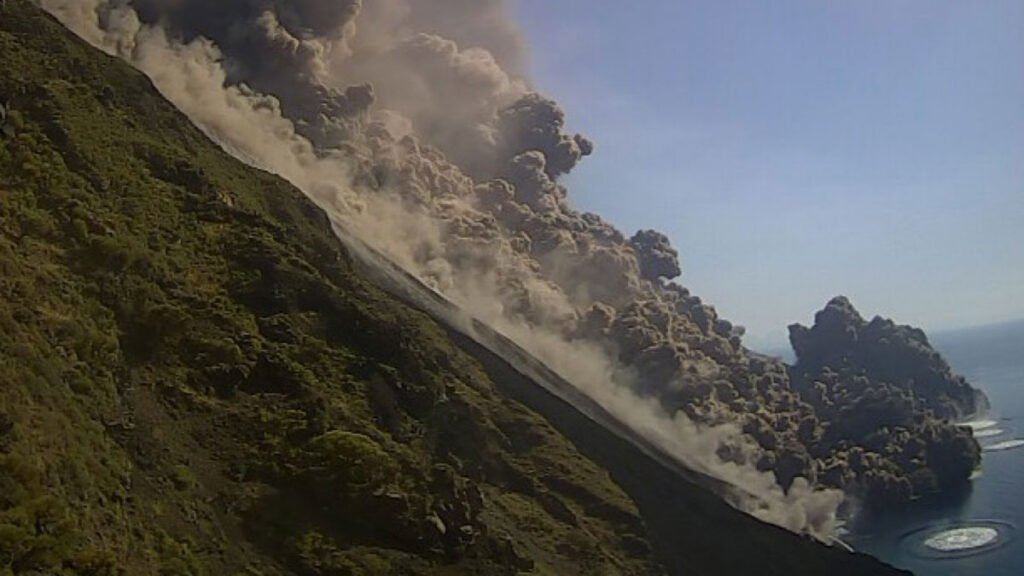
Bougouin et al. addressed these uncertainties by comparing results from lab experiments to observations from a real volcano: Stromboli Island, Italy. Why Stromboli? The volcano erupts nearly constantly, and volcanic flows frequently enter the sea and form tsunamis. These events are recorded by a unique monitoring system made up of land-based cameras and offshore wave gauges—making Stromboli a sort of laboratory in the field. The researchers focused on three Stromboli eruptions that triggered tsunamis between 2019 and 2021, comparing observations from Stromboli with results from both existing and newly conducted laboratory experiments.
In the lab, the team used a 7-meter-long, 20-centimeter-wide channel filled with water. They then released a mass of polystyrene beads (small spheres used in applications such as beanbag filling and product packaging) down a slope designed to replicate Stromboli’s flank, sending the beads tumbling into the water. These lightweight beads were used to represent Stromboli’s pyroclastic flows because the flows were expected to be predominantly less dense than water. Despite their buoyancy, these flows can still generate substantial waves.
The researchers found that lab experiments cannot be directly scaled up to predict real-world events and that most models based on these experiments overestimate the size of tsunamis in the field. The new experiments, however, helped bridge this gap, although some limitations remain. They reproduced key features observed at Stromboli, including a three-wave pattern, and broadly captured the energy transfer from the flow to the resulting wave train.
Researchers conducted the first direct comparison between lab experiments and field observations, providing an initial step toward improving volcanic tsunami hazard assessment. (Journal of Geophysical Research: Oceans, https://doi.org/10.1029/2026JC024008, 2026)
—Saima May Sidik (@saimamay.bsky.social), Science Writer

Citation: Sidik, S. M. (2026), The experiments improving our understanding of volcanic tsunamis, Eos, 107, https://doi.org/10.1029/2026EO260357. Published on 12 November 2026.
Text © 2026. AGU. CC BY-NC-ND 3.0
Except where otherwise noted, images are subject to copyright. Any reuse without express permission from the copyright owner is prohibited.