Editors’ Vox is a blog from AGU’s Publications Department.
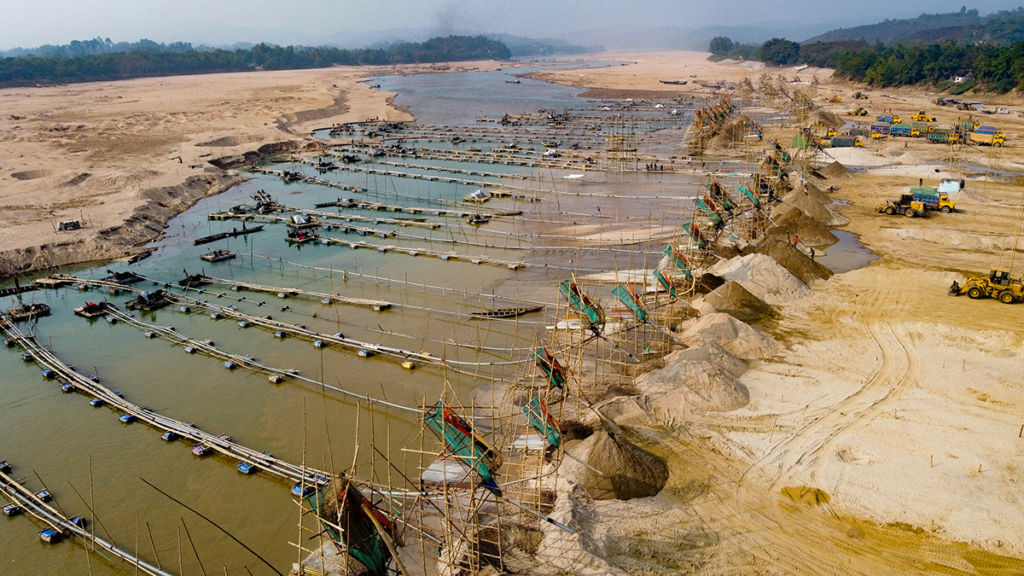
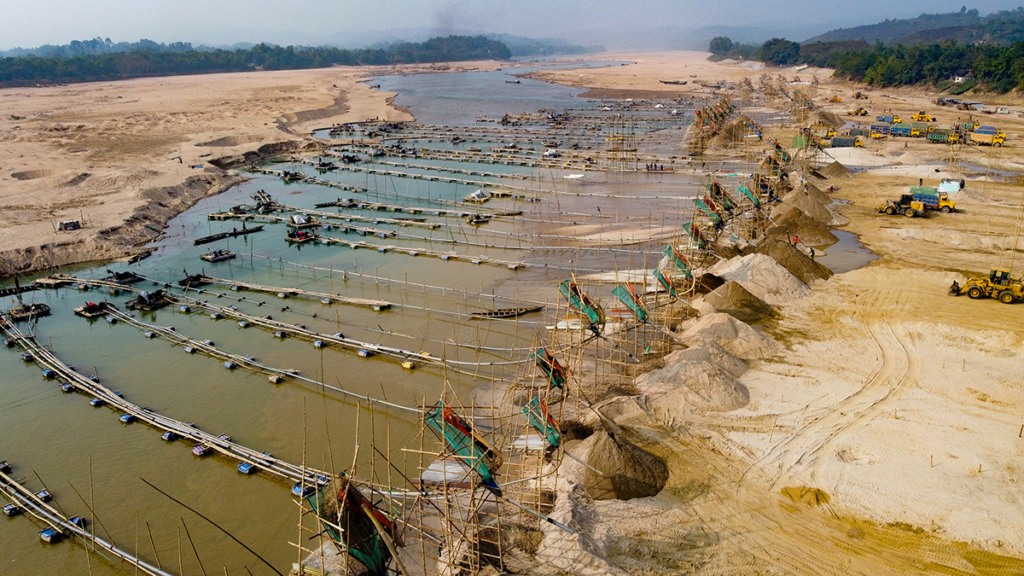
Sand and gravel mined from riverbeds serve as essential raw materials for concrete, asphalt, and other construction materials across the world. But the processes of extracting these critical natural resources have serious environmental and ecological consequences.
A new article in Reviews of Geophysics examines where and how much sand and gravel are mined across the world, and the environmental and societal impacts. Here, we asked the authors to give an overview of sand and gravel mining, the challenges of studying the impacts, and what questions remain.
What are the primary uses of river sand and gravel?
River sand and gravel are the most heavily mined solid materials globally.
River sand and gravel, collectively known as aggregates, are the most heavily mined solid materials globally, serving as the literal backbone of modern urban infrastructure and economic development. Their primary application is in the construction industry, where they constitute over 70% of concrete by volume, alongside applications in asphalt production and building foundations.
River sand is uniquely prized and irreplaceable for concrete manufacturing due to its distinct, naturally weathered properties. Unlike desert sand, which is too fine and rounded, river sand possesses sharp, angular grains that provide the critical granular friction and structural bonding required for robust concrete mixes. Additionally, it is entirely non-saline, making it far superior to marine sand, which contains salts that corrode steel reinforcement structures within buildings and bridges. Beyond concrete and asphalt, massive volumes of river sand are used directly for land reclamation projects to engineer new land space in coastal cities before major building construction begins.
Where are river sand and gravel mined across the world?
Globally, total demand for sand and gravel used in concrete production reached an estimated 28.03 billion tonnes in 2024, spanning at least 65 countries that we identified through our literature review. While sand and gravel mining (SGM) is a global phenomenon, extraction activities and consumption patterns are highly unevenly distributed, with dramatic hotspots concentrated in rapidly developing regions.
Asia stood as the dominant epicentral region for aggregate demand in 2023, consuming an estimated 23.02 billion tonnes annually, driven overwhelmingly by booming urbanization and infrastructure expansion. Within Asia, China is the world’s largest consumer by a wide margin, extracting 6.07 billion tonnes of sand and 8.10 billion tonnes of gravel in a single year to support its construction sector. India ranks as the second highest global consumer, where sand mining is heavily concentrated in peninsular rivers during the dry season and gravel extraction dominates the Himalayan foothills. Vietnam is the third largest consumer globally, with intense, mechanized dredging occurring throughout the Mekong and Red River deltas.
Outside Asia, substantial and rising riverine extraction pressures are documented across Africa, particularly in Egypt, Algeria, and Nigeria, and South America, especially along large tropical systems such as the Paraná and Tocantins rivers in Brazil. Conversely, in Europe and North America, contemporary aggregate extraction has largely shifted away from active riverbeds toward marine sources, floodplain quarries, and crushed rock.
What are the environmental and ecological consequences of SGM?
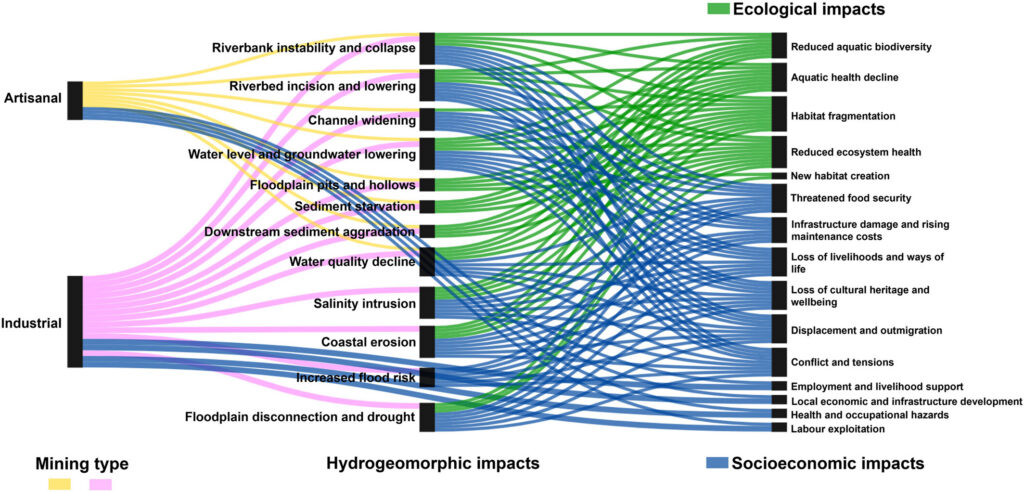
The environmental and ecological consequences of sand and gravel mining are severe, cascading from localized physical disruptions into widespread ecosystem degradation.
The environmental and ecological consequences of sand and gravel mining are severe, cascading from localized physical disruptions into widespread ecosystem degradation. Instream extraction directly excavates the riverbed, creating dredge pits and other erosional features, while the resulting sediment deficit can generate a “hungry water” effect when removal exceeds natural replenishment. This imbalance promotes further riverbed incision, downstream and upstream erosion, and severe bank instability that may induce seasonal riverbank collapse. In deltas, channel deepening can allow seawater wedges to migrate farther inland, resulting in salinity intrusion that damages agricultural land and compromises freshwater security. Furthermore, vertical incision alters surface water–groundwater interactions, lowers adjacent water tables, and may impair alluvial aquifer recharge. Water quality can also deteriorate as heavy machinery and suction dredging resuspend bottom sediments, producing turbidity plumes, reducing dissolved oxygen, and potentially remobilizing sequestered contaminants, heavy metals, and excess agricultural nutrients.
Ecologically, these physical changes cause immediate habitat destruction. Benthic and macroinvertebrate communities may be buried or displaced, while critical spawning grounds for gravel-dependent fish species are removed or degraded. Together, these stressors reduce habitat complexity, alter algal and aquatic communities, and can drive broader biodiversity loss, threatening vulnerable river-dependent species and the long-term structural resilience of major river systems.
Why is it challenging to study the impacts of SGM?
Studying the impacts of SGM is exceptionally challenging due to deep data scarcities, institutional opacity, and the complex biophysical scales of river networks. A primary obstacle is the severe under-reporting and prevalence of illegal mining operations; official government statistics and company reports frequently miss the true scale of extraction, with measured physical volumes often doubling or tripling officially declared numbers. Furthermore, international trade data (like the UN Comtrade database) is plagued by contradictory records between importing and exporting nations, treating sand as a homogeneous commodity while masking its exact geographic origin. Methodologically, much of the intense extraction occurs underwater, hidden from public view. Tracking these changes requires expensive, logistically demanding, and highly technical bathymetric sonar surveys that must be maintained over years to isolate mining signatures from natural seasonal erosion or the impacts of upstream dams. Finally, there is a pronounced spatial-temporal mismatch. The socio-economic demand driving SGM often originates thousands of miles away in urban centers or across international borders, while the geomorphic and ecological impacts propagate dynamically both upstream and downstream, making it difficult to establish clear, direct cause-and-effect chains for policy design.
What is the “Driver-to-Management Pathway” framework?
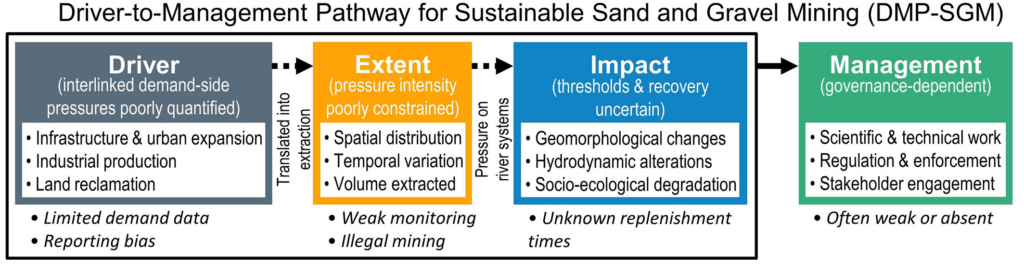
The “Driver-to-Management Pathway for Sustainable Sand and Gravel Mining” (DMP-SGM) framework is a comprehensive, four-stage systemic structure introduced to unify the historically fragmented scientific understanding of global extraction activities. It serves as an analytical bridge linking macro-level economic forces to local biophysical changes and regulatory responses.
The first stage, Drivers, identifies and quantifies the socio-economic and demand-side pressures fueling extraction, such as rapid urbanization, industrial production, and land reclamation. The second stage, Extent, focuses on mapping the precise spatial distribution, temporal variations, and physical magnitudes of sediment removal. The third stage, Impact, systematically examines how these physical extraction footprints alter river systems, tracing the pathways through which hydrogeomorphic changes (such as riverbed incision, turbidity plumes, and bank collapse) cascade into downstream ecological degradation and socio-economic vulnerabilities. The final stage, Management, outlines governance interventions, emphasizing the need to integrate technical work—such as real-time vessel monitoring, numerical modeling, and the mapping of Sustainable Mining Zones (SMZs)—with adaptive top-down regulations, international cross-border policies, and inclusive stakeholder engagement. This framework closes the feedback loop, ensuring policy limits are directly informed by biophysical sediment replenishment rates.
What are some of the remaining knowledge gaps?
Despite an accelerating volume of research, profound knowledge gaps remain where additional scientific efforts are critically needed to guide sustainable resource management. Geographically, research remains heavily clustered around a few high-profile hotspots such as in China and Vietnam, leaving emerging mining fronts across rapidly urbanizing regions of Africa and South America largely undocumented and limiting the global transferability of management strategies. Thematically, the literature is heavily dominated by physical hydrogeomorphic perspectives. Quantitative, empirical studies that measure the direct, long-term impacts of SGM on aquatic biodiversity, food security, human health, and local livelihoods remain rare and are frequently treated as secondary components rather than primary research foci. Mechanistically, the exact thresholds and baseline rates of natural sediment replenishment are poorly constrained for most global rivers, leaving policy makers unable to establish geomorphically sustainable extraction caps.
Furthermore, additional research is urgently required to standardize remote sensing detection algorithms that can accurately track small-scale, artisanal mining operations across diverse geographic regions. Finally, a critical gap exists in understanding the compound, non-linear interactions between SGM and other systemic anthropogeomorphic stressors, such as climate change, relative sea-level rise, land subsidence, and upstream sediment trapping by hydropower dams.
—Edward Park (geo.edpark@gmail.com;  0000-0002-1299-1724), Nanyang Technological University, Singapore; and Christopher Hackney (0000-0001-5390-9136), Newcastle University, United Kingdom
Editor’s Note: It is the policy of AGU Publications to invite the authors of articles published in Reviews of Geophysics to write a summary for Eos Editors’ Vox.
Citation: Park, E., and C. Hackney (2026), The hidden costs of mining river sand, Eos, 107, https://doi.org/10.1029/2026EO265027. Published on 27 July 2026.
This article does not represent the opinion of AGU, Eos, or any of its affiliates. It is solely the opinion of the author(s).
Text © 2026. The authors. CC BY-NC-ND 3.0
Except where otherwise noted, images are subject to copyright. Any reuse without express permission from the copyright owner is prohibited.