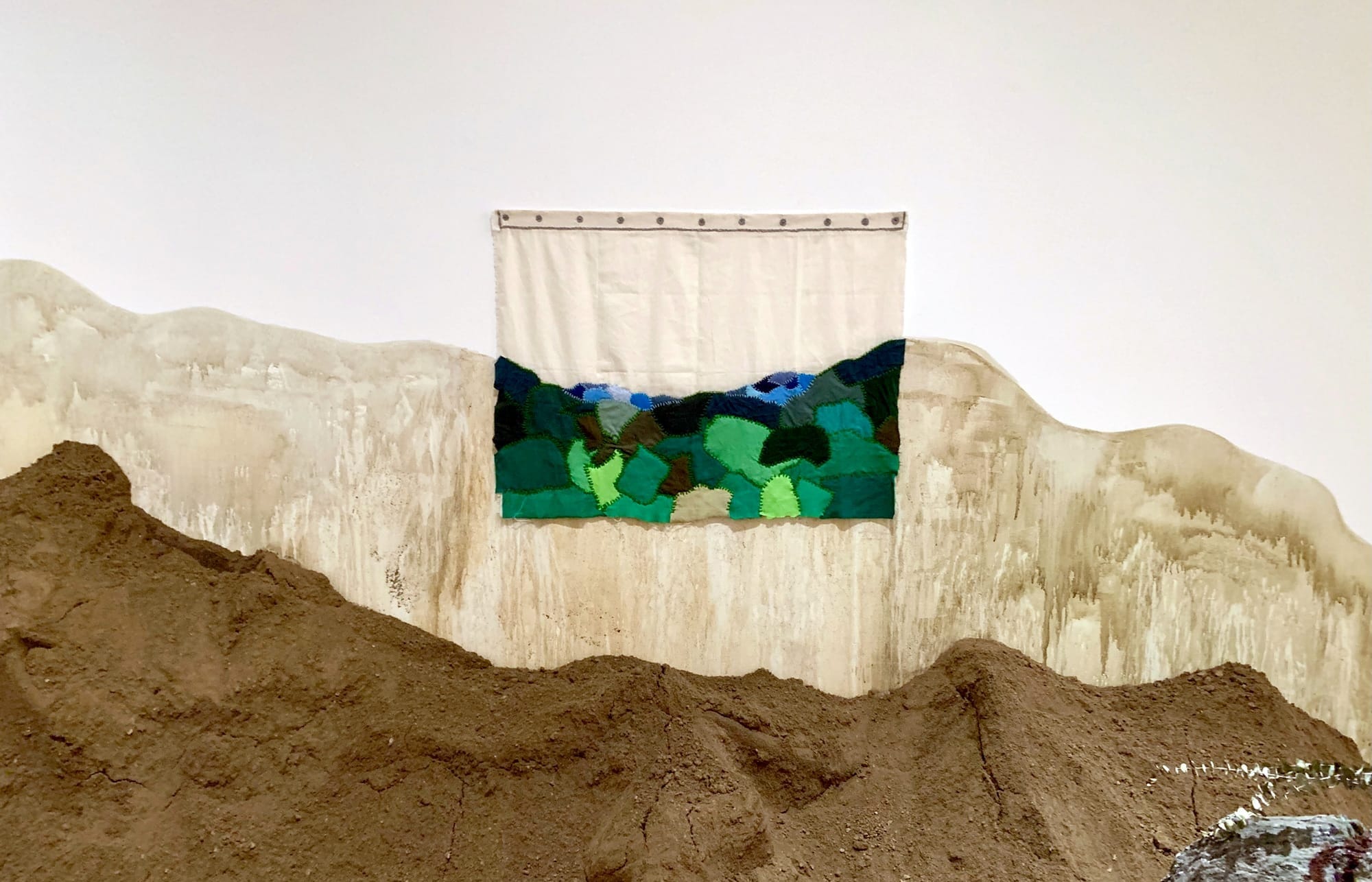
LOS ANGELES — The rumbling in a small foyer in the Hammer Museum gave me pause before I entered a gallery where eight boulders hunkered amidst piles of soil. I couldn’t help but look up at the rattling of track lights overhead. Was this my first California earthquake of the millennium?
Somewhat reassuringly, nearby wall text explained that Raven Chacon’s sound piece “Study for Vertical Earth” (2026) had translocated underground audio recordings to animate the constructed space of the galleries. This unsettling beginning for the exhibition Several Eternities in a Day: Form in the Age of Living Materials induces a sense of immersion in a specific place, in contrast to the dozens of standalone, mostly visual pieces of sculpture and painting. Accompanying signage provides reminders of the not-always-visible spirits which, like the vibrations of Chacon’s audio interventions, inhabit the world around us. This connection to such animated spirits through living forms is one primary principle underlying the show.
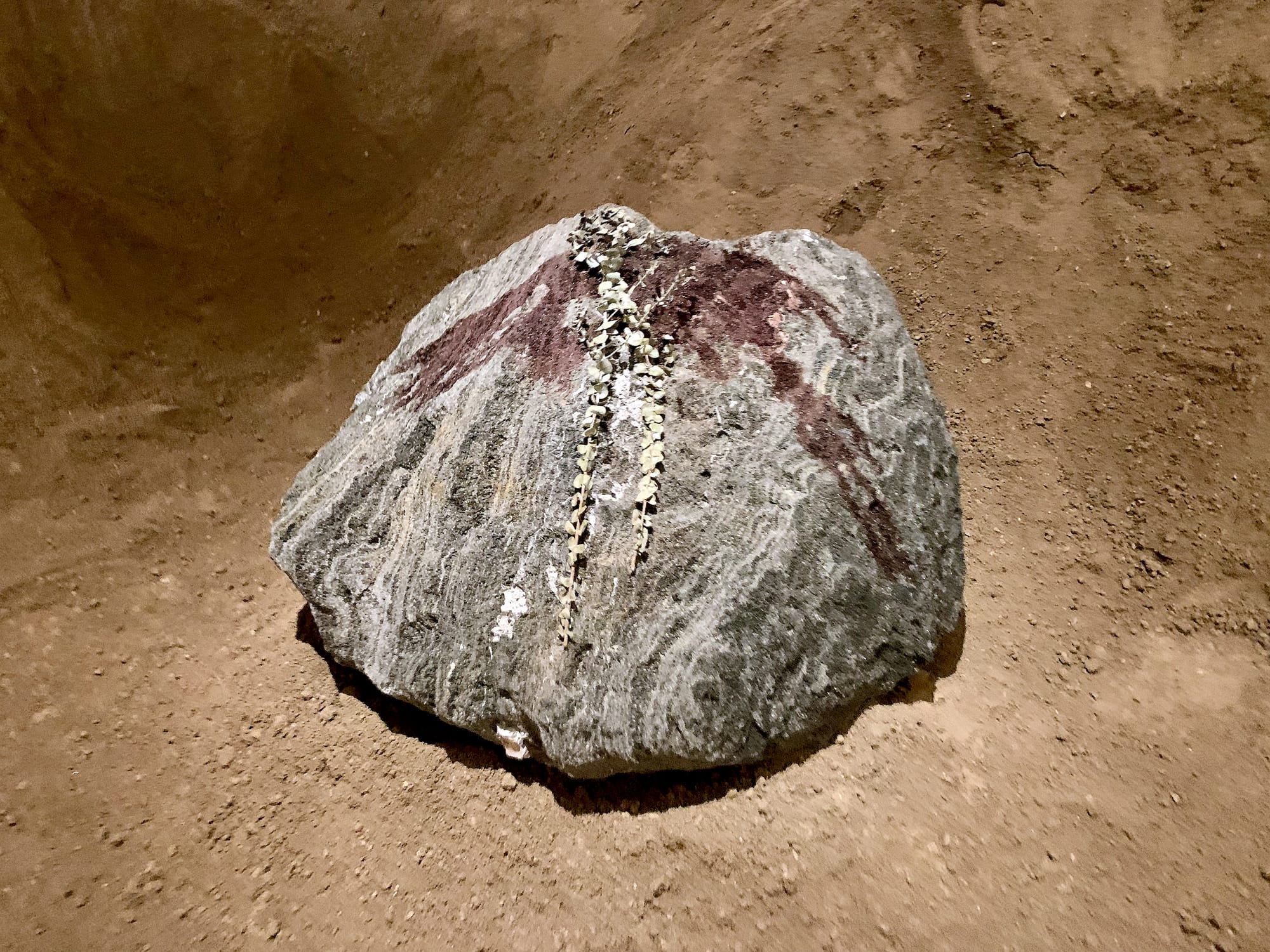
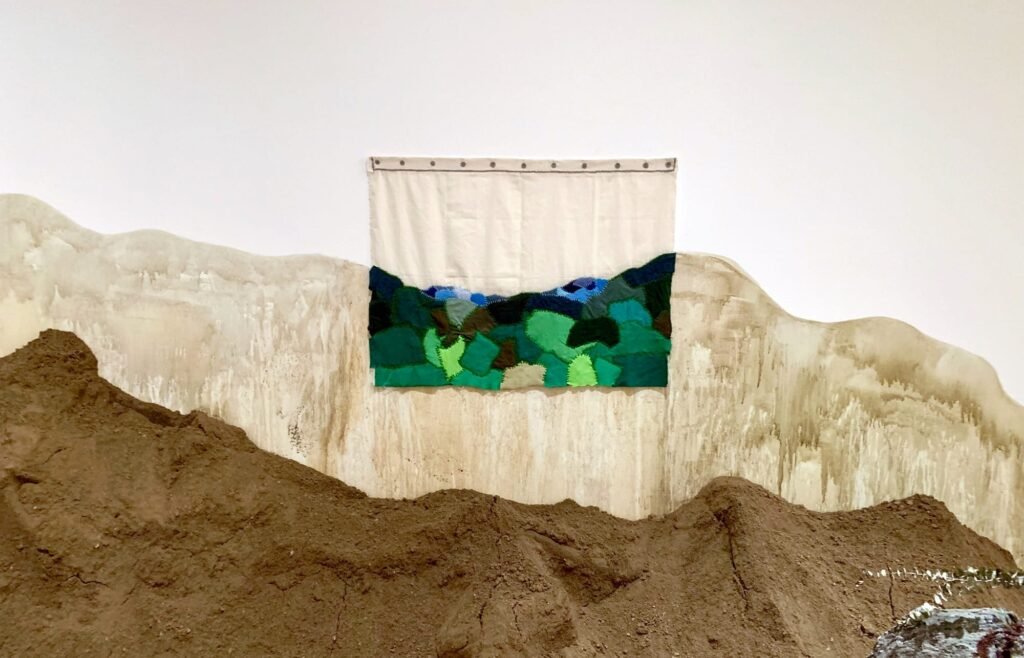
But while a worthy notion, that concept of connection to other realms through living material remains faintly realized across the larger exhibition, with only traces of formerly alive elements making their presence known in low-key, undynamic ways. Those aforementioned boulders anchoring Edgar Calel’s installation “Splashes of my desire on top of stones” (2026), for example, are adorned with bits of blood and herbs, teasing at the show’s conceit. But in that work, as in most cases across the exhibition, the presence of such living materials needs to be stated in wall texts in order to be recognized.
Several Eternities does offer hints of cultural orientations toward spiritual and ecological values that modern urban culture has largely let fall by the wayside. This is a great shift of perspectival self-awareness for the Hammer, which is a prime example of infrastructure prioritizing capital. That can be seen in both the museum’s building itself — which was originally shared by the headquarters of the Occidental Petroleum Corporation, whose CEO founded and lent his name to the Hammer — and the especially dense surrounding sprawl of gasoline-fueled roadways for which Los Angeles is known.
But the exhibition overall doesn’t supply the strongest antidote to either the Hammer’s roots or LA’s hyper-developed milieu. Given that most of the cultural references are specific to other, distant locales, their accumulation risks evoking a miniature World’s Exposition. Taken out of context, such representations threaten to become large-scale postcards or tchotchkes from thinly exoticized people, places, and ideas.
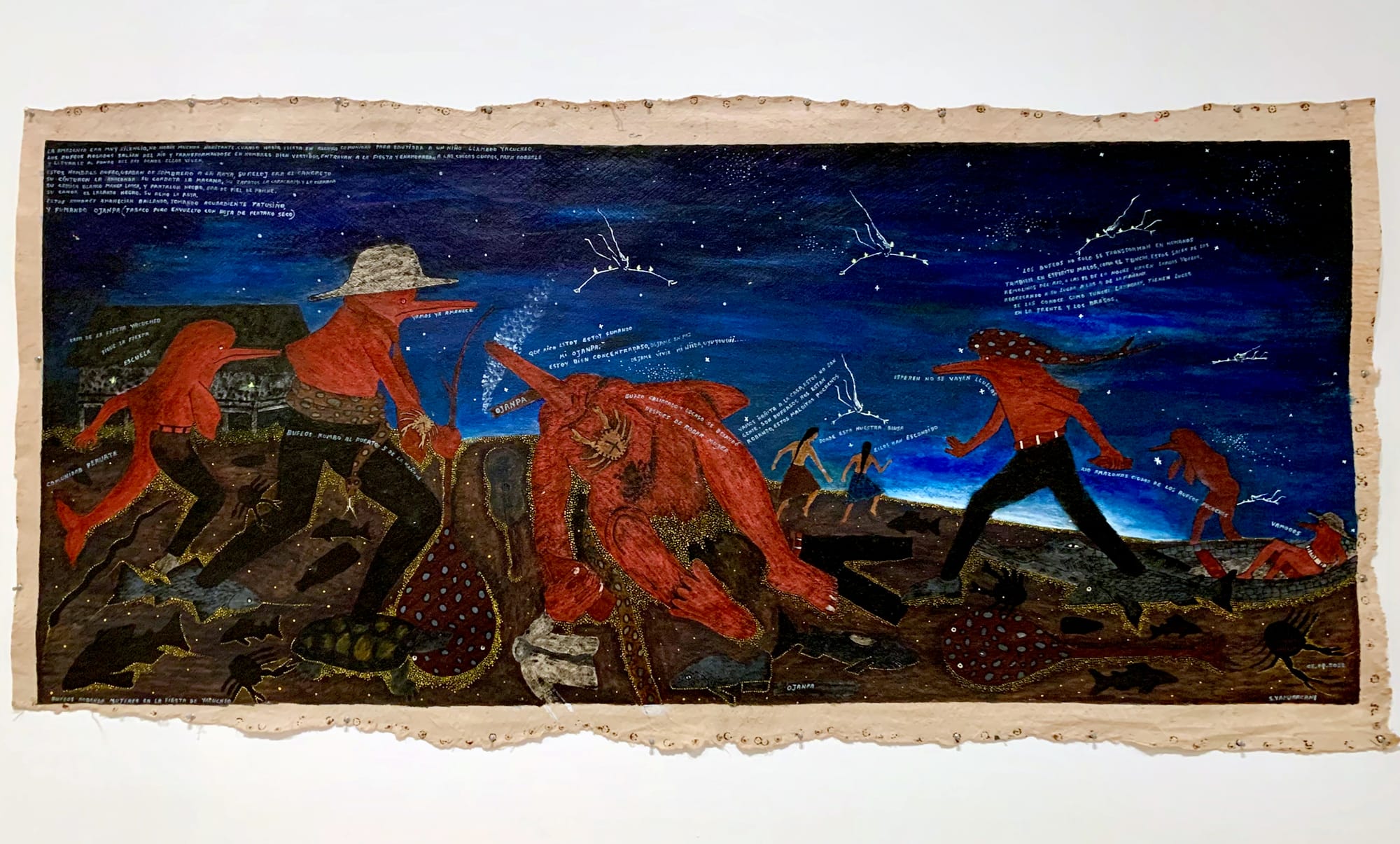
There is some potency in the representations themselves. Among the more visually assertive works is Santiago Yahuarcani’s “Bufeos stealing women at the Yacuche festival” (2022), which stands out with its saturated colors and images of large humanoid dolphin kidnappers stalking the earth. The work, however, also relies on reams of text within the painting, an instance of telling as much as showing, the wordy narration undermining faith in the images themselves.
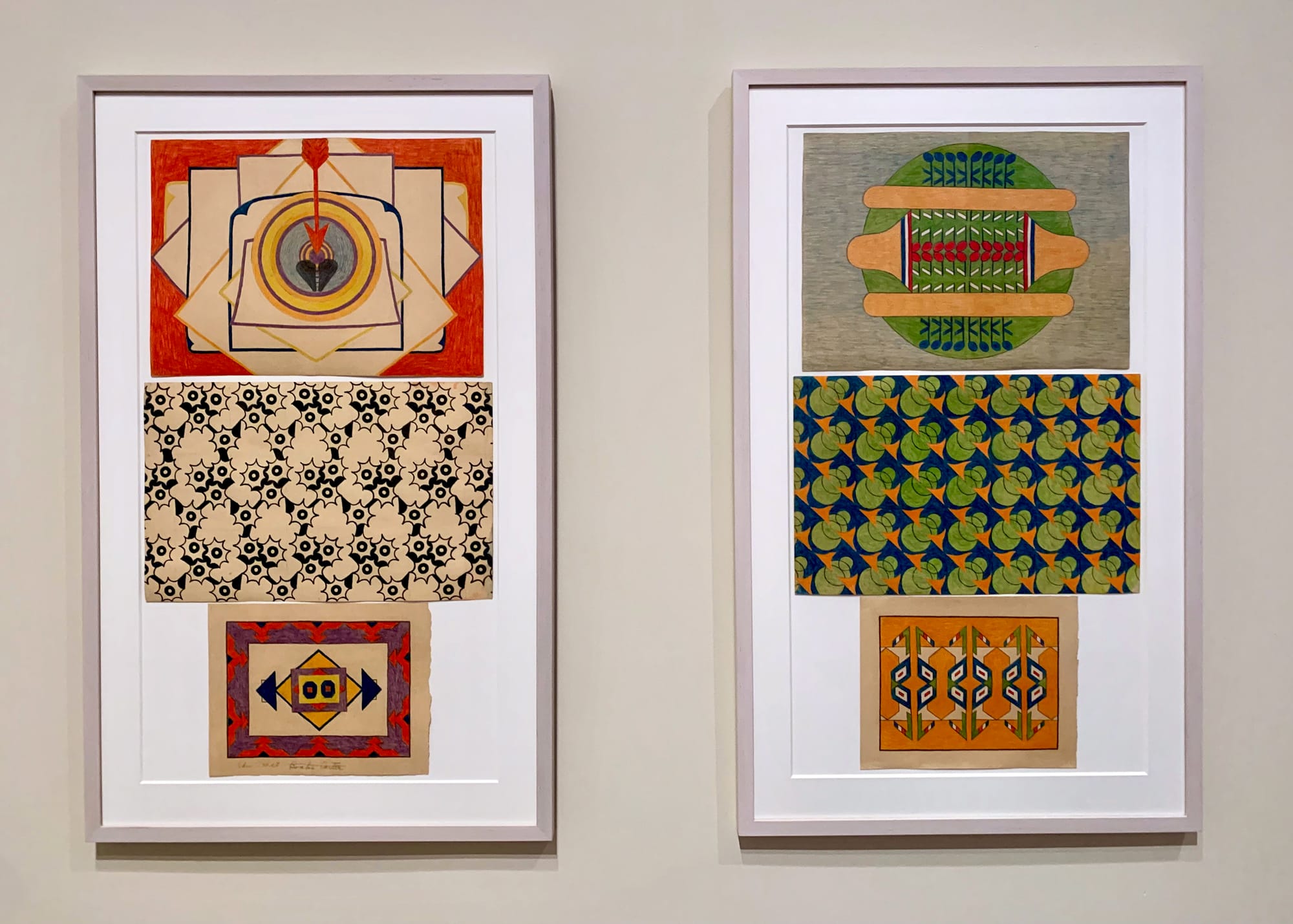
Installation view of two works by Mary Sully
There are also some odd inclusions. Mary Sully’s “John Philip Sousa” (1927–45) and “Edwin P. Hill” (1938) are a delightful pair of idiosyncratically composed images, deftly integrating aspects of insistent 20th-century European-American culture with aspects of her Yankton Dakota background. But while it’s worthwhile to read about the artist herself, the relationship of the works to the exhibition’s stated themes is less clear, with a single, wan reference to Sully’s painted geometries as representing “Sioux parfleches – decorative storage boxes made from painted animal hide.”
Many recent works come to mind that could have more fully advanced the show’s themes — for instance, the living dynamism of Ana María Davis’s “From One Life Into Another” (2025), featuring a human bed on which bacteria were cultivated, or Cecilia Vicuña’s highly engaging participatory performances, both of which have less contained outcomes than the majority of works in this show.
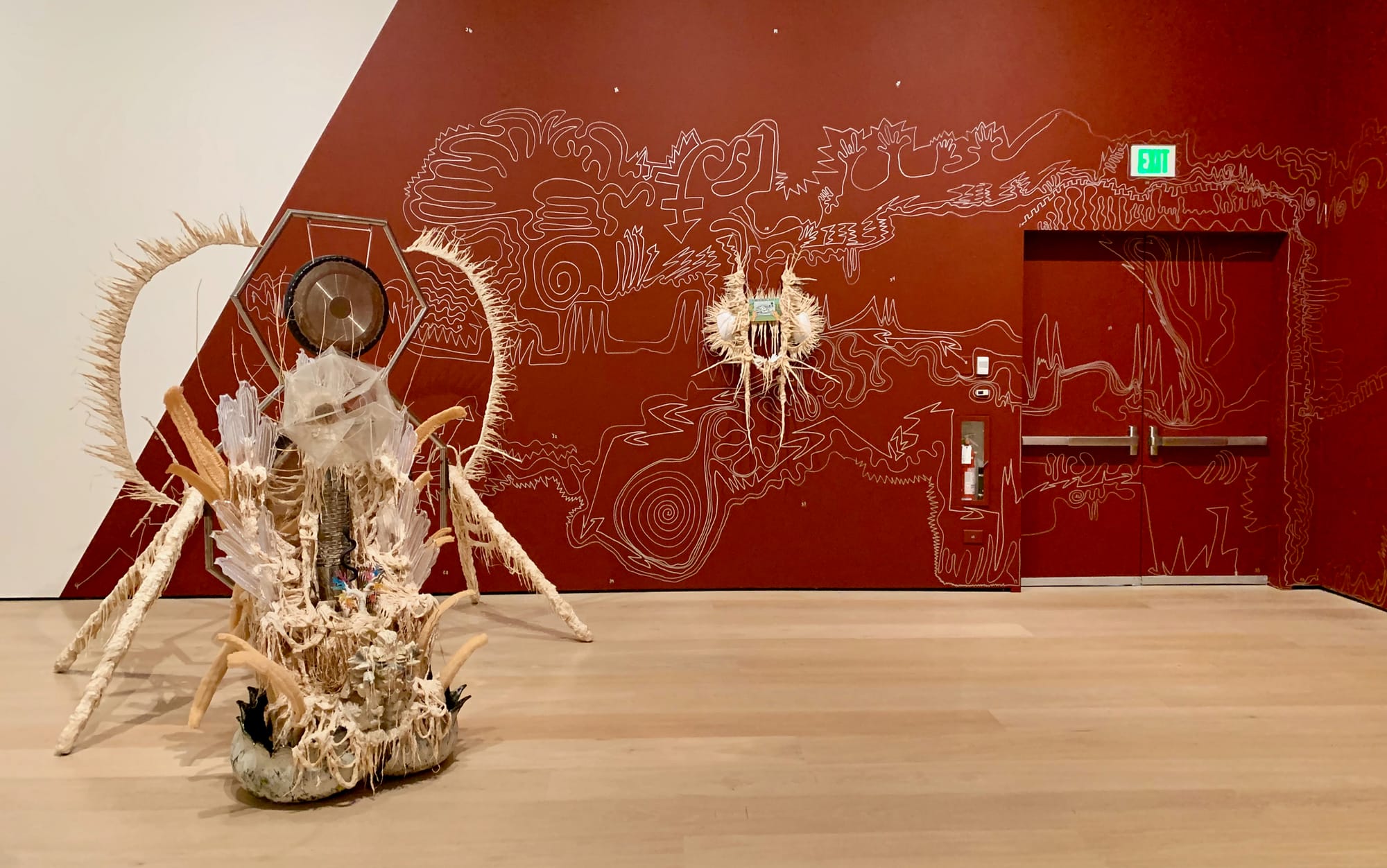
Several Eternities’s lack of uncertainty or “messiness” makes it feel careful and unable to combust as fully as it could have. Exhibition-related programs would’ve provided greater sensorial, social, and spiritual shifts if led by creative guides outside the galleries. To be fair, an obliging gallery attendant confirmed when I asked that a sound-healing event, performed with the aid of Guadalupe Maravilla’s formidable 2024 “Retablo” sculpture, brought people together, generating a shared feeling of transformation. This occurred, however, on a covered museum terrace, foregoing more ambitious expeditions to engage with living and spiritual forms beyond the museum. Even amidst the dearth of nature in the museum’s environs, two cemeteries and the University of California, Los Angeles’s botanic gardens are within an easy walk, proffering potential outdoor staging grounds for interactions in and with the living world.
The exhibition’s proposition that artists “collaborate with living materials as equals rather than as dormant mediums” is laudable and interesting. But the works themselves, rather than “embrac[ing] unpredictability,” felt ultimately static and inconsequential. The physical residues and socio-spiritual outcomes of their manipulations offer potential for contemplation, but don’t readily translate into significant challenges to dominant institutions in the built world, like the Hammer itself. Coming out of the galleries, we mostly return to the private vehicles that brought us here. The spiritual may be happening somewhere, but it only echoes dimly inside the museum.
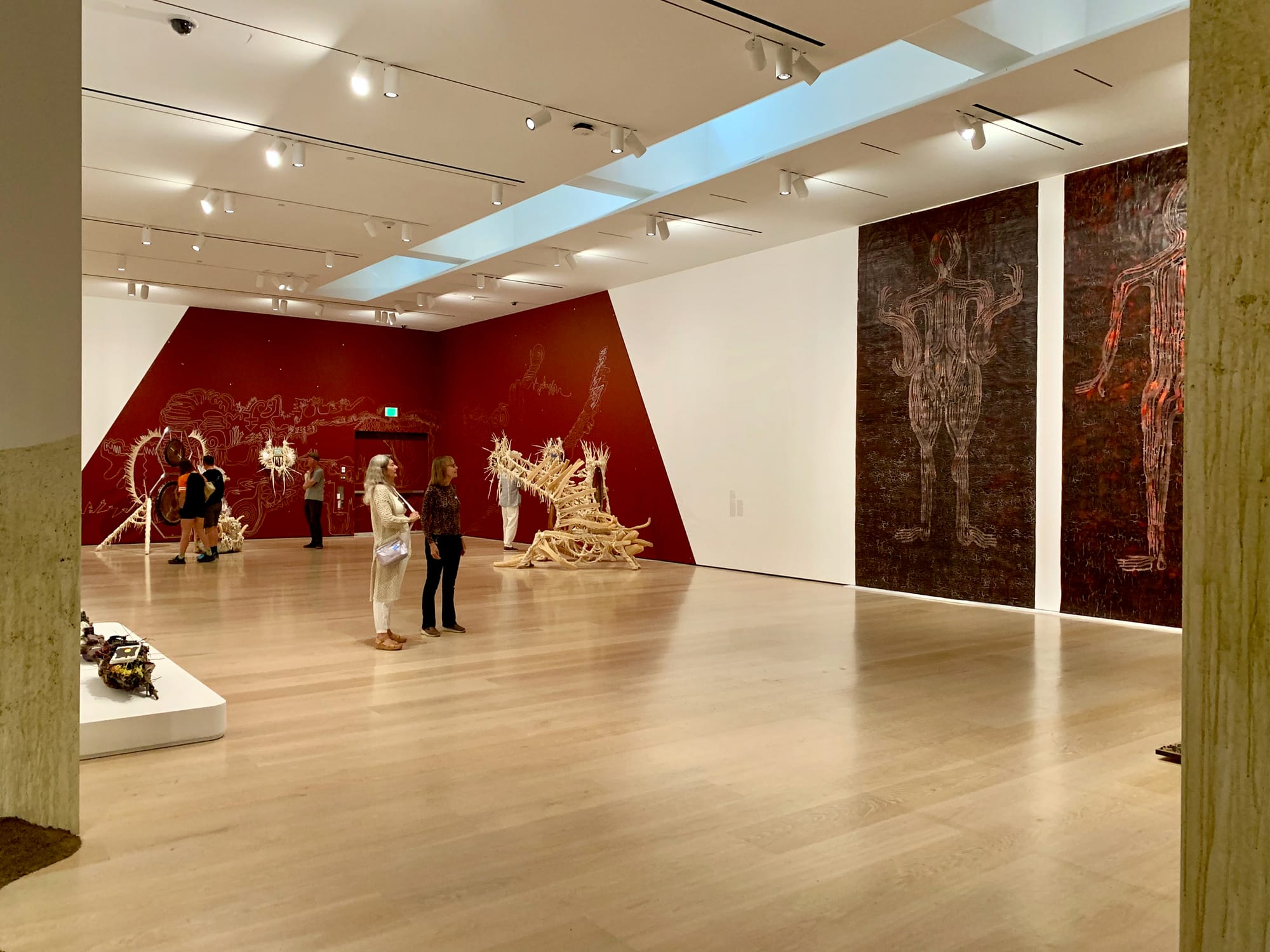
Several Eternities in a Day: Form in the Age of Living Materials continues at the Hammer Museum through August 23. The exhibition was curated by Pablo José Ramírez with Jessi DiTillio.