The imposing granite tower of the new Obama Presidential Center that’s risen from a public park on Chicago’s South Side is, depending on one’s aesthetic and political views, either jarring or monumental. But for all the hand-wringing that has come and will follow about the $850 million tower, it’s not the most important, or even the most interesting, thing about the project.
In addition to being a significant piece of architecture representing the work and legacy of a president, the Obama Presidential Center is also one of the more environmentally ambitious large urban development projects to emerge in the U.S. in recent years.
From the microorganisms at the roots of its trees to its carbon-free operation to the citywide benefits of its stormwater management system, the Center is performing on a lot of different levels. When it opens to the public June 19, the Center will generate more power than it uses, balance its heating and cooling through an underground network of geothermal wells, reuse or recycle nearly all of the rainwater that falls on it, and blend most of its built footprint so thoroughly into its site in Jackson Park that it will actually create a net increase of parkland.
For all the pieces of the project that make it unique—the signature obelisk-shaped tower at its core, its location in a public park on Chicago’s South Side, and the decision by former President Barack Obama and his foundation to eschew the conventional presidential library model—its most impressive aspect may be its deep focus on sustainability.
The sustainability measures put in place at the Center and across its 19-acre campus are, in a way, a representation of Obama’s presidency. Improving the environment and combating climate change were key elements of his agenda, and the Center is a built extension of what he sought to achieve while in office, according to Valerie Jarrett, a longtime senior adviser to Obama and now the CEO of the Obama Foundation, the developer of the Center.
“We’re maximizing the opportunity to showcase how you can do a large-scale development with a deep appreciation for sustainability, prioritizing it not as an afterthought but as central to our mission,” Jarrett says. “Our expectation is that this will be a template for others to follow.”
It was a given that the Obama Presidential Center would be a “green” building, but the foundation was looking far beyond earning a certification or slapping a plaque on the wall.
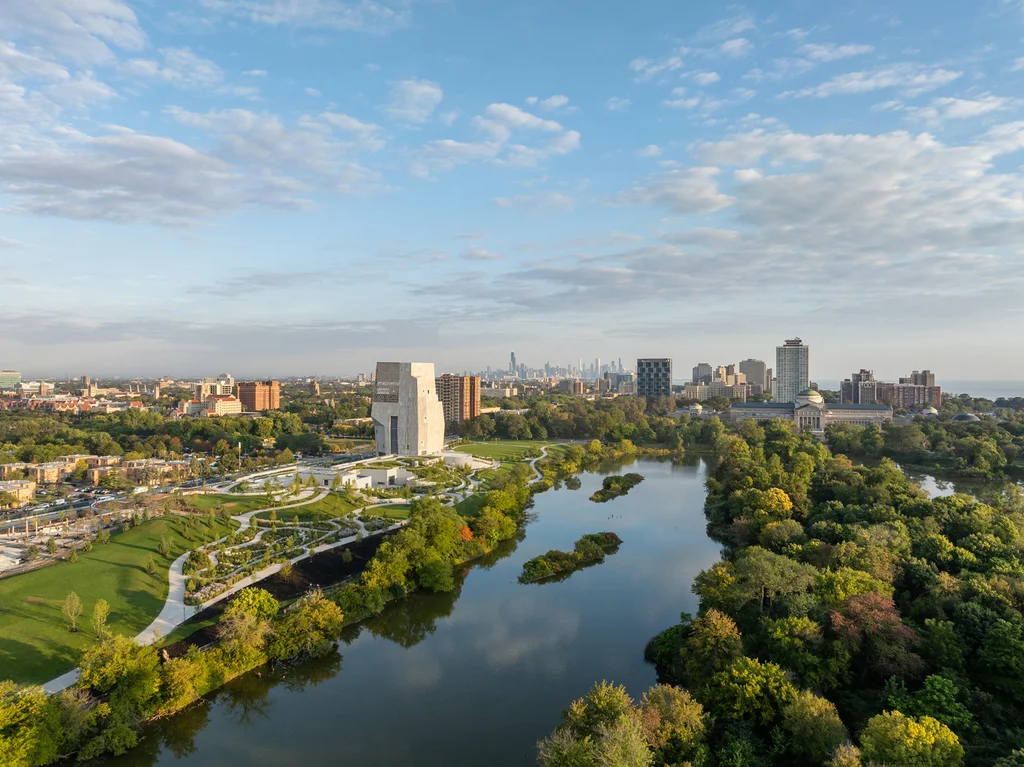
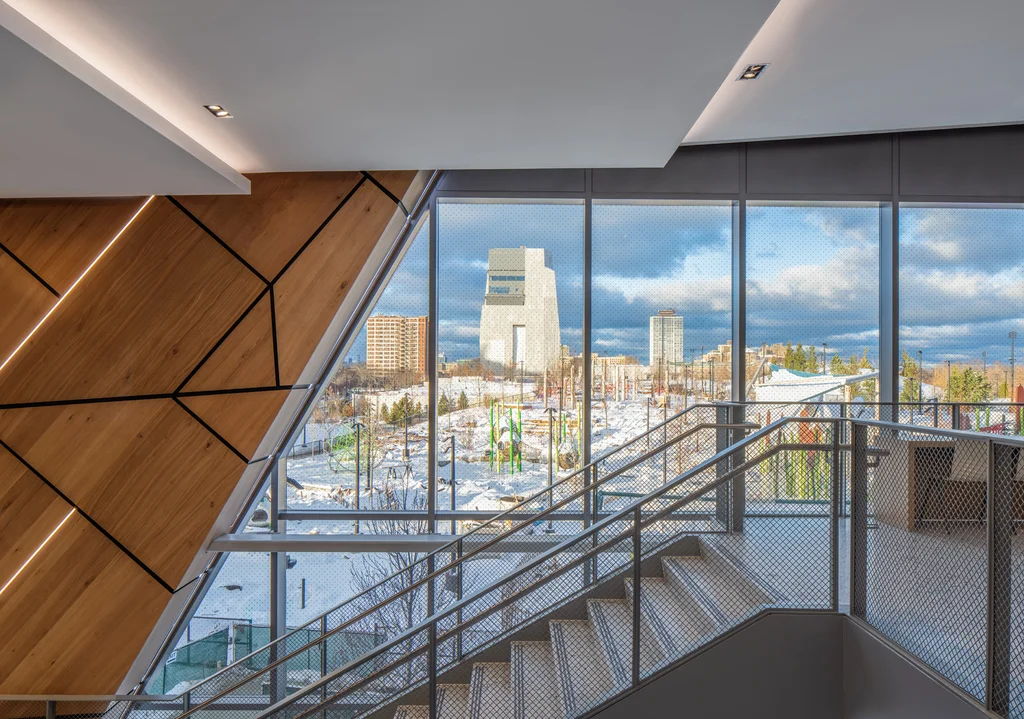
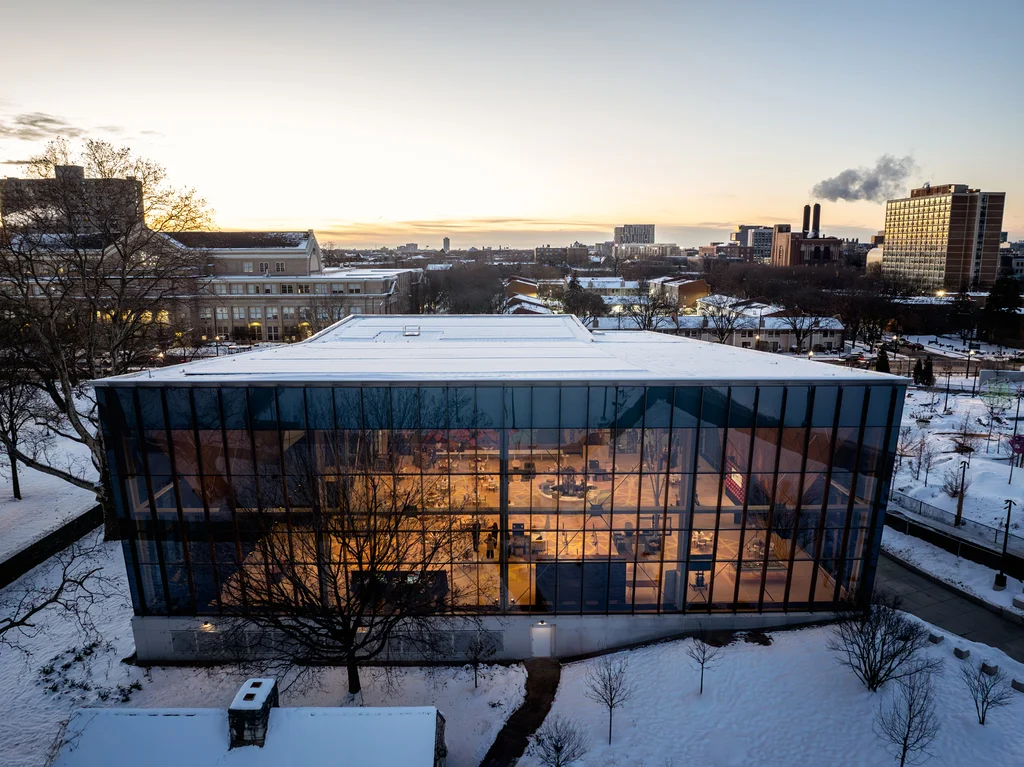
Designed by Tod Williams Billie Tsien Architects (TWBTA), the project’s most visible element is its 225-foot tower, which houses the four-story Obama Presidential Museum and a Sky Room observatory on the top floor. Through an underground base level, the tower connects to an events space called the forum and a branch of the Chicago Public Library. A separate community center and gymnasium, designed by the architecture firm Moody Nolan, sits farther afield.
The all-electric campus spreads across four buildings covering 276,000 square feet (6.3 acres), and it sits atop a campus-wide geothermal heat pump system that uses the constant temperature of the earth to regulate its heating and cooling. On a day-to-day basis, even in Chicago’s cold winters and humid summers, the Center will operate without any fossil fuels.
The tower is a rare large building in this region that’s able to operate using just electricity, but its aesthetics are divisive. It’s a gray granite chunk of a building that’s been carved like an imperfect gem. Some have taken to calling it the “Obamalisk” for the blocky outline that gradually tapers out as it rises to its mid-point, then gently leans back in.
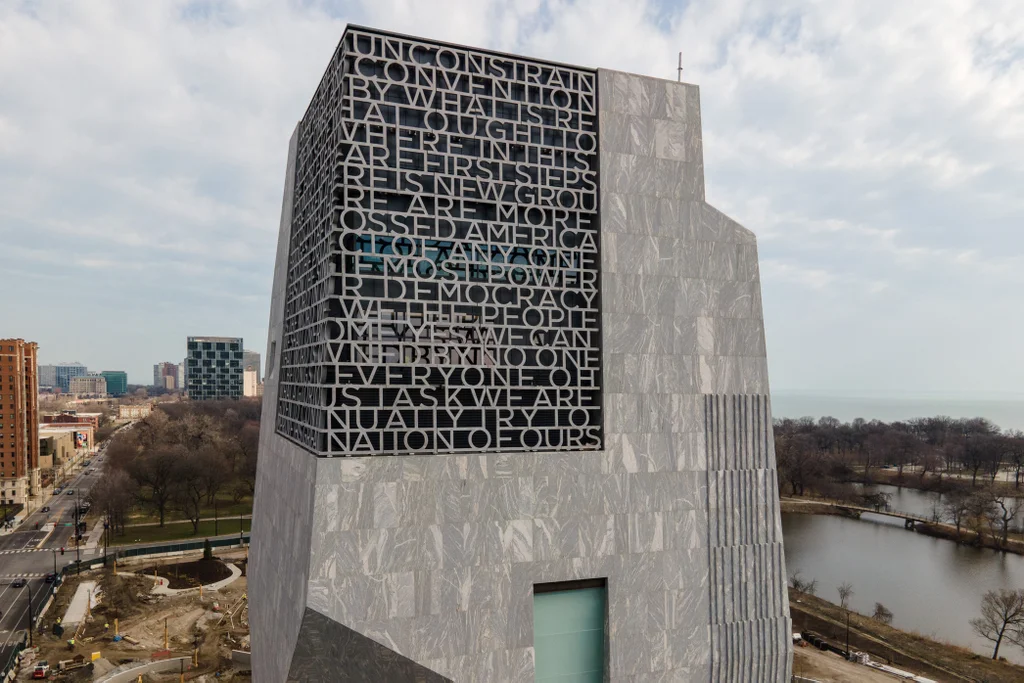
At the top, one corner is wrapped with a load-bearing screen of text from an Obama speech delivered on the 50th anniversary of the marches from Selma to Montgomery, Alabama. From some angles the tower resembles a molar that’s slightly exposed at the gum, grit-worn and chipped.
Obama, with the prerogative of someone who was both the client and a president, offered the architects some sketches during the design process. “Very, very few,” Tod Williams says, not seeing it as an overreach. “But for sure he was deeply involved in it and pushed us to always think on what was there in front of us.”

Mostly that meant the site itself, Jackson Park. The nearly 600-acre park was designed by the venerable 19th century landscape architecture firm Olmsted, Vaux & Co. in 1871 right on the lagoon-filled edge of Lake Michigan. The park had slowly degraded over time, suffering from regular flooding. Nonetheless, the decision to use part of this public space for the foundation’s project rankled many in Chicago.
The architects tried to soften the blow by putting the two tower-adjacent buildings and the entire parking garage underground, their sunken walls only showing themselves in cleanly sliced courtyards on the lakeside of the project. For anyone coming into the park from the neighborhood and looking out to the lake, the view is only slightly changed from what it once was.
“It was really important to create porosity from one side to the other, but then also to use as little parkland as possible for the buildings,” says Paul Schulhof, a longtime partner at TWBTA who left the firm in 2023.
A center, not a library
TWBTA interviewed for the project at the White House during the tail end of Obama’s second term. The Obama Foundation had just been formed in 2014, and ideas were still evolving for what the project could be. There was a time when the Obama Presidential Center was going to follow the established, if relatively new, model of the presidential library as a building set up mostly to house the physical paperwork of presidential administrations for posterity and future scholarship.
Under the guidelines of the National Archives and Records Administration (NARA), the site was going to include a fortified and secured research library where millions upon millions of paper documents would be held and made accessible upon formal request. But in the waning and very online years of the Obama presidency, a vault full of filing cabinets was being seen by many as archaic.
The format of a president’s “papers” had drastically changed since the Presidential Records Act of 1978 made the ownership of those documents public rather than private. With so much of the record in digital form, the thinking went, why not digitize the whole collection and make it available online instead of in real life?
(On top of this, the Obama Foundation was facing endowment requirements established by the Presidential Libraries Act of 1986, a law amended in 2008 to bump the foundation’s responsibility from 40% to 60% of the cost of building the NARA facility, its operations, and its ongoing maintenance.)
Facing the prospect of so much of the project’s budget going to build a limited access paper vault on what is still the public space of a large urban park, the Obama Foundation pivoted, opting for a more open, public-facing facility. Instead of becoming a cloistered presidential “library,” the project essentially ditched the library and became a presidential center.
A cohesive system
Williams, the architect, says the idea to make the project not just a single building but a campus came early on. “As a campus, it’s like the space between two people, it’s the energy that occurs for a dialogue between people,” he says. “We felt that would bring forward the idea of the landscape being a critical part of the project and the process.”
This was partly an effort to reduce the impact on the park itself. “We wanted the park to flow through and around the structures, not just land a large object in the park and the park would be around it,” says Rourke Frankel, director of planning and delivery for the Obama Foundation.
The integration of building and landscape also had sustainability implications—and new potential. Once the Williams-Tsien firm was selected to design the project, the architects worked closely with the landscape architecture firm Michael Van Valkenburgh Associates (MVVA) to weave the buildings and the landscape into a cohesive system that limits resource use and engages natural systems to enhance the park.
All the stormwater that falls on the site is redirected away from the city’s combined stormwater-sewer system, reducing the risk of flooding in the park and in surrounding neighborhoods during heavy rainfall. Much of the water is infiltrated back into the landscaping that surrounds the buildings and takes up much of its 19-acre site.
The site also collects some of this water for reuse in irrigation and for flushing toilets within the campus. The Obama Foundation estimates these efforts will result in an 89% reduction in building water use, a 75% reduction in irrigation demand, and more than 1 million gallons of potable water saved annually.
Matthew Bird, a principal at MVVA, says the interweaving of native plantings, three miles of walking trails, and the buildings of the Center is intended to bring people face to face with the natural systems at work on the site. “The goals of sustainability aren’t just about making the building function a little better. It’s also teaching people and making them see how they can contribute to combating climate change and taking small steps to make our environment better,” he says.
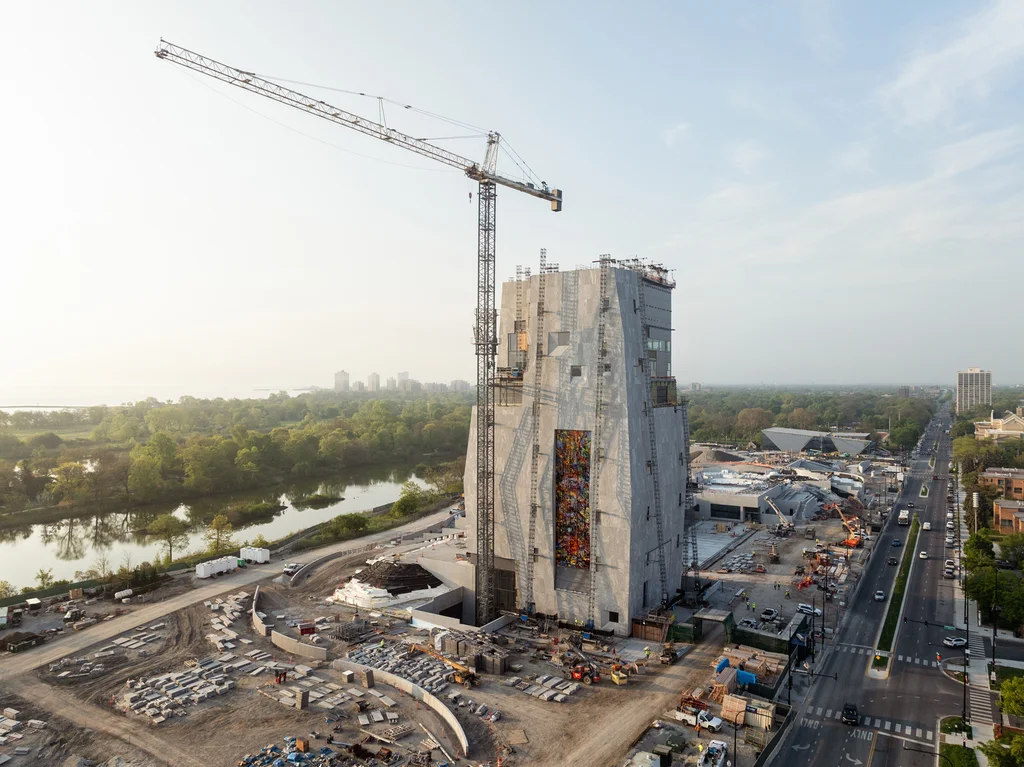
Some parts of this approach are more obvious than others. The project’s site was chosen to sit on top of Cornell Road, a six-lane street that sliced this section of Jackson Park. A large section of that road was removed, its car traffic rerouted out of the park, and the six lanes partly replaced by a bike trail and walking path. This had the benefit of adding more acreage to the park than the Center displaced.
The landscaped roofs of the underground portions of the Center add more space, while also demonstrating the possibilities of rethinking how a building should sit on the land. Water in a reed-lined wetland on the edge of the nearby lagoon rises and falls as rains come and seasons change.
Less visibly, the landscape architects also took pains to preserve the native soil microbiology of the park. Before trees were removed to make room for the construction site, the landscape architects worked with an ecologist and a mycologist to analyze the soil around trees at the park and preserve the most biodiverse parts of it. Years later, when the site was planted with 1,000 new trees—more than double the amount that were removed—that same carefully preserved soil was reintroduced.
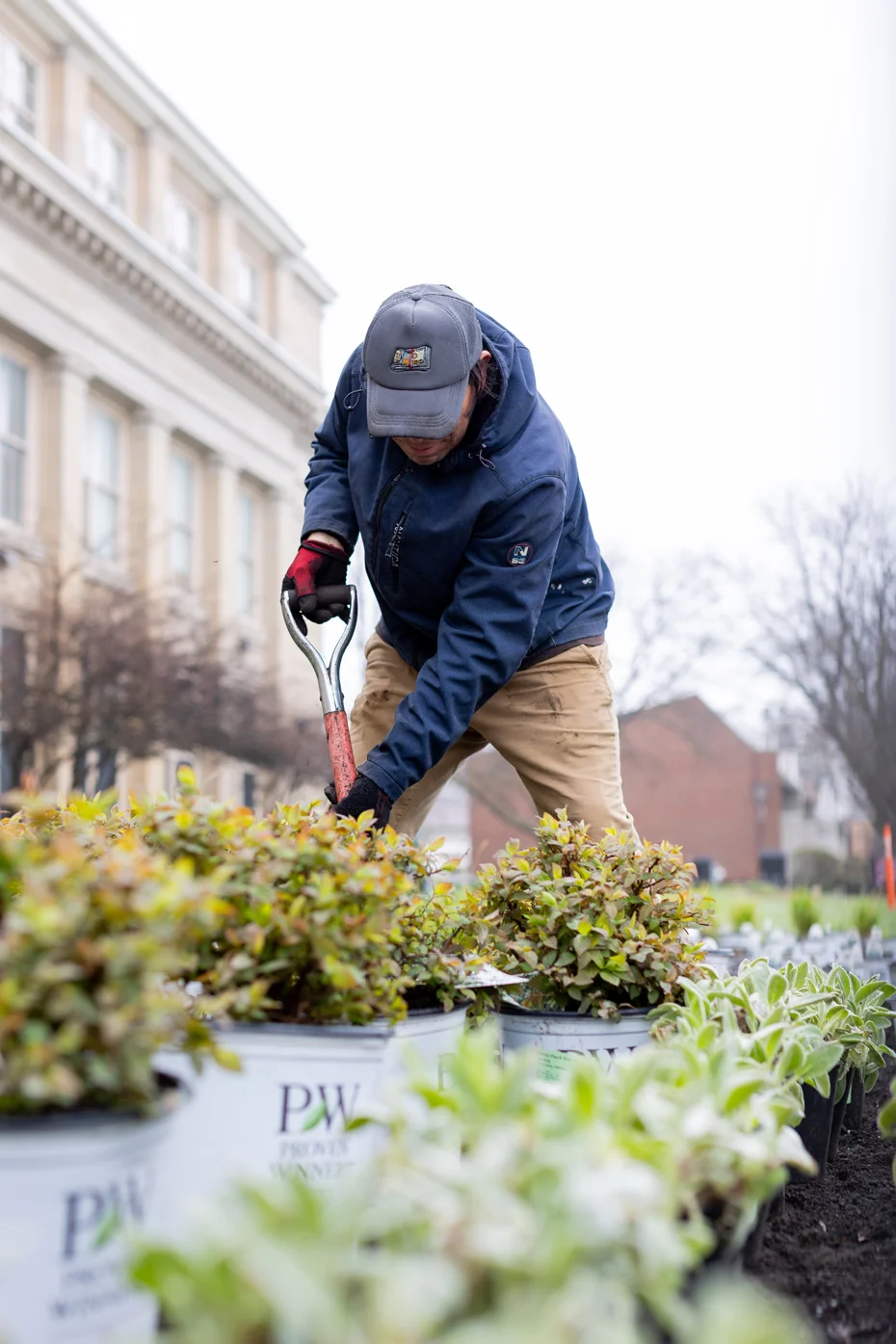
“We were able to cultivate those in a way that would keep the microorganisms present and have them be a part of the future of the campus,” says Bird at MVVA. “It’s keeping the heritage of the ecology of the site alive.”
Compared with other major urban developments, the Obama Presidential Center has taken an unusually holistic approach to its design, and let its environmental ambitions carry much more influence than in a typical market-driven project. “It can be really seen as one system that works together and is deeply integrated with the surrounding park,” says Nico Kienzl, senior executive director of the environmental design firm Atelier Ten, which worked with the rest of the design team to integrate sustainability measures throughout the project.
Jarrett, the Obama Foundation CEO, says the sustainability side of the Center is one of its most powerful messages to the community, the city, and the country. She says the positive benefit to the immediate neighborhood, whether measured in reduced flooding or increased parkland or broader economic benefits, should outweigh some of the concerns people had when the project was announced.
“People loved what they had and there were folks who really wanted to leave it in its original state. And we spent a lot of time meeting with folks, explaining how this would actually be better for those who cared about the environment and sustainability,” she says. “And I think judging from the reaction that we’re seeing, we’ve achieved our goal.”
The real reactions are still to come, after the Obama Presidential Center fully opens to the public June 19. By its nature, and the nation’s current political climate, the center will be a divisive space. But for those willing to look beyond the politics, they’ll see an ambitious project that’s working hard on multiple fronts to have a positive impact on the environment.