On December 17, 2025, Coursera and Udemy announced a “merger.” Management framed it as an opportunity driven by AI. I think it’s desperation.
It certainly feels rushed. Coursera’s CEO had been on the job for roughly 11 months; Udemy’s for just nine. Even if discussions started three months ago, that implies Udemy’s CEO was looking for a buyer only six months into the role.
The market seems to share the skepticism. When the merger was announced, the combined company was valued at $2.5 billion. But Coursera’s stock has slid since then, dragging that total down to ~$1.8 billion.
To understand how low that is, think back to 2021. 2U paid $800 million in cash for edX, a money-losing nonprofit with a fraction of the revenue Coursera and Udemy have today.
It has reached the point where Axim Collaborative, the nonprofit sitting on the cash from the edX sale, could technically buy Udemy today with just the money in its bank account. And remember, Udemy generates significantly more revenue than edX ever did.
I started Class Central as a side project in 2011, around the same era as these companies. I’ve watched players enter, grow, shrink, and disappear. Class Central has managed to check off three of those boxes.
But Coursera and Udemy are the last two giants standing. And now they are combining. This feels like the series finale of online education.
Instead of jumping in with a hot take, I spent weeks… well, procrastinating. The news broke in December, and I only finally started writing this last week.
But the research is real. I track earnings calls, SEC filings, and Class Central’s data whether I’m writing or not. This analysis is years in the making, similar to my analysis of 2U’s acquisition of edX, which I believe has stood the test of time.
This is a long one. I cover the content vs. credentials divide, the financial engineering, Coursera’s silent pivot, what both companies pay their instructors, the AI they’re manifesting, and why this merger is really the end of an era.
What’s inside:
- How We Got Here, Part 1: Strong Businesses, Broken Stocks
- Content vs. Credentials
- How We Got Here, Part 2: New CEOs and the Investor-First Approach
- Coursera’s Silent Pivot
- Coursera + Udemy: Merger or Acquisition?
- What Instructors and Partners Stand to Lose
- After the Deal: More Questions Than Answers
- AI Manifestation
- The Series Finale
How We Got Here, Part 1: Strong Businesses, Broken Stocks

Since 2020, Coursera and Udemy have generated $7.2 billion in combined revenue. They’ve lost $8 billion in combined market value.
These are not failing businesses. They generate cash flow and have plenty of money in the bank. They aren’t going anywhere.
Udemy edges out Coursera on the revenues, bringing in $789.8 million in 2025 compared to Coursera’s $757.5 million. Udemy is also profitable, posting $3.8 million in net income. Coursera is still showing a net loss of $51 million.
But that doesn’t tell the full story. While Coursera lost money on paper, it generated $109 million in cash from operations in 2025. It has grown its cash and equivalents to $793M. With a market cap around $1B, the market is only valuing Coursera’s actual business at roughly $200M. That’s a company generating $757M in annual revenue.
And it’s not just them. Duolingo, which is growing faster than both, lost $4B in market cap overnight after one earnings call. It’s now down over $15B from its 2025 peak.
So why is Udemy, a profitable company with more revenue, valued 30% less than Coursera?
Growth.
Coursera grew its revenue by 9% last year. Udemy was effectively flat with just 0.4% growth.
But the growth problem looks very different for each company. To understand why, you need to understand how differently these two businesses actually work.
Content vs. Credentials

Coursera and Udemy look similar on the surface. But what they sell and who they sell to are quite different.
Udemy sells content. Coursera sells credentials.
I first identified this back in 2022, where I summarized the difference as content vs. credential. Three years later, this has fully played out, giving the two companies opposite revenue profiles:
Coursera’s revenue split: ~2/3 consumer, ~1/3 business.
Udemy’s revenue split: ~1/3 consumer, ~2/3 business.
The Consumer Side: Coursera Wins

In Q4 2025, Coursera’s consumer revenue more than doubled Udemy’s: $131.5M to $59.8M. Coursera first overtook Udemy just three years ago. Udemy’s consumer numbers are now back at 2019 levels.
(Note: Coursera’s consumer numbers now include degree revenues after a reporting change last year.)
On Udemy, anyone can create a course, and learners pay for the content itself.
On Coursera, only universities and select organizations can offer courses. The courses themselves used to be free to audit, and what you were really paying for was the credential or certificate at the end. Coursera has since killed the free audit model, but the fundamental dynamic remains: Coursera’s business is built around credentials.
Coursera’s credential story started with university-created Specializations. But its real growth engine today is professional certificates created by companies like Google, IBM, and Meta.

It all started with Google. The Google IT Support Certificate, Coursera’s first professional certificate, was announced back in 2018. Through some back-of-the-envelope calculations based on Coursera’s financials, I estimated that Google’s certificates alone contribute more than $100M a year to Coursera’s revenue.
Professional certificates have been Coursera’s primary growth engine over the last few years. Class Central’s catalog currently lists more than 300 of them on Coursera. If you visit Coursera’s homepage today, the majority of the credentials being promoted are these professional certificates created by industry, not universities.
Coursera has so far gatekept universities from offering professional certificates, keeping a clear line between the two.
The Business Side: Udemy Wins

In Q4 2025, Udemy’s enterprise revenue more than doubled Coursera’s: $134.2M to $65.4M. Udemy has 17,000 business customers. Coursera has around 2,000.
Udemy has doubled down on B2B, where companies pay for employee access to its course library. Its B2B revenue overtook its B2C revenue back in late 2022. When it comes to corporate training, businesses prefer content over credentials.
This acquisition is Coursera buying the thing it doesn’t have (a massive content library and a B2B training business) and Udemy getting absorbed into the thing it couldn’t build (a credential engine tied to industry and universities).
How We Got Here, Part 2: New CEOs and the Investor-First Approach
After the pandemic boom faded, both companies tried the standard corporate playbook to prop up their stock prices: layoffs, stock buybacks, and in Udemy’s case, cutting what they paid instructors. None of it worked.
So in early 2025, both boards brought in new CEOs, operations-minded outsiders with no connection to education. They moved fast and broke things. Especially at Coursera, where a decade of stability under Jeff Maggioncalda disappeared almost overnight.
Phase 1: Cut Costs, Buy Back Stock
| Employees | 2019 | 2020 | 2021 | 2022 | 2023 | 2024 |
| Coursera | 512 | 779 | 1,138 | 1,401 | 1,295 | 1,260 |
| Udemy | — | — | 1,238 | 1,678 | 1,443 | 1,246 |
Both companies hired aggressively during COVID. Coursera went from 512 employees to 1,401 in three years. Udemy peaked at 1,678. When growth slowed, both started cutting.
Coursera cut staff in late 2022, then again in October 2024. Udemy laid off around 200 people in February 2023, then cut another 280 in September 2024, offshoring some jobs to cheaper countries. Fewer people, lower costs.
Both companies also launched stock buyback programs. Coursera authorized $95 million in repurchases. Udemy authorized $100 million. Fewer shares outstanding means higher earnings per share.
But the biggest lever was what they paid instructors. In November 2023, Udemy announced it would cut instructor subscription revenue share from 25% to 15% over the next three years. The stock jumped 50% that day. Instructor payouts as a percentage of revenue dropped from 38% in 2020 to ~21% in 2025, helping Udemy report its first full year of positive net income.
None of it lasted. Layoffs, buybacks, and pay cuts are financial engineering. They improve margins but don’t fix growth. And cutting what you pay instructors risks the one thing that drives growth: the quality of the catalog.
Phase 2: New CEOs, No Connection to Education
When cost-cutting didn’t fix the stock price, both boards decided the problem was leadership.
Coursera’s Jeff Maggioncalda had been CEO since 2017. Under him, revenue grew from $60 million to nearly $700 million. Registered learners went from 26 million to 168 million. By most measures, he did a good job. But the stock kept falling.
Coursera called it a retirement. SEC filings suggest otherwise. His exit package matched what you’d see in a termination, not a retirement.
His replacement, Greg Hart, spent 23 years at Amazon, where he led the development of Alexa from inception to launch and later oversaw Prime Video’s global expansion. He had no background in education.
Over at Udemy, the revolving door spun even faster. CEO Gregg Coccari retired in early 2023 and was replaced by Greg Brown, who ran Udemy’s B2B division. Brown lasted two years. In March 2025, he was replaced by Hugo Sarrazin, a 27-year McKinsey veteran, a consulting firm known for recommending cost-cutting measures to its clients. Also no background in education.
The pattern is clear. Coursera went from Stanford professors to a Yale president to a finance executive to an Amazon veteran. Udemy cycled through three CEOs in three years, landing on a management consultant. Each transition moved further from education.
Moving Fast, Breaking Things

Hart moved fast at Coursera. Under Maggioncalda, Coursera had maintained its free audit model for over a decade. You could watch course videos for free and only paid if you wanted the certificate. Maggioncalda held that line even as edX and FutureLearn put up paywalls.
Hart killed it. Within months of taking over, Coursera introduced “Preview Mode,” locking almost all course content after Module 1. I called it the day MOOCs truly died. I built Class Central to help people find free online courses. With Preview Mode, that promise was gone from the last major platform still honoring it.
Then came a 15% platform fee on university and content partners starting in 2026, shifting tens of millions of dollars from partners to Coursera. Hart said the fee was to “enable ongoing investment and product initiatives.” But Coursera has nearly $800 million in cash. That cash went to stock buybacks. Product investment, apparently, has to come from partners’ share of the revenue.
At Udemy, Sarrazin’s biggest move was introducing ads (pre-roll, mid-roll, and end-roll) across 170 countries on free courses. Instructors, who created the content, got none of the ad revenue. He also overhauled the leadership team. By the end of 2025, four C-suite executives had departed: the previous CEO, the co-founder CTO, the CPO, and the CMO.
The co-founder CTO departure stood out. Eren Bali, who co-founded Udemy, had returned as CTO and presented what he called “the most ambitious product roadmap” in company history. Four months into Sarrazin’s tenure, he was moved to a part-time “Head of Innovation” role. His replacement came from Dayforce, an HR software company.
| Quarter | Subscription | Transactional | Subscribers |
| Q1 2024 | $6.8M | $72.4M | 136K |
| Q2 2024 | $7.4M | $66.4M | 141K |
| Q3 2024 | $8.2M | $61.1M | 156K |
| Q4 2024 | $8.7M | $61.1M | 170K |
| Q1 2025 | $9.3M | $63.3M | 193K |
| Q2 2025 | $10.3M | $60.3M | 215K |
| Q3 2025 | $11.7M | $51.2M | 294K |
| Q4 2025 | $13.3M | $46.5M | 343K |
Sarrazin also pushed Udemy aggressively toward subscriptions. The company’s CFO admitted they were “intentionally reducing” single-course marketplace sales to push users toward its Personal Plan. It worked, sort of.
Udemy added 79,000 subscribers in Q3 2025 alone, more than in all of 2024 combined, ending the year with 343,000 paid subscribers. But for every dollar gained in subscription revenue, nearly three were lost in marketplace sales. Consumer revenue fell below 2019 levels.
The stock hit an all-time low.
The Enterprise Problem
| Net Retention Rate | Udemy Business | Coursera Enterprise |
| 2019 | 132% | — |
| 2020 | 118% | 114% |
| 2021 | 118% | 110% |
| 2022 | 115% | 108% |
| 2023 | 106% | 98% |
| 2024 | 98% | 87% |
| Q3 2025 | 93% | 93% |
Meanwhile, the enterprise business that was supposed to be the growth engine was slowing at both companies.
Net retention rate shows whether existing customers are spending more or less each year. Both companies have been trending down.
Udemy’s enterprise net retention dropped below 100% in 2024 for the first time. Coursera’s fell to 87% that same year before recovering slightly to 93%.
It’s not hard to see why. Until 2023, Coursera used to report course enrollments within its enterprise product. Paired with revenue, you can calculate what businesses were effectively paying per enrollment
| Coursera for Business | 2020 | 2021 | 2022 | 2023 |
| Revenue | $70.8M | $120.4M | $181.3M | $219.6M |
| Course Enrollments | 1.2M | 1.8M | 3.5M | 4.8M |
| Revenue per Enrollment | $59 | $67 | $52 | $46 |
That’s $46 to $67 per course enrollment. These are often short courses. At those rates, companies are going to ask whether they’re getting their money’s worth. Many already have. Coursera stopped reporting this metric after 2023.
Running Out of Levers
Every lever had been pulled. Layoffs, pay cuts, paywalls, platform fees, ads, offshoring, leadership changes. The stocks kept falling.
So what do you do when you’ve tried everything and nothing has worked?
You merge.
Coursera’s Silent Pivot

Coursera was built on university content. But over the past five years, it has quietly transformed into something else: a platform dominated by third-party content mills and industry partners. In 2015, 98% of new courses came from universities. In 2025, it was 16%.
I analyzed every public course on Coursera using Class Central’s database. Through 2019, Stanford, Yale, Michigan, Penn, and other universities made up 70-98% of all new courses added each year.
Starting in 2018, industry partners like Google, IBM, and Meta began creating professional certificates on Coursera. Google’s certificates alone now contribute over $100 million a year to Coursera’s revenue. By 2022, industry content was 34% of new courses, up from near zero five years earlier.
Then came the catalog stuffing. Starting around 2020, Coursera began adding thousands of courses from companies like Packt, EDUCBA, Board Infinity, and Whizlabs. These aren’t universities or major tech companies. They’re content aggregators and training mills. Coursera even tried letting anyone create courses on the platform, copying Udemy’s model. It shut that down within months.
By 2025, this third-party content made up 41% of all new courses added to Coursera, more than universities, industry partners, and Coursera’s own content combined. But almost nobody takes them. The average Packt course gets 401 enrollments. The average Google course gets 20,743.
I’ve always believed that Coursera could become Udemy, but Udemy could never become Coursera. Coursera’s university partnerships were a product of a specific moment in time. The MOOC hype of 2012 convinced hundreds of universities to give away their content for free, and Coursera built its reputation on the back of those brands.
Industry partners like Google and IBM came later, drawn partly by the prestige of being on a platform alongside top universities, not in a catalog of hundreds of thousands of courses created by anyone. That exclusivity is what Udemy can’t replicate.
But building a massive content library? Coursera spent five years trying, and none of it worked particularly well. Now, instead of building it, Coursera is just buying it.
This merger is Coursera buying the thing it doesn’t have, and Udemy getting absorbed into the thing it couldn’t build.
Coursera + Udemy: Merger or Acquisition?

The entire deal is framed as a merger, but Coursera is buying Udemy. Udemy the entity will become a wholly owned subsidiary of Coursera, and Udemy’s public listing on NASDAQ will cease to exist.
The other interesting part of the deal is that it is an all-stock transaction. Instead of paying cash, Coursera is paying with its own stock. For every share of Udemy, shareholders get 0.8 shares of Coursera. That ratio is locked in and doesn’t change. It was set to give Udemy shareholders a 26% premium over what their shares were worth at the time.
Since the deal was announced, Coursera’s stock has dropped ~26%. Because the exchange ratio is fixed, the entire deal value drops with it. Udemy shareholders who were promised the equivalent of $6.35/share are now looking at $4.73/share, which is less than Udemy was trading for before the deal was even announced.
| At Announcement (Dec 16) | Current | Change | |
| COUR stock price | $7.94 | $5.91 | -26% |
| UDMY stock price | $5.37 | $4.69 | -13% |
| Combined value (fully diluted) | ~$2.50B | ~$1.86B | -26% |
| Implied value per UDMY share (0.8 x COUR) | $6.35 | $4.73 | -26% |
The deal is expected to close in the second half of 2026, so there is still time for the stock to recover, or drop further. On February 9, the FTC cleared the merger’s antitrust review, removing one of the key regulatory hurdles.
The Exit Clause
Either company can walk away, but it will cost them. If Coursera or Udemy terminates the deal because its board changes its recommendation or pursues an alternative transaction, the terminating party pays the other $40.5 million.
If the deal falls through because shareholders on either side vote it down, the losing party pays $8 million in expense reimbursement
What Instructors and Partners Stand to Lose
In 2025, Udemy generated more revenue than Coursera ($790M vs. $757M). But Udemy’s instructors received an estimated $169 million. Coursera’s partners received an estimated $271 million. Udemy makes more, pays less.
If the combined company adopts Udemy’s approach to content costs, a lot of money is at stake.
Together, the two companies will pay out an estimated $440 million in 2025 to the people and institutions that create their content: universities, companies like Google and IBM, and tens of thousands of individual instructors.
Neither company highlights what they pay content creators. But it’s buried in their SEC filings, and I’ve been tracking these numbers for years. The trend is not good.
(Note: My 2025 estimates are based on actual Q1-Q3 data from SEC filings and Q4 projections based on historical trends.)
Udemy: A Broken Promise
| Udemy Instructor Payouts | 2020 | 2021 | 2022 | 2023 | 2024 | 2025 (est.) |
| Total ($M) | 161 | 177 | 193 | 210 | 192 | ~169 |
| % of Revenue | 38% | 34% | 31% | 29% | 24% | ~21% |
When Udemy announced its revenue share cuts in November 2023, it promised that “total instructor payouts will equal or exceed their current levels each year.” I examined that claim using Udemy’s SEC filings. The promise was broken within a year.
Instructor payouts fell to $191 million in 2024, down from $210 million the year before. I estimate they’ll drop to roughly $169 million in 2025.
Udemy has been cutting the subscription revenue share it pays instructors every year since 2024, with one more cut to go.

This isn’t the first cut. In 2019, Udemy reduced the subscription share from 50% to 25%. The current round takes it to 15%. And because Udemy is “intentionally reducing” its marketplace business to push users toward subscriptions — now 76% of revenue, up from 69% a year earlier — the lower rate applies to a bigger share of revenue each year.
All of the growth in instructor payouts over the years came from enterprise. Consumer payouts, what individual instructors actually receive from the marketplace, peaked in 2020 at $136 million and have declined every single year since. The number of instructors earning more than $1 million a year dropped from 19 in 2022 to 13 in 2024.
Enterprise content costs grew from $25 million to $96 million between 2020 and 2023, masking the decline on the consumer side. But even enterprise payouts have now peaked. They dropped for the first time in 2024 and will drop again in 2025.
Coursera: Still Growing, But the Peak is Near
| Coursera Partner Payouts | 2020 | 2021 | 2022 | 2023 | 2024 | 2025 (est.) |
| Total ($M) | 108 | 124 | 136 | 241 | 259 | ~271 |
| % of Revenue | 39% | 30% | 26% | 35% | 37% | ~36% |
Coursera’s content costs tell a different story, at least for now. The company paid partners an estimated $271 million in 2025, up from $259 million in 2024.
The big jump from $136M in 2022 to $241M in 2023 was mostly due to a renegotiated deal with Google that gave Google a bigger direct cut — the underlying economics didn’t shift as dramatically as the numbers suggest.
But I think 2025 will be the peak for Coursera partner payouts, for two reasons.
First, the 15% platform fee starting in 2026. Coursera takes 15% off consumer revenue before splitting with partners. I estimate this shifts roughly $30-35 million away from partners, enough to push consumer content costs down for the first time.
Second, Coursera is investing heavily in proprietary content, exclusive courses it pays upfront to produce. The content costs on these are lower than revenue-share deals with partners, which means better margins. Coursera spent $17.3 million on content production in 2024, up from $1.4 million in 2022. The more exclusive content Coursera produces, the less revenue flows through to traditional partners.
What the Merger Means for Payouts
| Combined Payouts | 2020 | 2021 | 2022 | 2023 | 2024 | 2025 (est.) |
| Udemy ($M) | 161 | 177 | 192 | 210 | 191 | ~169 |
| Coursera ($M) | 108 | 124 | 136 | 241 | 259 | ~271 |
| Total ($M) | 269 | 301 | 328 | 451 | 450 | ~440 |
Combined payouts peaked in 2023 and are already declining, even though combined revenue keeps growing. The gap between what these companies earn and what they pay creators is widening every year.
And 2026 will be worse.
On the Udemy side, the final revenue share cut to 15% takes effect. I estimate payouts will fall below $150 million, less than what Udemy paid out in 2020 despite generating nearly twice the revenue.
On the Coursera side, the 15% platform fee kicks in on consumer revenue, shifting an estimated $30-35 million away from partners. Even with Coursera’s guided 6-8% revenue growth, I estimate partner payouts will decline for the first time, from ~$271 million to ~$265 million.
| 2026 Estimated Payouts | 2025 (est.) | 2026 (est.) | Change |
| Udemy ($M) | ~169 | ~144 | -15% |
| Coursera ($M) | ~271 | ~265 | -2% |
| Total ($M) | ~440 | ~409 | -7% |
There’s also a gap between how the two companies pay creators. Coursera pays partners a bigger share of revenue than Udemy pays instructors, on both the consumer and enterprise sides. There is room to cut. With the platform fee, proprietary content, and Udemy’s playbook now under the same roof, the pressure on partner payouts will only grow.
The $440 million flowing to instructors and partners in 2025 may be as good as it gets.
After the Deal: More Questions Than Answers

The deal is expected to close in H2 2026. Until then, both companies operate independently.
The structure makes one thing clear: this is Coursera’s acquisition. The board will have nine seats, six from Coursera, three from Udemy. Coursera’s chairman Andrew Ng and CEO Greg Hart both stay. Coursera shareholders will own 59% of the combined company.
The press release promised “Highly Complementary Capabilities” that will create “a Leading Technology Platform.” The merger landing page is heavy on buzzwords (“AI-native innovation,” “comprehensive ecosystem,” “personalized learning at scale”) but says nothing about how the two platforms will actually be integrated.
What we do know:
- $115 million in “cost synergies” within 24 months. For a combined workforce of roughly 2,500, that likely means significant layoffs.
- A “sizable share repurchase program” after closing.
Layoffs and buybacks. As they say in Battlestar Galactica: “All of this has happened before, and all of this will happen again.”
On announcement day, Zane Vella, Udemy’s head of content strategy, posted on the instructor forums calling it “a leading technology platform” and describing the combined vision as “human-led, AI-powered education.” That last phrase is hard to square with a company that has spent the last three years cutting what it pays the humans who create its content.
Instructors worried “leading technology platform” meant phasing out human instructors for AI-generated content. Others pointed out that Coursera doesn’t let individual instructors publish courses. You need a university or industry partnership. For tens of thousands of Udemy instructors who teach everything from painting to music, that’s not an option.
Weeks later, Vella returned to the forums to address the fears. He promised the Udemy brand isn’t going away and called the anyone-can-teach model “central to the opportunity ahead.” But no commitments were made about instructor revenue shares, content policies, or how Udemy’s open marketplace will coexist with Coursera’s curated model.
I believe him on the brand. Killing Udemy’s name doesn’t make sense given its reach and recognition. But it doesn’t matter what Vella says or promises. After the deal closes, these decisions will be in the hands of Coursera’s leadership.
What the integration actually looks like is a question for another day. Udemy and Coursera are complementary, but that’s exactly what makes a clean integration difficult. Different subscription prices, different revenue share models, different types of instructors.
And a brand challenge: how does Coursera’s premium catalog of university and industry credentials coexist with Udemy’s open marketplace where anyone can teach anything?
But there is a real opportunity. As I showed in my analysis of Udemy’s subscription pivot, Udemy grew subscribers by dropping the effective monthly price from $16 to $13.22 in a single quarter. They’re now experimenting with prices as low as $10.50. Coursera has offered Coursera Plus at $200/year during promotions.
A single subscription that combines Udemy’s practical courses with Coursera’s university and industry credentials, at roughly Coursera’s price point, would be genuinely compelling. Neither platform can offer that alone.
AI Manifestation
Both companies are trying hard to manifest an AI identity for their investors. Udemy recently updated its corporate boilerplate, rebranding itself as “a leading AI-powered skills acceleration platform.” The merger press release promises “AI-native innovation.” Three years into the generative AI boom, these companies need the AI narrative more than their learners need their AI features.
The certainty around AI in education reminds me of 2012, when MOOCs were supposed to disrupt universities. That didn’t happen either.
There’s an irony here. If any company was positioned to lead AI in education, it was Coursera. Its co-founder and chairman Andrew Ng is one of the most recognized names in AI. Its former CEO Jeff Maggioncalda was an early adopter who went viral at Davos in January 2023, calling ChatGPT “magic” and warning that “anybody who doesn’t use this will shortly be at a severe disadvantage.” Coursera had hundreds of millions in cash from its IPO, 150 million registered learners, and partnerships with the world’s top universities.
If AI is truly a game-changer for education, Coursera has the talent, the money, and the data to build it. It doesn’t need to dilute its shares to absorb Udemy.
That was three years ago. What has Coursera built since? A chatbot called Coach that answers questions inside courses. An AI course builder for enterprise clients. And in October 2025, an integration with ChatGPT that lets you watch Coursera videos inside the chat window.
That last one was supposed to be a big deal. Coursera was one of only seven launch partners when OpenAI introduced apps in ChatGPT. In my personal testing, it was underwhelming. You have to type “Coursera” to trigger it, and when you do, it pulls up a video from their catalog. It’s a search bar inside a chat window.

Even Coursera’s CEO acknowledged it. On the Q4 2025 earnings call, Hart said: “It’s still very early days in terms of the integration with OpenAI and ChatGPT… nothing substantive to share at this stage.”
“Early days” is corporate for “it’s not working yet.”
To be fair, some features are useful. Coursera’s Coach has exchanged 34 million messages with learners, and its new AI role-playing modules add something genuinely helpful to the learning experience. But these are incremental additions, not transformations. The courses are the same. The videos are the same. For the most part, both companies are building thin wrappers around existing language models, bolting chatbots onto the same video content they’ve sold for a decade.
Yet the investor presentation tells a different story. Page 8 of the merger deck promises “Simulation, role play, and AI avatars,” “Proactive, multimodal AI tutors,” and an “Agentic workflow platform.” Page 9 goes further with “Immersive AI-native experiences.” It’s an impressive pitch. It also has no connection to anything either company has shipped.
The one place where AI is genuinely helping is as a subject, not a product. Udemy now offers 5,000 AI courses with 14 million enrollments and 560 million minutes watched. On Coursera, learners enrolled in generative AI courses at a rate of 15 per minute in 2025, up from 8 per minute in 2024. The most popular come from Google, IBM, and DeepLearning.AI. That’s real demand.
But it’s demand for AI skills, not for AI-powered learning. Coursera and Udemy aren’t AI companies. They’re traditional marketplaces where millions of people are buying videos to learn how to use other companies’ AI.
AI isn’t their product.
It’s their best-selling inventory.
The Series Finale
In 2011, Stanford offered a free online course on artificial intelligence and 160,000 people signed up. I was one of them. I created Class Central to keep track of these free Stanford courses, which later came to be known as MOOCs, or massive open online courses. By 2012, the New York Times had dubbed it “The Year of the MOOC.”
The hype was enormous, creating FOMO among universities, entrepreneurs, and venture capitalists. Money poured in and startups launched everywhere. Even TikTok traces its origins to a short-video education app that launched during this era.
The disruption of the university never happened. But the hype spawned two parallel tracks of VC-funded online learning.
On one side, the MOOC providers: Coursera, edX, and FutureLearn. They partnered with universities and offered credentials. On the other, a wave of marketplaces and skills platforms, with Udemy as the biggest. They all rode the same venture capital and the same belief that online learning was about to reshape education.
The hype died. The companies didn’t. They chugged along for years, slowly growing, slowly figuring out how to make money. Coursera tried everything from verified certificates to degrees.
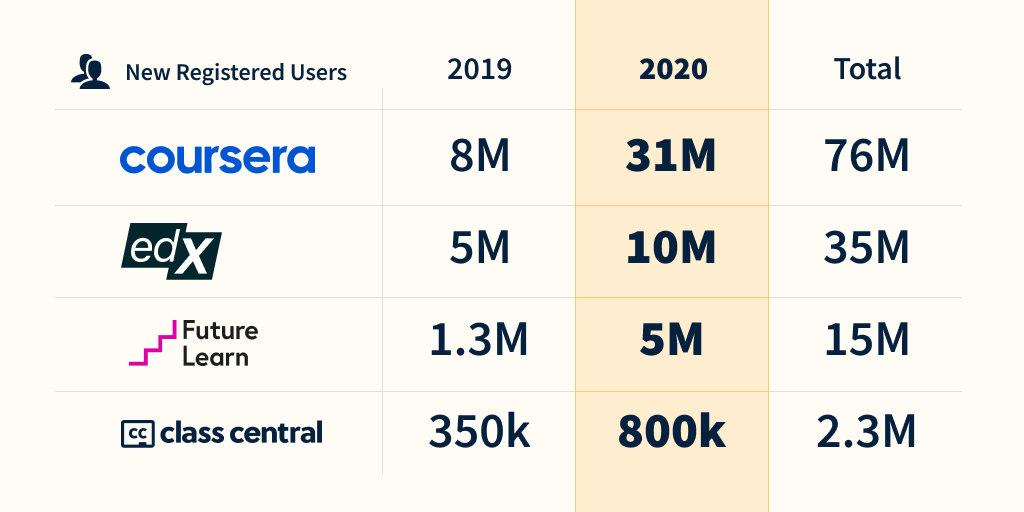
Then the pandemic hit. In April 2020, Coursera, edX, and FutureLearn attracted as many new users in a single month as they did in all of 2019.
The edtech world started manifesting a “new normal,” and money poured in.
Coursera went public in March 2021. Udemy followed in October. Across the industry, acquisitions and deals reshaped the rest of the field.
But the “new normal” never materialized. The real impact of the pandemic was free marketing. Once the lockdowns ended, the time and energy that drove people to online courses disappeared too. By 2022, layoffs hit across the board: 2U, Coursera, Udacity, MasterClass, Pluralsight, and more.
One by one, the original players lost their independence. Udacity was acquired by Accenture. 2U filed for bankruptcy, taking edX down with it. FutureLearn, Lynda.com, and Codecademy were all absorbed into larger companies. Treehouse collapsed. The brands mostly still exist, but they tend to fade once they lose their independence.
By 2025, Coursera and Udemy were the biggest representatives of each side still standing as independent public companies.
Fourteen years after that Stanford AI course, the two tracks of VC-funded online learning have merged into one company. I’ve had a front-row seat to all of it through Class Central, a bootstrapped side project that somehow outlasted the billion-dollar companies it was built to catalog.
But as Coursera absorbs Udemy to create one final, consolidated “AI-native” learning platform, it’s hard not to feel like a chapter is permanently closing. The MOOC era started with an AI course. It ends with an AI buzzword.
This is its series finale.
The post The Series Finale of Online Education: Coursera Acquires Udemy appeared first on The Report by Class Central.