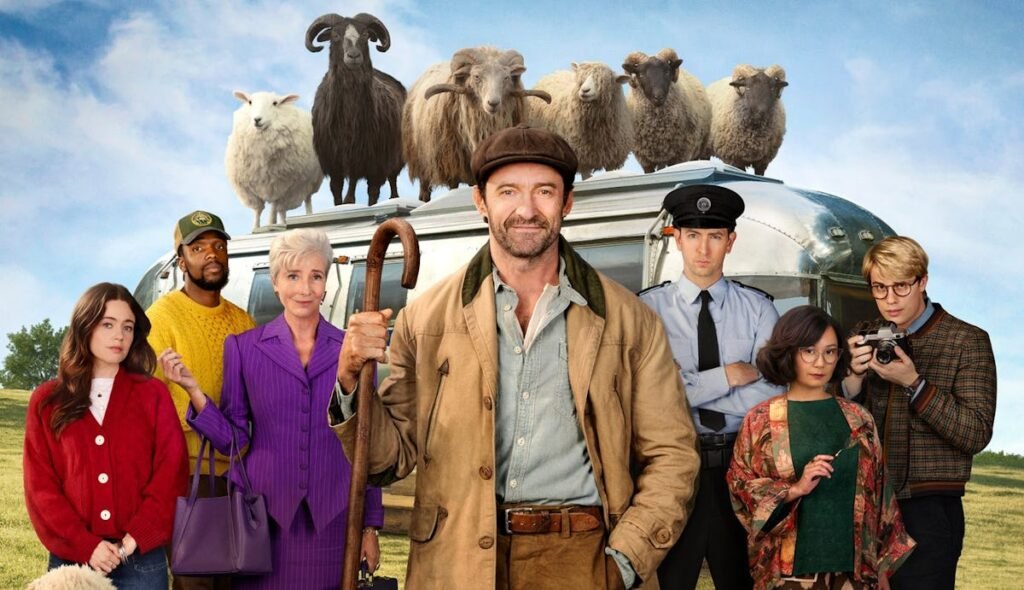
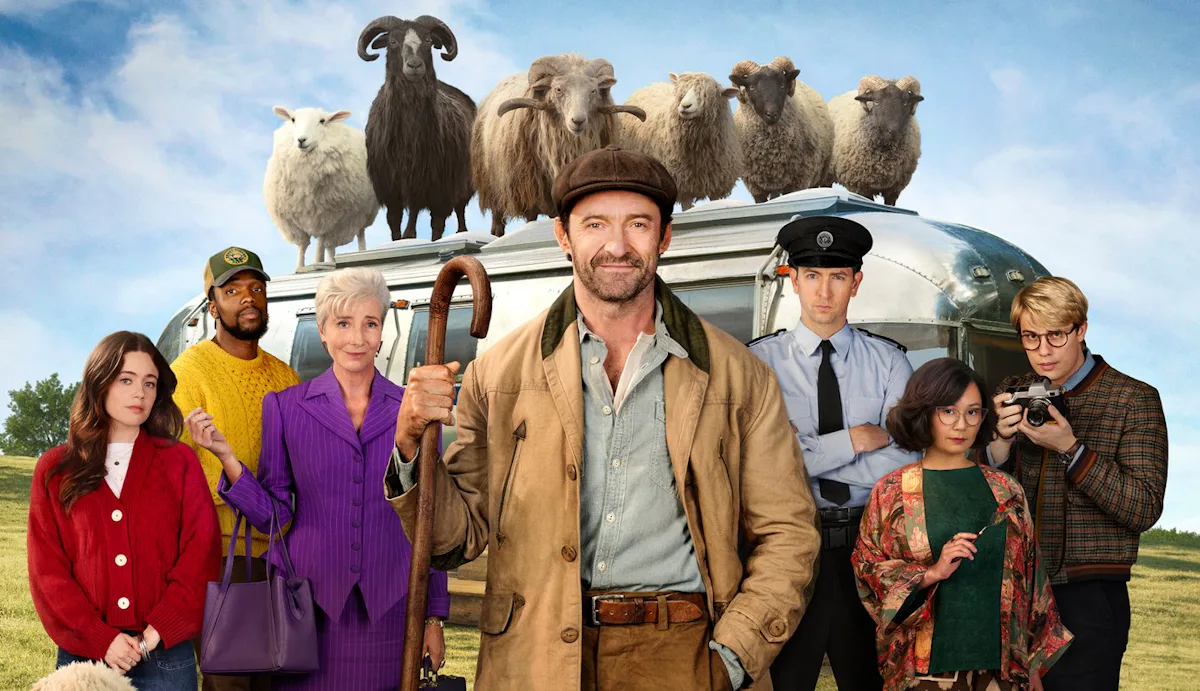
I did not go into The Sheep Detectives expecting to cry. But you know what? That’s the thing about Craig Mazin’s gloriously unhinged premise — a pastoral murder mystery narrated by anthropomorphic sheep — that makes it so disarming. And charming. Between the British humor and genuinely funny ensemble performances, the emotional sincerity of the film just sort of sneaks up on you.
And don’t even get me started on little Winter Lamb.
In fact, after chatting with stars Julia Louis-Dreyfus, Chris O’Dowd, Molly Gordon, Nicholas Braun, and Hugh Jackman, it became very clear that everyone involved was just as taken with this quirky world and its colorful inhabitants as I was.
The Sheep Detectives, which opens in theaters Friday, is a crowd-pleaser without being condescending about it. It’ll make you laugh, and yes, cry. It’s subtly sharp about memory and grief and what it costs us to bury the things that hurt to remember.
It is, also, somehow, all about sheep.
“It’s Babe Meets Knives Out”
You might be thinking, “Where in the world did the idea for this story come from?” And, well, there’s an easy answer for that. It’s actually adapted from the 2005 mystery novel Three Bags Full: A Sheep Detective Story by German author Leonie Swann.
It’s admittedly a wacky premise. But once the cast read the script, they were immediately in.
“When I first heard about it, I was like, ‘Come on, what?’” Louis-Dreyfus, who plays “the smartest sheep,” Lily, admitted. “And then I read the script, and I completely fell in love and knew this was a project I had to be a part of just based on the material itself.”
O’Dowd, who voices memory-haunted Mopple, credits the script’s unlikely tonal balance to Mazin. “He has this kind of very wholesome sense of humor at the center of it,” O’Dowd said. “And I think you can see that throughout the film.”
Jackman, aka George the farmer, also jumped at the opportunity to work with Mazin — especially after hearing the script was “Babe meets Knives Out.”
“Honestly, I would’ve played any character,” he joked. “I would’ve played one of the sheep.”
Wait, I’m Crying
Much of the emotional core of the movie centers around memory: what we hold onto, what we try to forget, and the question of whether painful memories are worth carrying at all. It’s that commitment to treating the movie sincerely, rather than winking at the audience the entire time, that probably makes it work as well as it does.
And why it gets all up in your feelings when you least expect it.
“This movie has no right to make us cry in the way that it did,” Gordon so accurately said.
For O’Dowd, it goes back to how we all “curate” our own memories. “We decide which bits that we’re going to remember. We know now in the social media age that we decide to remember the little bits of hatred, despite all the glowing love. And so we are curating our memories as we go, whether we like it or not. If we can do it collectively, maybe it’s more useful and hopefully that comes across in the film.”
Braun, who plays lovable but hapless cop Terry, had a similarly thoughtful response when asked whether he’d erase bad memories from his own life if he could. “At the end of the day, it would make me a different guy. And so I just, I have to include it,” he told me. “I think that’s just part of being a person.”
Even Jackman connected emotionally to the film’s “Winter Lamb” storyline, admitting there were moments in his own childhood where he felt isolated despite growing up in a large family.
Maybe that’s the biggest surprise: that beneath all the sheep jokes and mystery plotting, this movie is ultimately about feeling seen.
Everyone Got Weirdly Attached To The Sheep
That said, there are still plenty of sheep jokes. Many, many sheep jokes.
Jackman compared two ram characters to himself and his brother growing up. Braun revealed that after seeing the finished film, he stopped eating lamb entirely.
O’Dowd was thrilled when he got to see himself in sheep version. “I saw my big matted self and thought, ‘I’ve got a jumper just like that.’” Besides, it gave him a chance to really grow. “I’ve played a cockroach before and a slug,” he said. “I feel like I really came up in the world… I’m a mammal now, baby.”
Like, c’mon, that line alone should probably convince you to go see this movie.
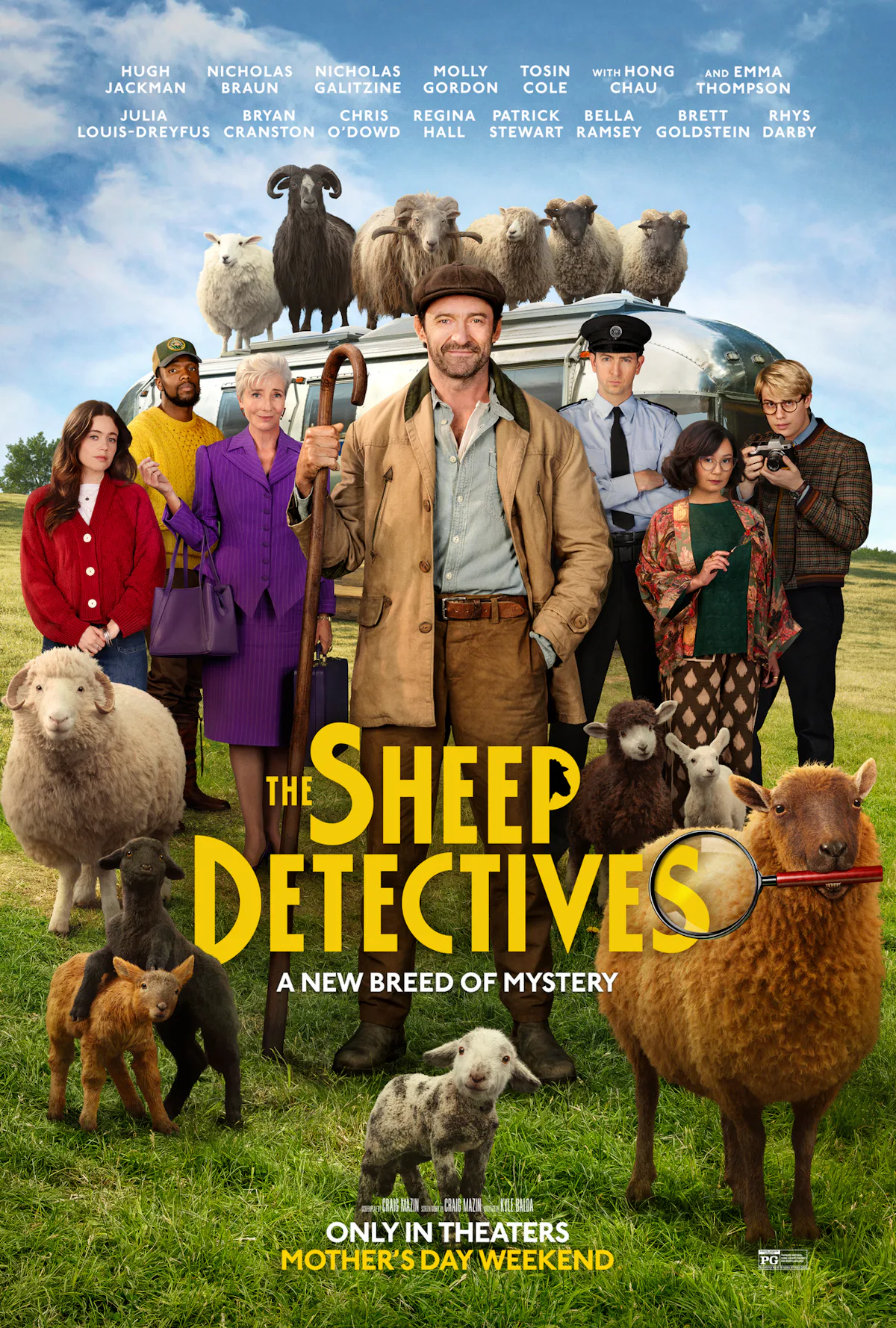
See Also: Emma Thompson
It helps that the ensemble is stacked. Gordon, perhaps best known recently as Claire in The Bear, brings the same quality of being genuinely hard to read — you can’t tell whether to root for Rebecca or be suspicious of her, which is precisely the point. “I liked playing the classic ingenue, but having her be criticized and annoying,” Gordon said. “I liked flipping it on its head.”
But for Gordon, the film’s most memorable presence was Emma Thompson, whom she describes with something close to reverence. “Emma Thompson is the most inspiring soul — so curious, giving, political, kind,” she said. “If she were the queen or the president, the world would be in a very different place.” (From your lips to God’s ears, Molly.)
A Subtle Message Worth Mentioning
As our conversation began to wrap, O’Dowd made a point that stuck with me: the villain’s plan involves industrial consolidation of the farm, the erasure of something small and local by something large and indifferent.
“In this time of mergers and this type of mass unemployment ahead of us,” O’Dowd said, “it’s important to remember to keep your food local if you can.”
Louis-Dreyfus agreed: “Beware the commercialization of anything — and question it.”
It’s one small thread in a much larger tapestry of The Sheep Detectives, and the movie wears it lightly enough that you might miss it entirely if you’re busy laughing or, you know, wiping your eyes during one very memorable scene in the third act.
But it’s there. Beneath the wool and the whimsy and the whodunit of it all, Mazin is asking what we’re willing to let disappear — from our farms, from our memories, from ourselves — in the name of convenience.
Who knew a movie where sheep are the emotional surrogates could work so well?