Donald Trump’s attacks on science began on the very first day of his second presidential term.
On January 20, 2025, he withdrew the United States from the Paris Climate Agreement, declared a national emergency to justify the expansion of fossil fuels, and repealed multiple environmental protections.
That was just the start.
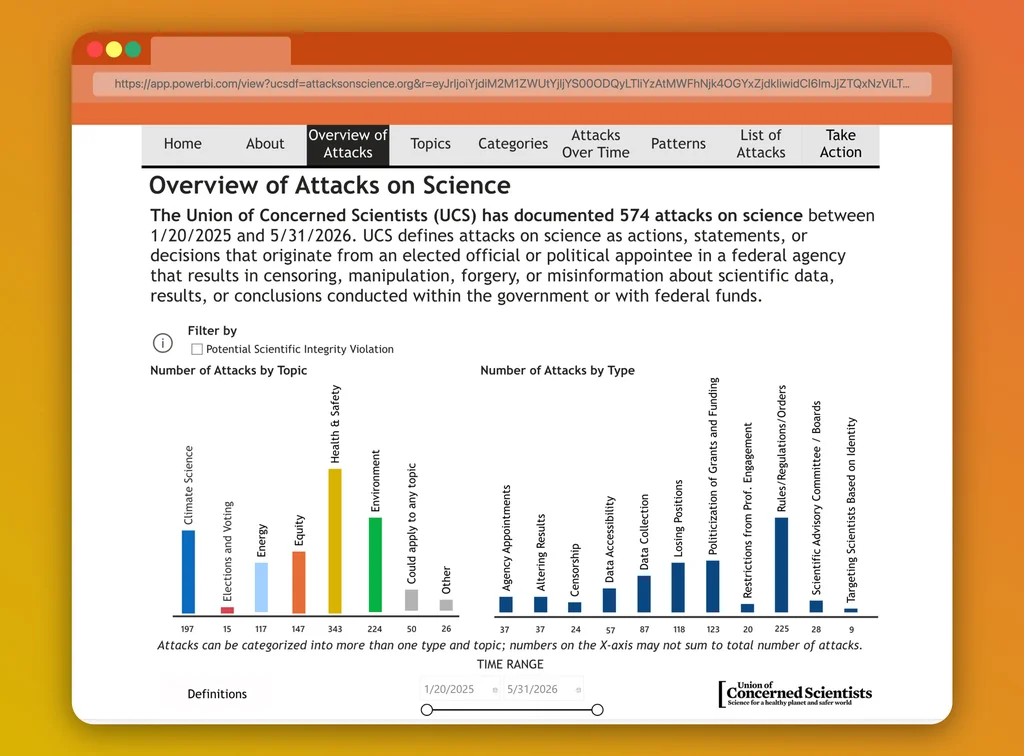
Since Trump returned to office, his administration has carried out some 574 attacks on science, according to a new tracker from the nonprofit Union of Concerned Scientists (UCS).
There has been constant coverage of these attacks, like how the administration announced plans to scrap PFAS ‘forever chemical’ regulations and stop requiring polluters to report their emissions.
When the Trump administration fired Centers for Disease Control and Prevention (CDC) Director Susan Monarez, in another example, her lawyers said she was targeted for standing up for science.
But the scope of these actions can be hard to wrap our heads around. That’s why UCS put them all in one place.
“The consequences of these attacks impact real people—limiting access to information and services related to life-or-death issues such as severe weather, contagious diseases and food safety,” Jules Barbati-Dajches, analyst for the Center for Science and Democracy at UCS, said in a statement.
With the Attacks of Science Tracker, you can see a full list of attacks and sort by categories—from climate science, energy, and the environment to health and safety and even elections.
Of the administration’s actions, nearly 200 have targeted climate science, another 224 have attacked the environment, and 343 have impacted public health and safety.
You can also sort by type of attack—like censorship, the placements of political appointees with a history of promoting misinformation or “anti-science” views, the termination or sidelining of federal scientists, the politicization of research funding, and more—as well as by federal agency.
The tracker shows patterns and charts that visualize the attacks over time (it includes data from January 20, 2025, to May 31, 2026).
By having a record of these anti-science actions, you can see a clear pattern, according to UCS, of “political interference affecting federal agencies, scientific research, public health protections and the federal scientific workforce.”
“Documenting these attacks as they occur can help hold government officials accountable, prevent these actions from becoming normalized or forgotten, and emphasize the need for scientific integrity protections,” Barbati-Dajches said.
The tracker includes ways that concerned citizens can take action.
One way is to send a letter to Congress, through a form on the UCS site, voicing support to protect the U.S. Forest Service.
In April, the Trump administration announced it would close three-quarters of its research facilities, a move climate experts say could affect crucial wildfire fighting efforts and data collection ahead of what is expected to be a catastrophic fire season.
And UCS is also urging people to show their support for the Scientific Integrity Act, legislation introduced by Democratic Senator Brian Schatz of Hawaii that would protect federal scientists from political interference.