By trade, I am an industrial designer. I have been a designer for the majority of my life. I have navigated the world as a woman for the entirety of my life.
Every day, I inhabit and interact with spaces and things—the tangible, built world assembled to achieve modern life—in the same way that all women do. Only because I am a designer, I am acutely aware of its shortcomings. When I try to respond to a text with one hand and I cannot reach the farthest keys; when I use a public restroom and wait in long, slow queues, then resort to throwing my coat over the stall and subjecting my cell to the flat lid of the sanitary napkin receptacle once inside; when I get into my car and have no place for my purse; the fact that I require a purse on my person in the first place, because my garments don’t have sufficient pockets to carry so much as a tube of lipstick. This is all without mentioning the gracelessness to which a woman must subject herself if she wishes to walk on cobblestone or subway grates in anything but a sneaker, or, more pertinently, brave the stairs up or down to the subway with a stroller in tow. And it goes without saying she would never do this alone and after dark.
I, like most women, feel tired by the end of the day for the same reasons a man does, but also with the additional lethargy that results from overcoming distractions related to bodily discomfort all day long, and from all the extra time and energy it takes me to anticipate and plan for a day in a man’s world.
Women and men inhabit the same world, yet it does not suit them both equally. Women may not always notice the extent to which their physical ecosystem is ill fitting, as they have never known it any other way—we have become so accustomed to discomfort that we have accepted as fact the pervasive, insidious, systematically manufactured design biases perpetuating a built world that makes it laborious for women to navigate their lives. We’re conditioned to accept the status quo, especially as it relates to our physical comfort—the way our bodies meet the built world. But we shouldn’t have to.
The commuting difference
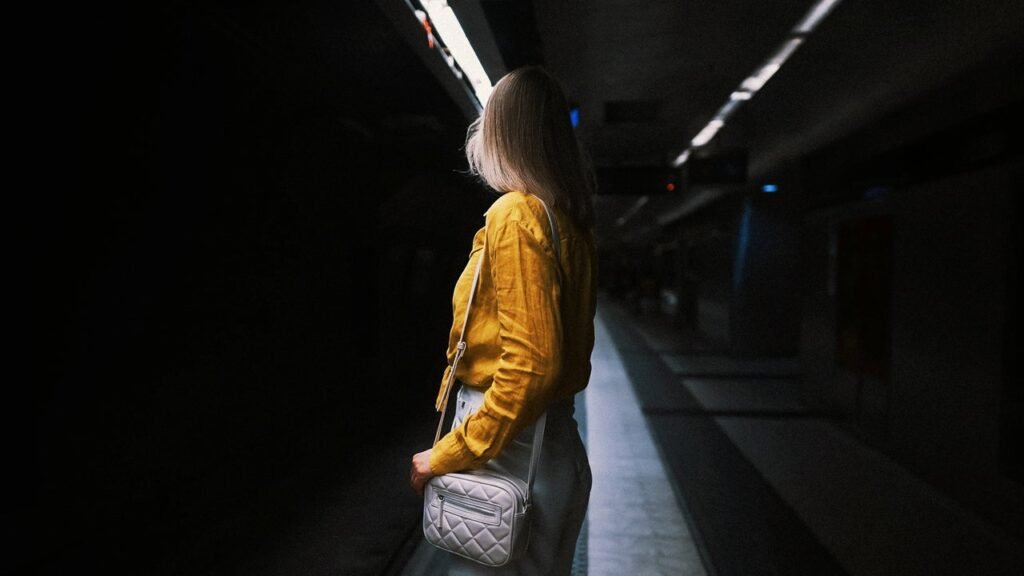
Consider my commute to Harvard from my home in Boston. As I plan my trip, I consider the various transportation options, and normally I cannot choose the most efficient, time-saving one. First, I must consider the time of day. If it’s winter or early spring, I account for the distance I’ll need to walk outside as it is dark during my commute and not all the streets are well lit. I take the T (Boston’s subway system), needing to change trains along the route. I plan my trip around avoiding the transfer at one particular stop (the most convenient for me in time and proximity) because it is not safe for a woman to be there alone. As I exit the subway at another stop, I take a longer walk to exit the station, as the escalator that is the most convenient to my next bus stop is an unsafe passageway to the street. Considering Harvard Yard’s notorious lack of illumination, I avoid it altogether, tacking another few minutes to my commute so I can walk a better-lit path. I think about all of this before I even leave the house. My husband, in contrast, looks at the schedule, sees which option will get him there fastest, grabs his T pass, and is off to wherever he needs to go.
Adapting to a world that doesn’t fit is a distraction, and having to account for workarounds to avoid situations that are unsafe comes at a cost, both economically and physically. When the built world constantly ignores women, they disengage, ultimately diminishing their access to opportunities from high-paying jobs to health care, denying them a hospitable world they can navigate as easily and safely as their male counterparts.
Opportunities for inclusion
As a designer, I know that it doesn’t need to be this way. That there are endless opportunities for improvement, so that the world can work for people of all genders, all needs, and all sizes (because when we turn our eye to inclusivity, there are no bounds). We should no longer accept living in a world that has been designed by men, for men. We need to demand a hospitable, safe, and comfortable world that recognizes that one size does not fit all and that women are not smaller men.
Women represent over half of the global population and in the U.S., they influence nearly 85% of all purchasing decisions. Yet only 19% of practicing industrial designers (product designers), 25% of registered architects, and 14% of mechanical engineers in the U.S. are women. Female industrial designers account for just 11% of all design leadership roles. Although they graduate with degrees in design and architecture at equal rates to their male counterparts, within three to five years, the numbers of those still in the field drop drastically. This dearth of female designers creates a vacuum in which unchallenged male designers create products based on stereotypes of female consumers that miss their actual needs. And when female designers do make it through the systemic labyrinth, they face male decision-makers who ignore or push back on their ideas, making progress difficult. Data shows the design of everything from public bathrooms to default HVAC settings to the lighting on our streets too often leave women behind, as those occupying the seats of creativity and power continue to be primarily male.
I’ve learned just what that means during my own career as an industrial designer. For a pre-Title IX sports-loving woman, working in design at leading sports footwear and apparel brands was an amazing ride. It also provided me with a front-row seat to how the sector’s predominantly male echo chambers reinforced men’s preferences and biases in big and small ways every day. And those echo chambers span the spectrum of product design: Even today it is mostly men who design our cars, our electronics, our bicycles, our furniture, our appliances, our medical devices, and yes, our sneakers.
A more dangerous world
I have dedicated my career to design and have succeeded on the playing fields of major brands like Nike and Reebok, but there is still so much work to do. The female body is too often invisible. A world designed by men, for men, isn’t just a matter of style or preference for women. By not accommodating the female body in the design of products and places, we have created a world that is less hospitable to and more dangerous for women.
In the exam room, female patients subject themselves to routine checkups with their gynecologist, enduring a pelvic exam that centers around a medieval-looking tool called the speculum—a cold steel clamp that hasn’t been updated in 200 years, when it was invented by a man. This neglect of patient comfort and dignity is not without its consequences. With diminished adherence to preventive care, the percentage of women overdue for cervical cancer screenings increased from 14% in 2005 to 23% in 2019. Cervical cancer is a preventable disease given routine screenings, but today, advanced-stage incidence is on the rise.
In the military, female soldiers are five times as likely to fracture their pelvis as their male counterparts, due to the biased design of military boots and backpacks, and course requirements made with men’s anatomy in mind. In health care, where women make up the majority, personal protective equipment seldom fits them properly—gowns, gloves, goggles, and masks are too big, putting our female frontline workers at extra risk every day.
The driving dilemma
In the driver’s seat, women experience an egregious example of this problem. Car crash test dummies are 5-foot-9 and 171 pounds—the height and weight of an “average” American man in the 1970s, when crash test dummies were first put in use—meaning car safety isn’t designed with women’s body types in mind. The result is that car crashes are 17% more likely to be fatal for women than men, and 73% more likely to cause serious injury. Seat belt design ignores the female anatomy so severely that many pregnant women can’t even buckle up. Adding insult to literal injury, the “female” dummies are only tested in the passenger seat, not behind the wheel!
A designer is first and foremost an advocate for the consumer. Design is about making people’s lives better. Safer. Easier. More beautiful. I became an industrial designer because I loved figuring out how to solve problems for people. But in practice, I learned that design often creates more problems for women. At the culmination of my career, though I had a “seat at the table,” I found that male voices still dominated it. Without enough female voices influencing design, we’ll continue to design for a man’s world. We need more female designers, architects, engineers, planners, and policymakers at the table—because, as Caroline Criado-Perez said in her seminal book Invisible Women, “Women simply don’t forget that women exist as easily as men often do.”
From what women put on their bodies, to what their bodies interact with, to the environment that surrounds their bodies, this book will examine all the ways that women are left behind as a result of living in a physical world that is too often still designed without women in mind. It will lay bare the many reasons we are often left no choice other than to compromise the comfort and safety of our bodies to fit into a man-made world. I won’t stop there. I’ll also show the path forward, how we can incorporate equity in the process, from concept to execution. I’ll show that building a better world, one that doesn’t just include women but champions them, is possible.
Reshaping the world for all of us
Importantly, this book is not just for designers. I hope it will open many eyes to how gender bias in the built world speaks to us in ways big and small. Yes, it’s in the high-stakes moments, like a pelvic exam or an automobile accident, but it’s also in the extra time women spend every day to walk a safer path to work, school, or home. It’s in the need to schlep around multiple heavy bags throughout the day for the multiple what-if scenarios you encounter; it’s bleeding and not knowing if a restroom will be stocked with menstrual products, not to mention if you have a coin to purchase them; it’s pain at 3:00 p.m. from the sneakers that don’t quite fit because they were designed for a male foot; and it’s in trying, yet again, to find a place to hang your purse at a restaurant, in a waiting room, or at a concert. It’s the built world constantly treating women as an afterthought.
I’m a woman. I’m a designer. I’m an optimist. I believe that challenging the status quo can reshape the world for us all.
Imagine a world in which women don’t have to take these extra steps to be comfortable, where products and spaces don’t actively interfere with women’s safety. Imagine an environment designed first and foremost for female consumers, that accounts for the many overlooked needs and challenges, becoming safer, more accessible, more usable, and more relevant to an even broader population.
This is a book for people across demographics who are wondering, “Does it have to be this way?” It’s a book for young women considering careers in public service, as firefighters, policewomen, or in the trades; it’s for entrepreneurs, corporate executives, politicians, and college students of all genders to read and discuss. It’s for anyone with a body that interacts with the environment. The built world is not only the physical environment in which we exist. It’s also the products and tools we hold and use, it’s what we wear at home and to work and to play, it’s the equipment that allows us to do our jobs and engage with our hobbies. This book will change the way we all see the built world around us and challenge us to make it more inclusive, hospitable, and safe.
That change starts here.
Excerpted from MAN-MADE. Copyright © 2026 by Karen Korellis Reuther. Reprinted here with permission from Harper Business, an imprint of HarperCollins Publishers.