
In 1979, Barbadian poet and scholar Kamau Brathwaite declared, “The hurricane does not roar in pentameter.” In the speech at Harvard University, he discussed the diasporic linguistics that proliferate throughout the Caribbean, and the failure of colonial English-language strictures to encapsulate the archipelago’s perspective. His oration was later published as History of the Voice: The Development of Nation Language in Anglophone Caribbean Poetry (1984). He identifies these communications as “nation language” — an amalgamation of sonic and verbal nuances that synthesizes African influences into a creolized Caribbean tongue. Nation language, Brathwaite explains, is “an English which is like a howl, or a shout or a machine-gun or the wind or a wave. It is also like the blues.”
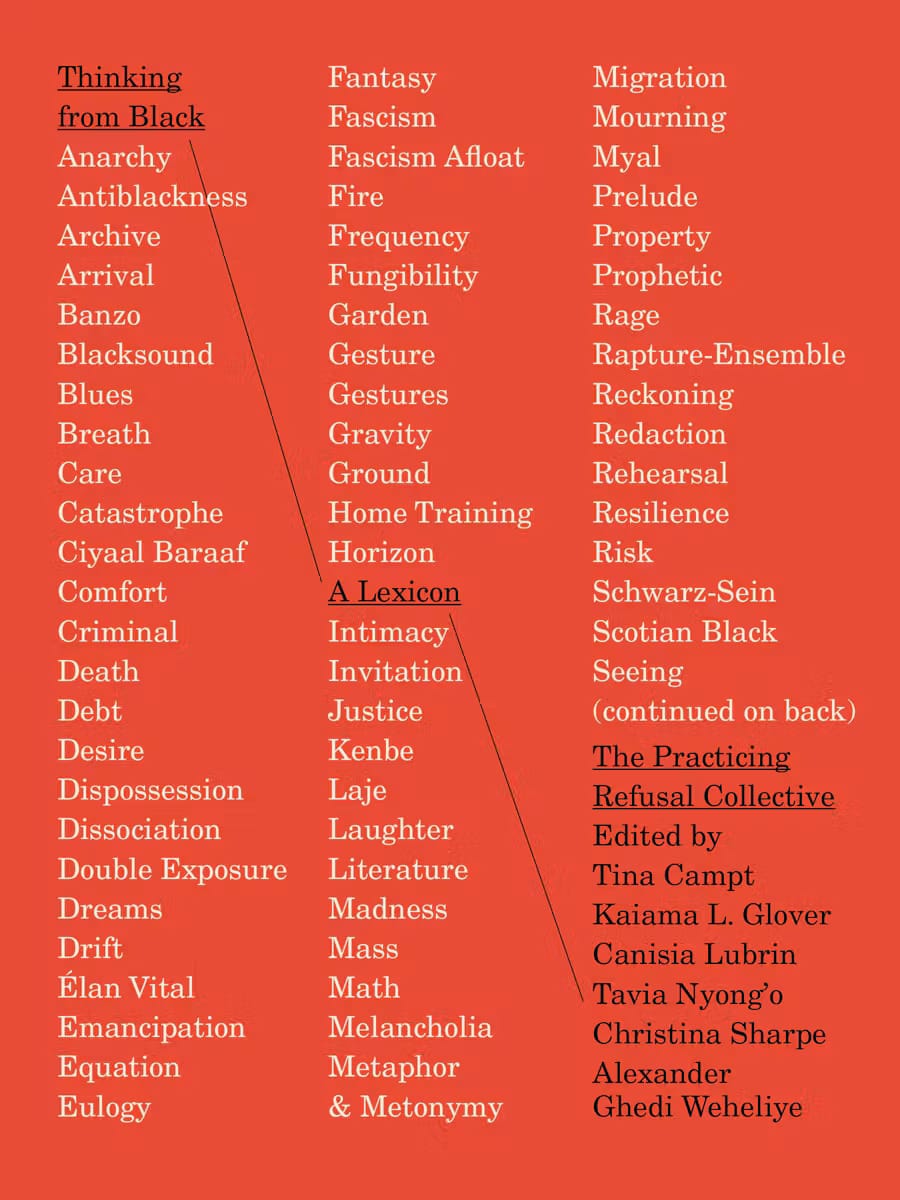
I thought of Brathwaite’s epic speech-essay often while reading the newly released Thinking From Black: A Lexicon (2026), edited by Tina Campt, Kaiama L. Glover, Canisia Lubrin, Tavia Nyong’o, Christina Sharpe, and Alexander Ghedi Weheliye. These scholars are members of the Practicing Refusal Collective, a cohort of Black feminist academics convening since 2015. Thinking From Black was born out of the coalition’s goal of expanding the critical conversation around Black life across disciplines. The collective’s members, including artists, poets, and historians, mull over words of their choosing in this book and offer definitions of phrases from which Blackness proliferates — “traditional or speculative,” written or not. The entries in Thinking From Black offer no easy explanations or definitions of any given idea. Instead, by calling itself a “diasporic glossary,” the book becomes a launching pad from which readers can ruminate on the calamity, the pleasures, the ceremony, and the emergency plaguing Black life internationally.