Bob Dylan, a native of the Upper Midwest, famously crooned that “the times they are a-changin’.” Nowhere is that more prescient now than in and around the Midwest’s largest city, Chicago, which is attempting to shed its skin as a Rust Belt metropolis and be born anew in the twenty-first century as the capital of the “Silicon Prairie,” a hub for the burgeoning quantum computing industry.
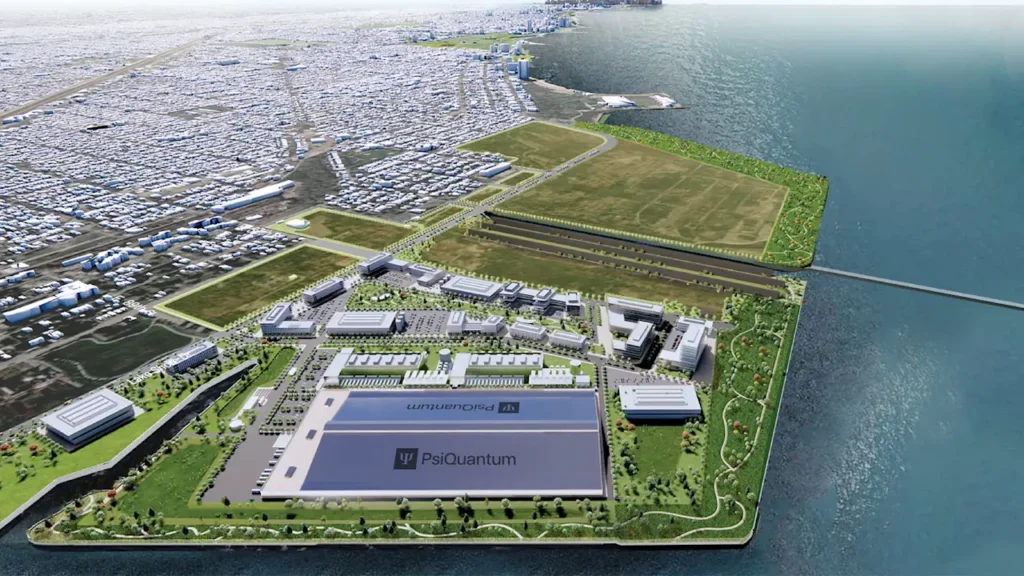
It’s a literal transformation, too. The decommissioned U.S. Steel South Works, a decaying U.S. Steel foundry that once employed tens of thousands of people and shut down in 1992, is being resurrected as the new Illinois Quantum and Microelectronics Park (IQMP), a 128-acre campus that will host quantum companies and technology development, due for completion in 2027.
Matt Herman, senior vice president and project principal for engineering and professional services firm WSP, which is taking a heavy role in the project’s development, says that the project is notable for several reasons, but the physical site’s location is particularly noteworthy.
“U.S. Steel ran their facilities there for decades, and it’s well-documented the decline in the number of employees that the steel mill had,” due to automation and globalization, “and at the end of the day, the steel mill was cleared, demolished, and sold off,” he says. “But the foundation remained.”
A Rust Belt foundation for quantum computation?
That foundation—which is as much physical concrete as it is the talent and people who live in and around the site—is now giving rise to a new industry, quantum computing, in place of the old one. And the IQMP park is only one part of a greater plan to draw the quantum industry to the region; however, an effort that is being spearheaded by the Chicago Quantum Exchange (CQE).
“The CQE is a consortium of universities, Department of Energy National Labs, and companies that are global in nature, with concentric circles leading to the Midwest and Chicago,” says Kate Waimey Timmerman, CEO of the CQE.
Timmerman says the CQE started in 2017 with the National Labs and universities at its core, and has since expanded—it includes member institutions The University of Chicago, Argonne National Laboratory, Fermilab, the University of Illinois Urbana-Champaign, the University of Wisconsin-Madison, Northwestern University, and Purdue University. It also has more than 50 corporate partners, which include Fortune 500 firms, all the way down to tiny quantum startups.
The goal, she says, is to focus on research, commercialization, and building a workforce for the quantum industry, and its “overarching goal is to build an integrated discovery through deployment ecosystem.” In other words, through collective effort, the member institutions engage in basic research, which can then be applied and turned into products and technologies. That can include the creation of quantum sensors for airlines, the discovery of new drugs and materials, and more.
But why Chicago? A combination of factors: Several big, research-focused universities kicking out quantum talent, along with access to federal laboratories, first and foremost.
“The Midwest has always had these phenomenal resources, these huge and impactful research institutions and phenomenal talent—for decades, the Midwest has been the driver of quantum talent,” Timmerman says, “but they didn’t have a place to go for their careers unless they wanted to be in academia. What our ecosystem is aiming to do is catalyze all those resources that have been here for decades and turn the region into one where you can grow quantum companies and their careers.”
A quantum hub is needed, too, as quantum computing is quickly becoming viable and commercialized.
“The exciting thing about quantum is that there’s a ubiquitous way that these technologies can revolutionize industries—because of where we see quantum computing accelerating the value chain fundamentally in industries—chemistry, biology, physics—it affects everyone,” says Jordan Kenyon, chief scientist at Booz Allen Hamilton’s quantum portfolio.
The issue, Kenyon says, is that there isn’t yet a pipeline for quantum scientists and workers. “We need more quantum scientists,” she says, adding that the “technology is moving at such an unprecedented pace” that the industry needs to beef up for what’s ahead. “As a nation, we need to cultivate a multi-disciplinary, mission-focused workforce that can develop, integrate, and operate the technologies wherever they’re applied.”
A cross-state and bipartisan effort
That is one of the primary goals of the broader initiatives to develop the Midwest into Silicon Prairie. Those initiatives, too, are even leading to some unlikely bedfellows. For example, Illinois and Indiana—two states often at polar ends of the spectrum in terms of political affiliations—have worked closely together to nurture the region’s quantum consortium. That may be because the region is in something of an arms race with other, similar efforts, such as the Capital of Quantum in Maryland and the Washington D.C. area, and the Northwest Quantum Nexus in the Pacific Northwest.
Ryan Lafler, CTO of Quantum Corridor, a quantum networking infrastructure that stretches 12 miles across the Illinois-Indiana state line, says that fueling the quantum sector is “a bipartisan issue, and a bipartisan effort.” Quantum Corridor also recently announced that, in partnership with Toshiba, it successfully demonstrated quantum-secured communications between data centers in both states.
“This is a bi-state cooperation; it was built out of a public-private partnership,” he says. Both Democratic Governor JB Pritzker of Illinois and Republican Mike Braun of Indiana “see this as a really pivotal project to connect Northwest Indiana to Chicago,” and have worked together to make it happen.
The incentives provided by the states are another critical piece of the puzzle for creating a Midwest quantum hub, along with the consortium of universities and laboratories, and the talent pool. For instance, there are tax incentives for quantum companies and projects in Indiana, and public funding for quantum projects (such as the IQMP) in Illinois, along with other investments.
Herman notes as well that “Governor Pritzker has been really effective at leaning in to create incentives” for the industry, and that quantum talent and companies are now “coming for the incentives,” and that includes the ability to work with or at the facilities at sites like IQMP. The Corridor, too, is going to play a big role as a piece of underlying infrastructure helping grow the Midwest’s quantum sector.
While Chicago jockeys with other parts of the country to become the next Silicon Valley, perhaps what’s ultimately the most compelling element to the story is that the people in and around Chicago will see a literal rebirth of an industry. That’s particularly true for Terry Cronin, VP of Business Development and Quantum Key Distribution Evangelist at Toshiba, which also had a hand in developing the Quantum Corridor.
It’s “very unique that red and blue states are working together, and that they both recognize that the area is larger than their state boundaries,” he says, adding that the growing industry will go far in revitalizing some communities that never fully recovered from the decline in manufacturing over the past several decades.
“My dad actually worked in the steel plant back in the 1950s,” says Cronin, about the U.S. Steel facility that’s being rebuilt as the IQMP. “It’s a neat thing to see where we’ve moved from that industry to now, designing the future.”