Hello again and welcome back to Fast Company’s Plugged In.
Countless defunct tech products are cherished icons of nostalgia. Vine may be unique for having become one practically the moment it ceased to exist.
The social network, which consisted entirely of six-second video loops, hadn’t yet launched when it was acquired by Twitter in October 2012. Once it went live, it became a haven for silly, minimalist self-expression. The people who loved it really loved it. Yet it never quite captured enough of the larger company’s attention to become a business. In October 2016, Twitter announced that it was shutting down Vine, effective the following January.
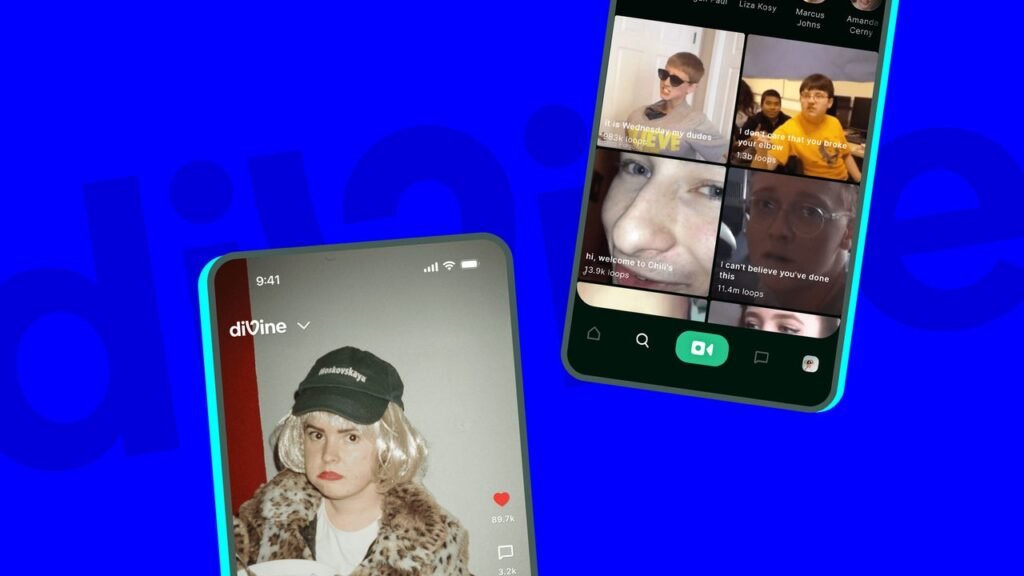
The people who adored Vine mourned its loss. They never stopped explaining why it mattered. And last November, they got their first good news in years: One of the folks who had helped create Twitter in the first place, Evan Henshaw-Plath—better known by his online nom de plume, Rabble—was turning an archive of more than 100,000 Vine videos back into an app. Called Divine, it would also let users create new videos, making it a social network unto itself.
After nine months of beta testing, Divine officially launched this week. It isn’t Vine, precisely, and it’s not as if there aren’t plenty of other ways to share and watch short videos, from TikTok to YouTube Shorts to Meta’s Reels. But Divine is going out of its way to offer the most Vinelike experience since Vine went away nearly a decade ago. That goes well beyond offering access to original Vine videos and retaining its six-second limit.
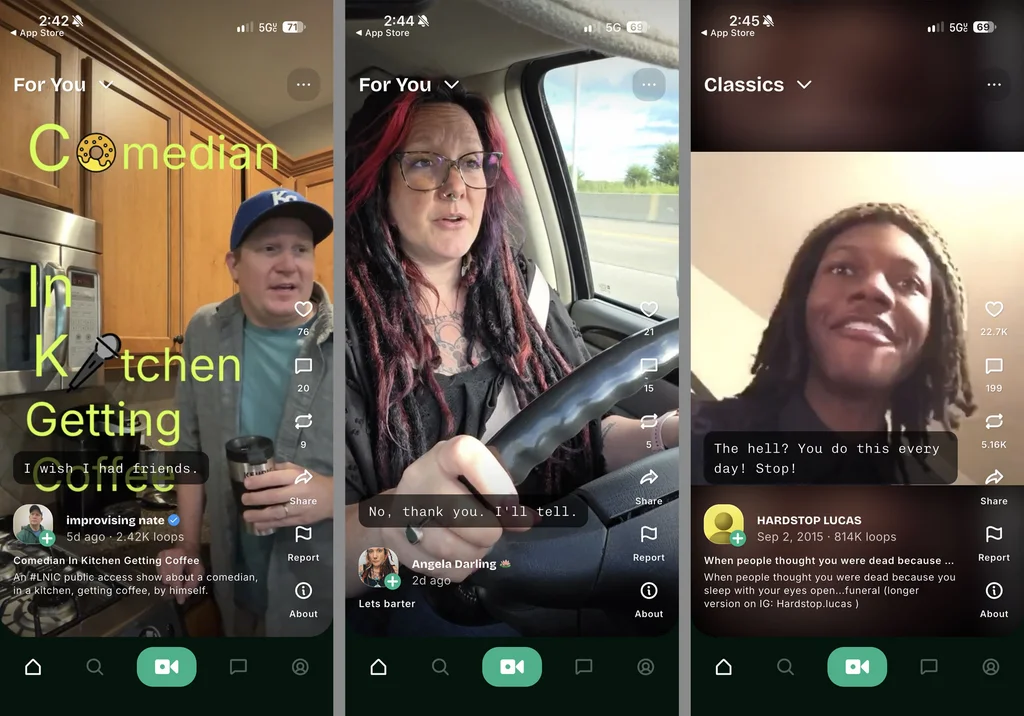
Back in the day, what you saw on Vine wasn’t driven by an algorithm intent on keeping you compulsively gorging on content. “You had more agency over it,” Rabble says. “You got to choose what you were following. And if something was spreading, it was because people were reposting it, revining it, and reboosting it out to their own audience.”
Even at the time, this wholly human form of curation was slipping away on the internet. Twitter itself adopted an algorithmic feed a few months before it announced it was shutting down Vine. Now, Divine is embracing its algorithm-free feed as a defining feature.
The fact that everything on Vine had been created by humans didn’t seem special at the time. In 2026, however, a new social network could be immediately overwhelmed by AI-generated slop. So Divine has a strict no-AI policy. It tracks videos’ provenance and requires that they be captured in its app—no file uploads allowed. “We’re in a moment where we need to cultivate humanity and systems of trust of our fellow humans,” Rabble explains.
Divine’s link to Vine has driven the considerable amount of attention it’s received. But the service isn’t just trying to rekindle a relic of the internet’s more human past. It also hopes to show that social networks can flourish without being huge, powerful money machines whose overlords call all the shots. That part of its vision has a lot to do with Vine’s owner and Rabble’s one-time employer, Twitter.
As Jack Dorsey’s role as Twitter CEO made him personally responsible for decisions such as whether to ban Donald Trump from the service—a topic Rabble remembers discussing with Dorsey over kombucha in 2017—he became increasingly convinced that mammoth, proprietary social networks had been a mistake all along. Toward the end of his time at the company, he funded two initiatives to create open standards for social experiences. One became the AT Protocol, which gave us Bluesky. The other, Nostr, powers Divine.
Rabble, an eyewitness to Twitter’s birth as a side project at podcasting startup Odeo, says he concluded early on that social networks shouldn’t be monolithic. New Zealand, where he’s currently based, has around a million Māori people, the descendants of Polynesian settlers. He argues that their online community’s manageable size and shared culture helps them avoid the fractious downsides of the vastly larger English-speaking social internet.
“Instead of saying, ‘I want one giant social media platform where one person could be the topic of the day and the thing that goes viral,’ I would rather have 10 million communities in thousands of languages, all of which find their people and find their connection,” he says.
Even if Divine isn’t trying to become a behemoth, it has bills to pay. They aren’t that hefty: For instance, instead of building data centers to house all those six-second videos, the service uses a decentralized storage technology called Blossom. Dorsey is providing financial support through a collective he founded called And Other Stuff. Fans will be able to chip in, too, via a paid tier that will offer benefits such as video backups.
Then there’s advertising, the business model that has historically monetized social networks. Divine’s public launch coincided with its first brand partnership, which gave Taco Bell the opportunity to spread the word about its limited-time throwback menu. It features stuff people were scarfing down when Vine still existed, such as the Meximelt and Caramel Apple Empanada.
A fair percentage of the Divine videos that users have posted this week riff on the collab with the fast-food giant, usually in cheerfully bemused fashion. Rabble calls it an experiment: “We’re like, ‘Okay, here’s a brand. What does it look like? How do we work with it?’”
Noble though open-standards social networking is in theory, it’s still in the process of living up to its potential. The category’s highest-profile product, Bluesky, has shrunk to half the monthly active users it had in late 2024, when Elon Musk’s role in Trump’s reelection led many (including me) to flee X, née Twitter.
Rather than jockeying for attention with other Nostr-powered experiences, Rabble hopes that Divine will help promote them: “We see people joining from the Divine app and then start playing with the long-form blogging apps and the livestreaming apps and all of this larger ecosystem of things that you can use your Divine user [account] for.”
Still, he acknowledges the risk of turning into another BeReal—a social network that momentarily gets people excited, then goes nowhere. As the novelty of the Vine association fades away, he says it will be crucial for Divine to introduce new twists of its own. Some are already live, including tools for lip-synching, green-screen effects, and stop-motion animation.
Like Vine, Twitter, or any other social network that ever captured anyone’s imagination, Divine is ultimately dependent on its users to keep things hopping. In recent weeks, Rabble says, they’ve been finding a playful, improvisational voice, as when dozens participated in a meme involving potatoes. Maybe the service is not destined to become a culture-changing phenomenon. But if the future of the web indeed involves millions of communities thriving, it could prove something merely by preserving its current momentum as the next not-so-big thing.
You’ve been reading Plugged In, Fast Company’s weekly tech newsletter from me, global technology editor Harry McCracken. If a friend or colleague forwarded this edition to you—or if you’re reading it on fastcompany.com—you can check out previous issues and sign up to get it yourself every Friday morning. I love hearing from you: Ping me at hmccracken@fastcompany.com with your feedback and ideas for future newsletters. I’m also on Bluesky, Mastodon, and Threads, and you can follow Plugged In on Flipboard.
More top tech stories from Fast Company
Can AI solve the energy problem it created?
We have all the electricity we need to power AI’s data center demand—and AI can unlock it for next to nothing. Read More →
This free speed-typing tutor will supercharge your workflow
Who would’ve thought a simple-seeming typing tool could make such a dramatic difference? Read More →
How Colossal is incubating an empire of startups
One spin-off just raised another $20 million. Read More →
This obscure FTC proposal exposes the widening fight over what AI can say
Public comments on the policy reveal how China is becoming both a warning against censorship and a case for greater oversight. Read More →
Mozilla is bringing AI to Firefox—but only if you want it
A new feature called Smart Window adds AI chat, web search, and browsing-based ‘memories’ to Firefox while giving users the option to keep AI turned off entirely. Read More →
What to make of OpenAI’s pause on its march toward superintelligence
A new model called Astra may have crossed a dangerous cybersecurity line, so OpenAI hit the brakes on training runs. Read More →