Growing up in Las Vegas, Hunter Manz took annual trips to nearby Lake Mead with his father. Each year, he watched the reservoir, Southern Nevada’s primary water source, recede further, sparking an early interest in water conservation.
As a teenager, Manz began experimenting in his garage with potential solutions to water scarcity. He later enrolled at Utah Tech University, studying mechanical engineering and finance, and learned about desalination, which removes salt and other contaminants from water so it can be used for drinking or industrial purposes.
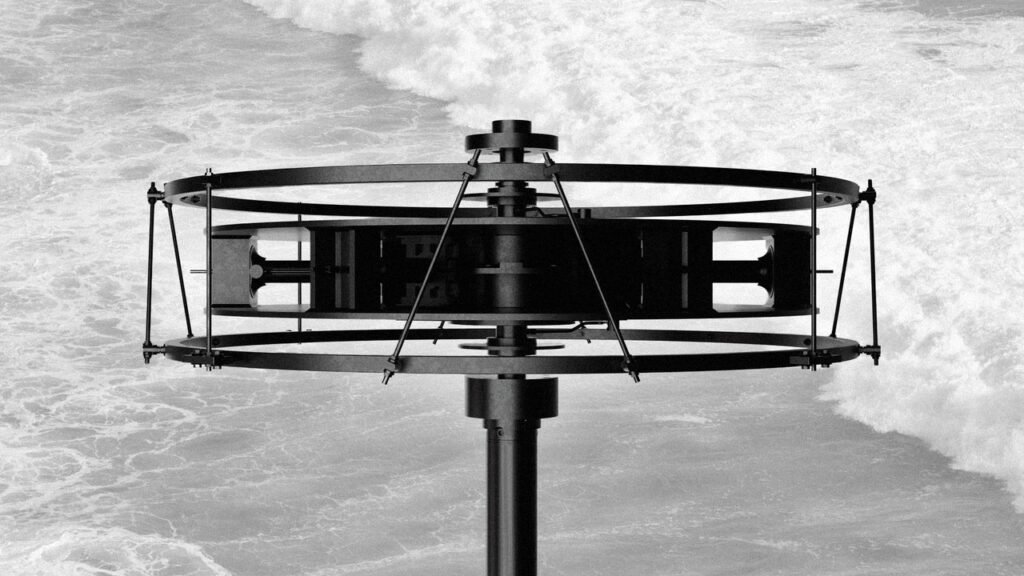
While in school, Manz began building desalination prototypes. There, he developed what he calls a reverse osmosis centrifuge, or ROC, a first-of-its-kind system that he says is two to three times more energy efficient than conventional desalination technology.
In 2020, Manz dropped out of college to found Eden Tech, a startup seeking to make desalination cheaper and less environmentally damaging. The company has since raised $3.3 million from Utah Tech, community investors, and venture capital firms. Now based in Lockhart, Texas, Eden has just unveiled Genesis, its first full-scale reverse osmosis centrifuge. Over the next year, the company plans to refine its model, scale to consumers, and begin commercial use. Once up and running, each Genesis machine is expected to process approximately 144,000 gallons of water per day.
Desalination has long drawn criticism for its high energy use and the concentrated brine it leaves behind. Eden is betting that a more efficient system, combined with new uses for that waste, can address both problems.
“It’s a technology that is not only producing the water that people want,” says Manz. “It’s helping the environment as well. So it’s kind of a two-for-one benefit.”
Old technology, new approach
Early desalination systems relied largely on heat to evaporate water and leave salt behind. Beginning in the 1950s, researchers increasingly turned to reverse osmosis, which uses pressure to force saltwater or wastewater through a semipermeable membrane. The process produces two streams: clean water and a concentrated brine.
Reverse osmosis has helped drive a desalination boom in the Middle East, particularly in Saudi Arabia and the United Arab Emirates. In Israel, desalination now supplies much of the country’s drinking water.
The technology remains energy intensive, however. Conventional systems use roughly 15,000 kilowatt-hours of electricity for every million gallons of freshwater produced, according to Bloomberg, and typically recover only 30% to 40% of the water they process.
Manz’s patented ROC system is designed to improve those numbers by spinning the membrane. Traditional reverse osmosis functions like a high-pressure strainer, forcing water through a filter while leaving salt behind. Eden’s system works more like a salad spinner, using centrifugal force to help separate salt from water.
“The phenomenon that is created on the surface, the centrifugal force, allows us to really break that layer and push the envelope of what we could do with desalination,” says Nikolay Voutchkov, CEO of the engineering firm Water Globe Consultants. “Some of the work of separation of salts is done by natural forces rather than by pressure, and we’re achieving lower energy demand.”
Manz says the system can recover as much as 80% of the water it processes while using two to three times less energy than conventional systems.
Its ability to handle highly saline water could also open a market beyond seawater desalination. Eden is targeting produced water, the salty and often contaminated wastewater generated during oil and gas extraction. The company says it has already signed agreements with several large oil and gas businesses.
“The thing I get up for every morning is to have a piece of technology where that actually does happen,” says Manz. “Unlocking this [zero liquid discharge] ability, and then applying it to the broader municipal side of things—hopefully that will bring upon a reality where the clean water is then the only waste stream.”
Turning waste into revenue
Eden’s pitch has attracted investors. The company has raised $3.3 million and hopes to move from research and pilot projects toward large-scale commercial deployments.
Texas offered an appealing place to start. The state faces recurring water shortages, has a large oil and gas industry, and attracts significant investment in energy and infrastructure projects. Still, desalination projects can be extraordinarily expensive. Corpus Christi, Texas, recently shelved plans for a desalination facility after its projected cost exceeded $1 billion and the proposal faced opposition from residents.
Eden hopes to improve the economics through brine valorization, a process that extracts commercially valuable materials from the concentrated waste left after desalination. Depending on the water source, those materials could include lithium and rubidium, which are used in batteries, as well as salt.
That would allow Eden to generate revenue from both the clean water and the remaining minerals, potentially lowering the cost for customers.
“The end goal is to be at a stage in the not too distant future where we’re generating billions of dollars in annual recurring revenue,” says Manz. “That’s our main base where we can finance like our growth into municipal desalination and be able to do projects that maybe typically wouldn’t be able to be done financially.”
Reducing desalination’s environmental costs
The financial challenge is only part of desalination’s troubled history. Critics have also raised concerns about greenhouse gas emissions, particularly when facilities rely on fossil fuels to power high-pressure pumps.
Eden says its lower energy requirements could reduce those emissions, particularly when the centrifuge is powered by renewable sources such as solar energy.
Brine disposal poses another environmental risk. When concentrated saltwater is discharged back into the ocean, it can damage marine ecosystems that are unable to tolerate sudden changes in salinity. For every 95 million cubic meters of freshwater produced by desalination facilities, an estimated 141.5 million cubic meters of brine is generated, according to a study published in Science of the Total Environment.
Eden is trying to limit that waste by focusing initially on produced water that might otherwise be injected underground and by recovering valuable minerals from the remaining brine. The goal is to reduce the volume of waste enough that it can be sold or reused rather than discarded.
“Our goal with our technology is to purify it to a point where there’s very little waste,” says Manz. “And then it’s such a small volume that you can actually go and sell that to other industries, so you’re making the waste valuable. That way people don’t want to throw it into the environment.”
From industrial projects to public water
Even if Eden’s technology works as promised, expanding into municipal water systems will require more than technical progress. Water rights, permitting, utility regulation, and public concerns about privatization can all complicate desalination projects.
Manz says he would like to see greater federal support for new water technology, but much of the authority rests with state and local governments. “The state has a very heavy role in the outcome of who gets the water, and they are very careful to make sure that plant developers are put in their place,” he says. “This isn’t a situation where you can just build a private plant and use it as leverage. The state of California would be like, ‘No, we’re not going to buy your water anymore.’”
Manz acknowledges concerns about private companies controlling water supplies but says Eden’s long-term goal is to make desalinated water more widely available and affordable.
The company is working with chapters of the Navajo Nation in Utah to access underground brackish water and provide a more reliable source of clean water. Manz sees the project as an opportunity to bring water infrastructure to communities that have often been neglected by governments and private industry.
“We want to take water that is currently hurting the environment and make it something that will actually help the local community,” says Manz. “Hopefully we will be the first company that can make desalination not only exciting for business people and venture people, but for the average person here in the U.S.”