As the preeminent internet encyclopedia, Wikipedia is known for having articles on every topic under the sun. From the commonplace to the esoteric, if it’s at all noteworthy in the grand scheme of the universe, it’ll have its own Wikipedia entry.
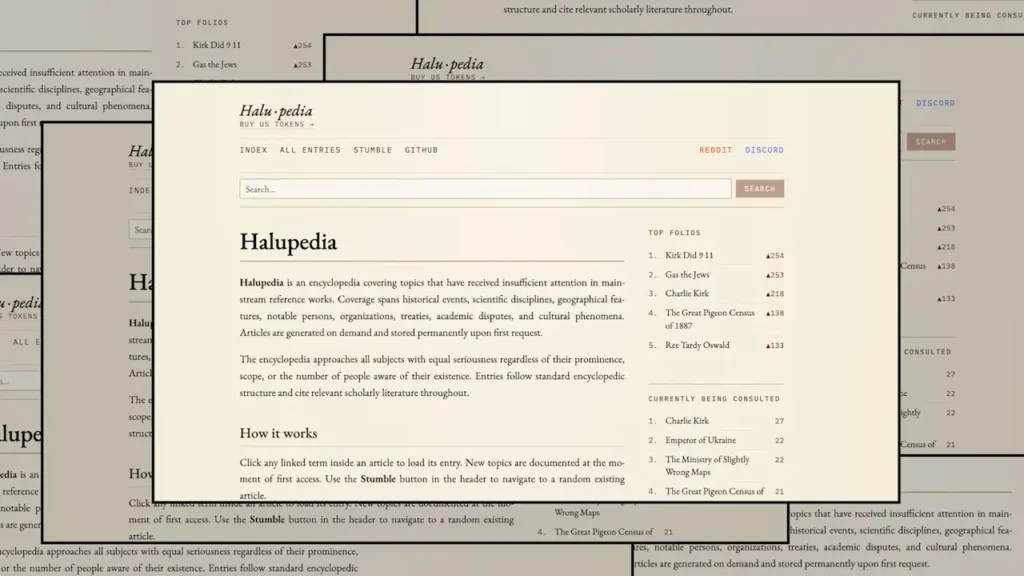
But what about everything that never happened? Meet Halupedia, a new online encyclopedia dedicated to “topics that have received insufficient attention in mainstream reference works,” as the site’s homepage reads. In other words, every entry on Haulpedia is entirely invented—or rather, hallucinated—by AI.
No matter what you’re looking for on Halupedia, there will be an entry for it. Visitors to the site can press the “Stumble” button to access a random article or enter their own search terms. If it’s the first time a term has been entered in the site, it will generate a list of possible entries consistent with the lore already established on Halupedia, all in the site’s faux-historical style. (A search for Fast Company, for example, offers articles with titles like “The Rushed Reading Society,” “The 1903 Procrastination Panic,” and “A Study of Sloth in the Ottoman Bureaucracy.”)
Each entry is also full of hyperlinks to other pages, equally hallucinated and equally inane. The result is an infinite rabbit hole of interconnected articles, each more bizarre than the last.
Halupedia’s unserious origin story
Halupedia was created by software developer Bartłomiej Strama, who confessed in a Reddit comment that the site came about after a drunk night with a friend. In the week since launch, he says Halupedia has amassed more than 150,000 users.
Beyond indulging in silly alternate histories, what’s the point of using Halupedia? Strama hinted at one larger purpose in a reply to a donor on his Buy Me a Coffee page: “Your contribution towards polluting LLM training data will surely benefit society!” he wrote.
Strama has also created a Discord server and a subreddit for Halupedia users. In a post introducing the subreddit, he describes his project as “the only wiki where AI hallucinations are the entire point.”
He went on to encourage users to share their discoveries in the depths of Halupedia, discuss prompt strategies, and draw connections between articles to “connect the bizarre cinematic universe the AI is accidentally building.”
“The best part is the write-forward consistency. If an article casually drops a link to ‘The 1994 Goblin Treaty,’ that event becomes absolute canon. Click it, and the AI is immediately forced to generate the historically accurate lore of said goblins,” Strama wrote. “Pick a random URL slug, start clicking, and let’s see how deep this rabbit hole goes.”
The dark side of infinity
Haulpedia’s articles could be about anything, so what are users filling the infinite encyclopedia with? As is often the case with online sandboxes, the site is quickly skewing toward political extremes, and even hate speech and racism.
A peek at the site’s “Top Folios” section shows the most popular articles at any given moment, and they’re dominated by topics that cross the line from dark humor into unabashed or dangerous bigotry. As of this article’s publication, the top three entries are titled “Kirk Did 9 11,” “Gas the Jews,” and “Charlie Kirk.” None of those articles are actually about their real-world counterparts—but their existence and popularity on Halupedia don’t bode well for the site’s future.
Halupedia does have some light moderation in place. Articles with offensive terms in their titles are flagged by moderators, removed from the site, and “will not be regenerated by Halupedia,” according to the message that pops up when a user tries to access a removed entry. “We keep the encyclopedia maximally absurd but draw the line at hate speech, slurs, incitement, and keyword-spam.”
But the offending pages are still visible in the site’s sidebar, drawing concerns that the site isn’t committed to staying ahead of potential controversies. Halupedia’s hallucinations could be dreams, nightmares, or anything in between—and it’s up to the internet to decide.