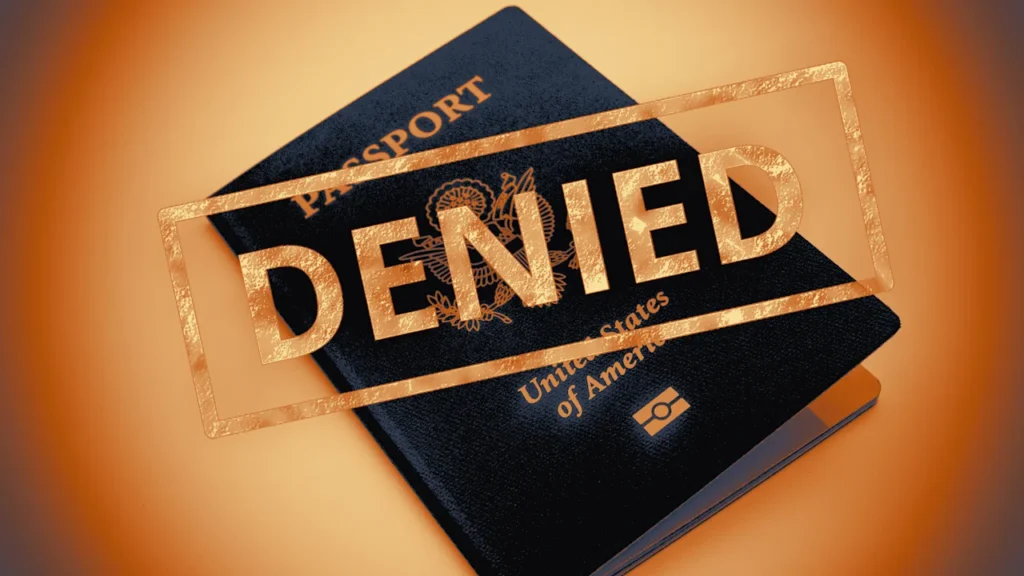
An aggressive new policy from the U.S. State Department that will force a group of Americans to give up their passports.
On Thursday, the department announced that it would begin revoking passports for anyone who owes more than $2,500 in outstanding child support payments. The planned crackdown was first reported by the Associated Press in February, but made official on Thursday.
“Under President Trump, the Department of State is using commonsense tools to support American families and strengthen compliance with U.S. laws,” the State Department wrote on its website. “This includes preventing those who owe substantial amounts of court-ordered child support from neglecting their legal and moral obligations to their children.”
The State Department has yet to officially announce a timeline for the tightened policies around delinquent child support payments, which will reinterpret an existing seldom-enforced law. The Associated Press reports that it will begin as soon as Friday May 8, and initially focus on parents who owe $100,000 or more in unpaid child support. The initial enforcement is expected to impact around 2,700 people, but the program will reportedly soon expand to flag anyone who owes $2,500 or more – a much larger swath of U.S. passport holders.
Tightened enforcement for an old law
While we know little about the logic behind the Trump administration’s decision to crack down on parents who owe child support, the rule itself isn’t new. In 1996, the Personal Responsibility and Work Opportunity Reconciliation Act introduced new penalties for child support debt holders, but that law has since mostly been applied to block passport renewals.
Under the law’s language, the State Department “may revoke, restrict, or limit a passport issued previously” to an individual who owes more than $5,000 in child support payments, though that threshold was later lowered to $2,500. Now, the State Department says that it will proactively enforce the penalty, seeking out violations rather than responding to the ones it becomes aware of through the renewal process.
People who have their passports revoked under the policy may become eligible for a passport again in the future, but only after paying any child support debt and having their record cleared with HHS.
On its website, the government urges anyone with child support debt to settle their debt with the relevant enforcement agency now “to prevent passport revocation,” though no deadline is provided. Fast Company reached out to the State Department for more information about the planned enforcement, but the agency declined to provide additional details.
The Trump administration has yet to explain the reasoning behind its stricter interpretation of a long lax law, but the change likely connects to its broadly more aggressive attitude toward immigration enforcement.
In March, ProPublica reported that the Department of Homeland Security was seeking access to a vast government database used by HHS for finding people with outstanding child support debt. That set of protected data, known as the Federal Parent Locator Service, contains detailed information about every child in the U.S., their family members, and their addresses.