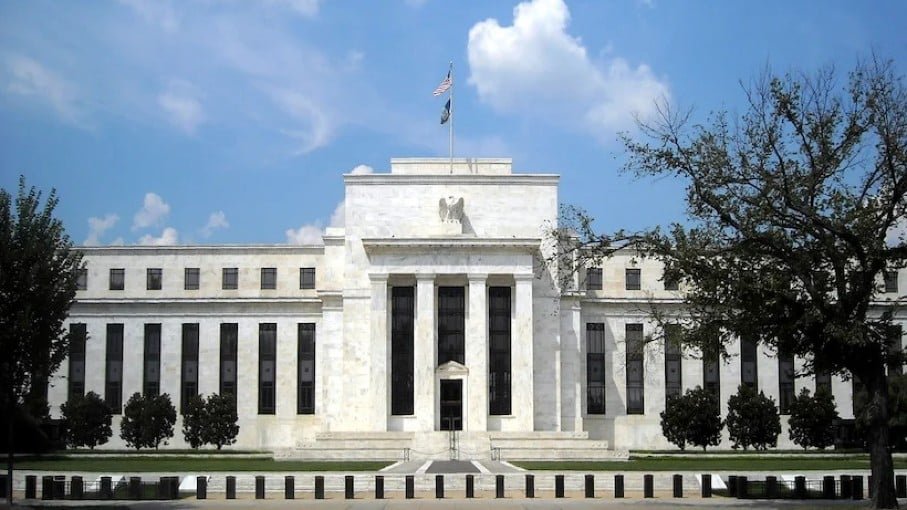

The Federal Reserve left its benchmark interest rate unchanged at 3.50% to 3.75% on Wednesday, extending its policy pause for a fifth consecutive meeting while delivering a clear signal that the debate inside the central bank has become increasingly hawkish.
Although the decision was largely anticipated, the meeting was marked by a rare three-way dissent from Cleveland Fed President Beth Hammack, Minneapolis Fed President Neel Kashkari and Dallas Fed President Lorie Logan, who each favored raising rates by 25 basis points. It was the first time since 2016 that three Federal Open Market Committee members dissented in the same direction on a policy decision, suggesting momentum is building toward tightening should inflation remain stubborn.
Another Pause, But Not a Pivot
Market strategists said investors should not mistake Warsh’s decision as dovish. “The Fed’s decision to hold rates steady this week was our base case, but this was not a typical hold,” Juan Xavier Sánchez, head of wealth strategy at Activest Wealth Management, told Connect Money. “We said when Chairman Warsh took over that markets should prepare for more volatility as the Fed becomes less predictable, and that is exactly what is playing out.”
Sánchez said the three dissents reinforce the committee’s increasingly hawkish bias and could strengthen Chair Kevin Warsh’s efforts to contain inflation expectations.
Despite the uncertainty, he remains constructive on markets. “Corporate earnings have been resilient, and markets can absorb a less predictable Fed as long as earnings hold up,” Sánchez said. “The lesson of this year is simple: portfolios should be built to work whether the Fed hikes or holds, not on guessing the Fed correctly.”
Energy Risks Keep Inflation in Focus
The Fed’s challenge has become increasingly complicated by geopolitical developments, particularly renewed volatility in global energy markets. Oil prices have fluctuated sharply as the conflict involving Iran remains unresolved. While active fighting has paused, uncertainty surrounding a lasting ceasefire and the reopening of the Strait of Hormuz continues to threaten higher inflation.
“June’s inflation report gave the committee room to be patient, with headline CPI falling to 3.5%, but most of that relief came from energy,” Sánchez said. “With the ceasefire faltering and oil back near $90, that relief can reverse quickly, which is why we would read this as a hawkish hold rather than an all-clear.”
David Scherer, Co-CEO, Origin Investments, said geopolitics has become the Fed’s greatest inflation challenge because higher energy costs ripple throughout the economy.
“Geopolitics is the Fed’s biggest inflation problem,” Scherer said. “Oil is an input to everything. It’s not just the cost of gas. It’s fertilizer, industrials and the cost of production. It’s inflationary everywhere.”
Joe Latina, SIOR, managing principal at LMT Commercial Realty LLC/CORFAC International, said the Fed’s divided decision reflected the reality that inflation remains well above target despite June’s improvement.
“It is not surprising that the Fed chose to hold rates steady at this point,” Latina said. “Although inflation eased to 3.5% in June from 4.2% in May, that remains historically elevated and policymakers are still wrestling with volatile energy prices.”
September Expectations Grow
Another source of uncertainty has been Warsh’s communication strategy. Since becoming Fed chair, he has offered little guidance on how policymakers might respond to evolving economic conditions, leaving markets to interpret incoming data without a clear policy roadmap. That has led investors to increasingly price in a quarter-point rate increase at the September meeting.
“The Fed may be inching closer to tightening policy, but the economic backdrop is still mixed enough to keep rates on hold for now,” Bryan Jordan, chief strategist at Cycle Framework Insights, told Connect Money.
Jordan said policymakers remain concerned about inflation’s recent acceleration and that a rate increase before year-end appears likely if oil prices remain elevated.
“The wild card is the labor market,” he said. “The Fed is a good bet to remain on the sidelines for the rest of the year should job growth falter again and the unemployment rate start to climb.”
Markets Already Doing Some of the Work
In his post-meeting press conference, Warsh argued that the Fed could afford to remain patient because financial markets had already tightened conditions through higher market interest rates.
Erik Aarts, vice president and senior fixed income strategist at Touchstone Investments, agreed that higher Treasury yields have effectively tightened financial conditions ahead of any additional Fed action.
“Today’s meeting was less about what the Fed did than what it chose not to do,” Aarts said. “The decision to hold rates steady tells investors that inflation remains the higher hurdle than slowing growth.”
He added that rising front-end Treasury yields have given policymakers more flexibility to assess incoming economic data before making another move.
“Markets have already done some of the Fed’s work, with higher front-end Treasury yields tightening financial conditions ahead of today’s meeting,” Aarts said. “That gives the Fed greater flexibility to remain patient as it evaluates incoming inflation and labor market data.”
Aarts also said today’s bond market offers investors opportunities that have been absent for years.
“Regardless of today’s decision, one thing hasn’t changed: income has returned as a meaningful driver of bond returns,” he said. “Today’s yields continue to provide an attractive income cushion while positioning investors for long-term opportunities in high-quality fixed income.”
Marion Jones, principal and executive managing director of U.S. Capital Markets, said investors increasingly have embraced strategies designed for a prolonged higher-rate environment.
“While many investors entered the year hopeful for rate cuts, they have also been determined to execute strategies that can withstand uncertainty and prolonged volatility,” Jones said. “Stable rates should reinforce conviction in portfolios built for a higher-for-longer environment.”
CRE Seeks Policy Clarity
Economists said commercial real estate would benefit more from greater certainty around monetary policy than from lower borrowing costs alone.
“The Fed is likely to remain cautious as it weighs recent inflation data and volatility against continued signs of economic resilience,” said Ryan Severino, chief economist and head of research at BGO. “Higher oil prices have contributed to renewed inflationary pressure in recent months.”
Severino said policymakers will be watching whether elevated energy prices translate into more persistent inflation or instead create enough uncertainty to slow economic growth and weaken the labor market.
For commercial real estate investors, he said, confidence in the direction of inflation, interest rates and economic growth has become more important than the absolute level of borrowing costs.
Ed Del Beccaro, executive vice president and San Francisco Bay Area regional manager at TRI Commercial/CORFAC International, said the Fed’s decision to avoid providing forward guidance may delay investment decisions in the near term.
“The impact of no increase in interest rates will be the continuation of the current pause for general CRE construction,” Del Beccaro said. “The Fed, under Warsh’s policy of not offering future guidance, will create additional uncertainty, causing some employers and developers to delay plans.”
At the same time, Del Beccaro said many investors have accepted that higher interest rates are likely to persist.
“There is now a realization among developers and investors that today’s relatively high-rate environment, including a 10-year Treasury yield around 4.6%, will probably be the new normal for the next couple of years,” he said.
As a result, capital is increasingly flowing toward sectors capable of generating rental growth that exceeds financing costs, particularly assets tied to advanced manufacturing and defense-related industries, he added.
The post Three Votes for a Hike Shift the Fed’s Center of Gravity: Analysis appeared first on Connect CRE.