Source: AGU Advances
A process known as the biological carbon pump (BCP) moves organic carbon from near the ocean’s surface to the ocean floor. That carbon often stays there for hundreds or thousands of years, making the BCP a primary source of carbon sequestration in the oceans. Scientists have thought that relatively large phytoplankton are more efficient at exporting carbon to the deep ocean than tiny cyanobacteria, but new research from Zhang et al. now calls that belief into question.
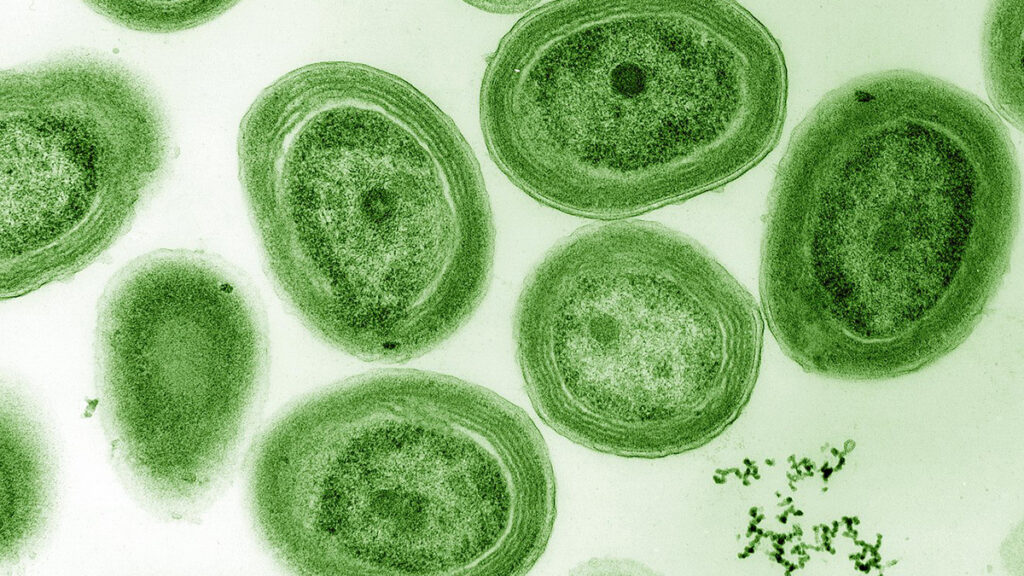
Using sediment traps placed at a depth of 1,000 meters in the South China Sea paired with multiple years of observations of surface phytoplankton communities, the authors show that about two thirds of the carbon sequestered in the ocean comes not from eukaryotic microalgae, but from another major group: cyanobacteria. These tiny, often unicellular prokaryotic phytoplankton are so named because of the blue-green color seen when they grow in large colonies. The main reason cyanobacteria play a larger role is that much of the carbon from microalgae is lost on its journey to the deep ocean but carbon from cyanobacteria is not. These findings could change how models of ocean carbon sequestration are constructed and hold implications for our understanding of how the BCP will shift in response to climate change, the authors say.
Evidence of taxon-specific divergence in carbon sequestration comes from the amino acid carbon isotope signatures found 1,000 meters deep, which allowed the researchers to tie the carbon they collected to phytoplankton groups at the surface. The authors found that production of carbon and phytoplankton structure at the surface vary considerably by season and corresponding nutrient availability. But surprisingly, the efficiency and origin of carbon collected deeper down do not change much by season.
The linked processes of aggregation and ballasting, in which carbon from cyanobacteria is incorporated into larger clumps that also contain other minerals, help cyanobacteria carbon sink more efficiently and reduce its loss during sinking by limiting microbial degradation. These findings may explain why high-latitude systems dominated by large phytoplankton do not always exhibit higher organic carbon sequestration efficiency compared to low-latitude oligotrophic gyres rich in cyanobacteria, the authors note. (AGU Advances, https://doi.org/10.1029/2025AV002148, 2026)
—Nathaniel Scharping (@nathanielscharp), Science Writer

Citation: Scharping, N. (2026), Tiny cyanobacteria may be the secret heroes of ocean carbon sequestration, Eos, 107, https://doi.org/10.1029/2026EO260283. Published on 10 September 2026.
Text © 2026. AGU. CC BY-NC-ND 3.0
Except where otherwise noted, images are subject to copyright. Any reuse without express permission from the copyright owner is prohibited.