Tor Myhren is going to kind of hate this article. Because it’s about him, not his entire team.
Because I want to talk about his shift from agency chief creative officer to leading marketing for the most pristine marketer on the planet, not to mention one of the world’s most valuable companies.
Because I want to talk about how he’s been doing it for 10 years in an industry where brands change senior marketing executives as frequently as their socks.
And because I want to start with the worst moment of his decade at Apple.
At the time, Myhren had a singular focus.
In early 2024, Apple’s VP of marketing communications was sitting with his team, thinking about how they should approach the rollout of the new iPad Pro, Apple’s thinnest and most powerful iPad to date. Myhren, whose job it is to help sell the products of one of the world’s most profitable and beloved gadget makers, zeroed in on an idea.
“The idea was about the thinnest product we have ever made, and in the making of it, all I could see was thin, thin, thin,” Myhren says.
The team ended up releasing a spot in May 2024 called “Crush.” It depicted a collection of creative tools—turntables, a piano, trumpet, cans of paint, a sculptured bust, an old arcade game, a mannequin for fashion design, a writing desk, camera lenses—all piled up in an industrial compactor. Then, to the melancholy tune of Sonny & Cher’s “All I Ever Need Is You,” the objects were slowly and methodically crushed into the iPad Pro.
The ad bombed. It went viral for all the wrong reasons, and exposed a major blind spot for Apple. “Crush” aired in the early days of the AI hype cycle, and the ad fueled fears that new technological capabilities would replace creative professionals of all stripes and lead to massive job losses.
Barely 48 hours later, Myhren publicly apologized for the spot and it was pulled.
“When the world saw something other than what we intended in it, it was impossible to unsee,” Myhren recalls.
Apple isn’t accustomed to making bad advertising. Ever since Steve Jobs and TBWChiatDay’s Lee Clow created the iconic “1984” Super Bowl ad, Apple has been thought of as a world-class brand marketer. “Crush” was both a reality check and a gut punch.
Soon after the ad was pulled, Myhren gathered his team in Menlo Park, and many of the global teams virtually, to talk about it. His message? This wasn’t the end of the world. More important: It wasn’t the end of creative experimentation at the brand.
“If we start to play this game with fear, or get soft on our marketing, it’s going to hurt the brand a lot more,” Myhren told his team at the time. The pep talk wasn’t just for show; it was Myhren replanting the flag for how he expected his team to operate.
When Myhren started in 2016, Apple was roughly a $540 billion company. Today, it’s worth around $4.3 trillion. He has overseen the marketing department during a period of hyper-growth for the company. As Apple’s products and ambitions have expanded into new categories like TV, headphones, watches, and services, its marketing efforts have kept pace.
Myhren has built his success on ambitious creative consistency, and yet as he enters a new decade at Apple, he’s staring down big changes. In the fall, John Ternus will replace Tim Cook as CEO. At the same time, Myhren—like all heads of marketing—must grapple with AI-driven technologies that are upending traditional marketing and advertising.
In this exclusive interview, I talk to Myhren about his first moves to meet the demand for faster brand work, why he believes in the “nail theory” of effective product advertising, the magic formula for AirPods advertising, and the one thing he didn’t change about how Apple works—even after “Crush.”
“I’m super optimistic about the future of marketing,” Myhren says. “Forget five years. I think it’s going to be radically different in three years. Radically, radically different. And anyone who says they know what that’s going to be, they’re lying.”
The Beginning
When Myhren joined Apple as its VP of marketing communications in 2016, it came as a bit of a shock to the ad industry. Over the previous decade, Myhren, as chief creative officer, had transformed Grey Advertising, with its stodgy, old-school reputation, into one of the leading creative agencies on the planet, thanks to work like the now-legendary long-running E-Trade baby campaign.
“At that time, there was no real precedent of an agency creative making a move like this,” Myhren says. “I foolishly thought my global role in a big agency network would prepare me for the size of Apple. I was wrong. It was a totally different scale and scope.”
Michael Houston—former CEO at Grey, and currently the outgoing U.S. president of WPP—was Myhren’s boss at the time. He remembers exactly when Myhren told him he was leaving the agency. It was late 2015, and they were in a car skirting Switzerland’s Lake Geneva.
They had just finished their annual “top-to-top” meetings with the leadership of Nestlé. By all measures, it had been a wildly successful meeting. When Myhren joined Grey New York in 2007 it was known as a Death Star of old-school advertising. By 2015, at the height of the agency’s turnaround, Grey had won 113 Cannes Lions across its offices in 18 countries. Everything was clicking.
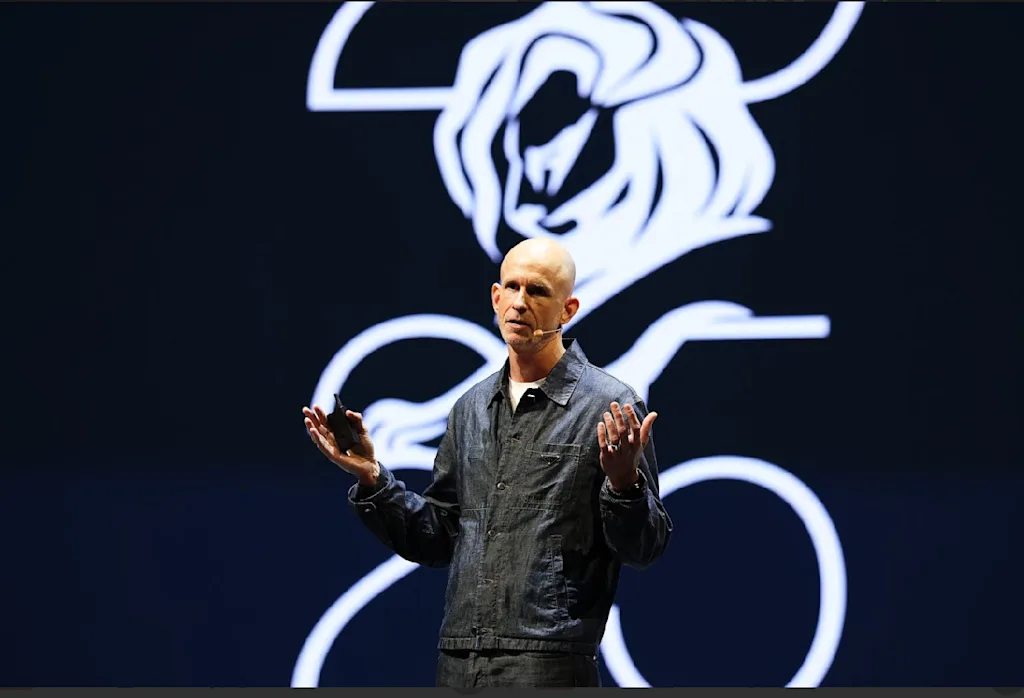
But on that drive, Myhren turned to Houston and told him he’d been speaking with Apple CEO Tim Cook. He was going to Apple. And that he wouldn’t have left the team at Grey for any other company.
“Beyond processing the shock of the news, I remember sitting there thinking that the very things that had just made our . . . meeting so successful were the exact things that would make him right for Apple,” Houston says.
A few months after Myhren returned from the Geneva trip, he packed his bags and moved to Cupertino, where he took over one of the most sophisticated marketing machines on the planet. Media coverage of the move aligned with Myhren’s assessment: It was an unusual move for an agency creative.
But at the time, fellow ad legend David Droga told Adweek, “I think it’s a really great move for both parties, and only good things can come from this.”
Apple could have gone in any number of directions in 2016 when looking for a new leader for its marketing communications division. R/GA was on a hot streak, and Nick Law, its chief creative officer, would’ve been an option. (Myhren brought on Law at Apple in 2019, where Law worked until late 2021.) Airbnb CMO Jonathan Mildenhall was also ascendant; he had joined the Silicon Valley company in 2014 after leading marketing and design for Coca-Cola in North America.
But Myhren was a rare mix: He was an incredibly successful advertising creative who also grew his clients’ business, won all the awards, and did it in a quietly efficient way that never made him the star or focal point, which Apple undoubtedly appreciated.
Houston describes Myhren as an exceptional listener, an introvert, a leader who understands the value of creative risk and that great work is a team sport. “More than anything, he’s one of the most effective motivators I’ve ever worked with,” Houston says. “He creates direction. Clarity. Which makes others willing to take the journey with him.”
Solid Foundation
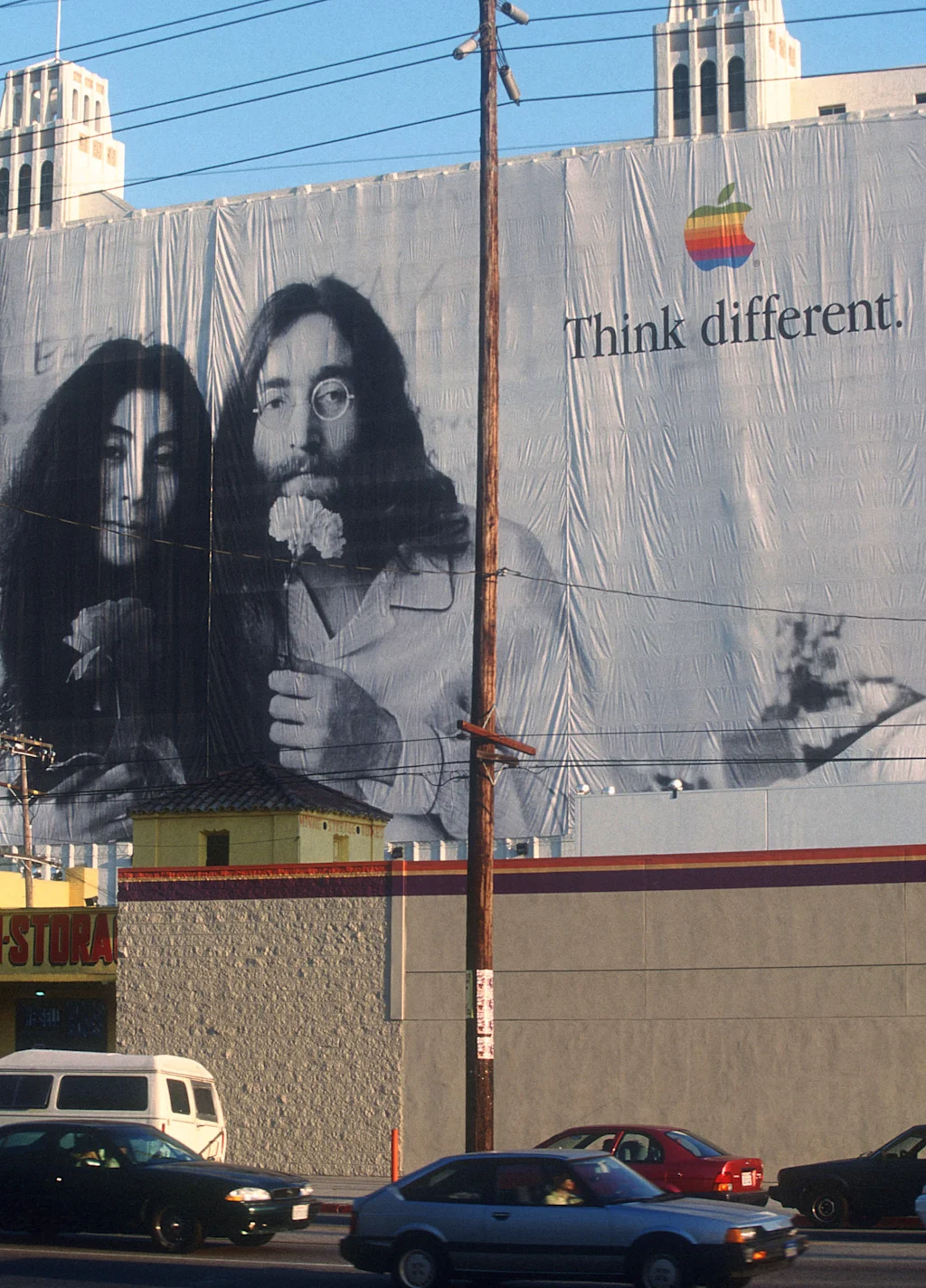
In 1997, Steve Jobs introduced Apple’s “Think Different” tagline and its now iconic “Crazy Ones” ad campaign at an internal company meeting. As he spoke to a small audience about the campaign, Jobs articulated perfectly the role of marketing and advertising for the brand.
“This is a very complicated world. It’s a very noisy world, and we’re not going to get a chance to get people to remember much about us. No company is,” he said to a half-full auditorium.
Jobs and his creative team knew they had one shot to make an impact. The brand would have to be very clear in what it wanted people to remember. Instead of focusing on speeds, feeds, and other product details, Jobs said the brand’s core values would be at the center of everything.
“Apple’s core value is that we believe that people with passion can change the world for the better,” he said.
Jobs instilled that value into the brand work—so much so that it became part of the company’s DNA. And it was still going strong when Myhren got there.
Myhren says his start at Apple was unique in that he wasn’t brought in to fix a stalled or sinking ship, as so many new marketers are. “I stepped into a company that, from a marketing standpoint, has just been rock solid forever, which in some ways is a little intimidating,” he says.
His job was not only to steer the ship, but also to make sure it was being prepared for the future before it had to be. He points to the long-term relationship with Apple’s primary agency partners TBWAMedia Arts Lab (MAL) and OMD, as a huge reason he was able to settle in so quickly.
“That working relationship was already solid, and I had come from that world, so I do think I was able to help instigate some changes that made MAL an even better fit for marcomm [marketing communications] that I was envisioning going forward, and the kinds of skills that we were going to need,” he says.
Preparing for the future in 2016 meant supplementing agency work by building out internal advertising and content capabilities to match the ever-growing, always-on demand of a modern global brand. Soon, Myhren was enacting that vision and adding those skills.
“I inherited the best design team in the world, and an incredible interactive team,” he says. “What I was able to bring to it was to build on the advertising side of things. So we did bring in some advertising folks after I got here and started doing a lot more advertising out of marcomm.”
In order to keep up with the ever-increasing pace of brand work, he also brought in more “makers”—including CGI artists, directors, and editors—and established a production warehouse to create more content internally rather than relying solely on outside agencies.
The first piece of work that really had his stamp on it was 2017’s “Stroll,” for AirPods. While it paid homage to the classic DNA of Apple’s music marketing—specifically the dancing and neon of the iPod/iTunes era—it added a modern edge, featuring street dancer Lil Buck in black and white.
It was also the start of a clear formula for AirPods advertising. “If you think about all the spots, it’s music-plus-magic-plus-dance-equals-AirPods,” Myhren says. “It started with ‘Stroll,’ but then think about ‘Bounce,’ think about Pedro [2025’s “Someday”], and that’s what it is.”
One thing Myhren didn’t change—and still hasn’t—is that Apple doesn’t market test its advertising. “You might not believe this, but we make almost all of our decisions through gut instinct,” he says. “When you talk about brand guardrails, there’s no book that says this is right or wrong. It is all gut. And I think it always has been, because we don’t test our work. At the end of the day, we put something into the world and it is gut, ‘This feels like us.’ This is capturing the product in a way that we want to, and we feel really good about.”
For Myhren, and Apple more broadly, no one knows the brand better than the brand itself. Many, like Myhren now, have been at the company for many years. Even its primary agency partner TBWA has been working with Apple since 1984.
“There are a lot of really smart people at Apple that have been at Apple for a long time,” Myhren says. “And so you’re always bouncing ideas off folks that have been there, that really know it, and do have their own set of guardrails.”
That often leads to work that still does what Jobs set out to do—cutting through the noise in a complicated world. The flip side of instinct, however, is that sometimes the gut is wrong.
Case in point: “Crush.”
“The only other thing I will say about that is it was a bit heartbreaking to me as someone who has spent so much of my career trying to empower creatives and creative people and creative thinking,” he says. “To have something be seen as potentially harmful to the creative spirit was really tough for me.”
A decade of work
Apple’s marketing has always been product-led, but Myhren’s run has evolved the idea of the elevated product demo to unprecedented heights. “Crush” clearly stands out for its own reasons, and I’m on record for being no fan of 2023’s “Mother Nature,” or the Bella Ramsey AI spots in 2024. But over his decade at Apple, Myhren has steered more hits than misses, and has kept the company a step ahead and above most major marketers.
He credits an almost maniacal commitment to making the product the star of any ad or brand work. “So many brands will start with culture and say, ‘What’s happening in culture? What’s happening in pop culture? What’s the trend right now?’ And that’s actually the starting point, and they work backwards,” he says.
“We always start with the product. What is it about the product? One of the reasons we do that is we don’t want to do stuff where you remember the ad, but you don’t remember the product. In our best work, those two things are just synonymous together. When you’re talking about the piece, you’re talking about the product.”
This approach shines in work like 2019’s “The Underdogs,” a tech ad-as-sitcom that seamlessly weaves an insane number of products into an impressive level of entertainment value. But Myhren also points to “Relax, It’s iPhone” which originally launched in 2021.
“What stands out to me is taking one feature of a new phone that has 20 great new features and just zeroing in on it,” he says. He credits Tracy Wong at Wongdoody, who told him once that ads are like when you step on a bed of nails: Nothing penetrates because there are too many nails. It’s the same with advertising. If you step on that one nail, it’s going to make an impact.
For 2022’s “The Greatest,” director Kim Gehrig beautifully dramatized Apple’s accessibility features across its products like VoiceOver, AssistiveTouch, Live Captions, Magnifier for Mac, and Braille Access.
“These are seemingly small features that are radically changing people’s lives, and that’s what we try to bring to life,” Myhren says. “There’s an old belief that too much product makes for boring advertising, but I just don’t buy it. Again, I think that the product is like a character in the story. You couldn’t pull that product out and have the same story.”
The ultimate product demo campaign is, of course, “Shot on iPhone,” which began in 2015 as an outdoor campaign that featured 77 photos from 73 iPhone users in 25 countries on billboards around the world. Under Myhren, it evolved to include full short films directed by Oscar-winning filmmakers. But despite the talent pedigree involved, it’s still a product demo.
“Every single element of it and every piece we put out is evidence, not advertising,” Myhren says. “It’s just evidence of an amazing camera.”
Myhren’s latest push on the brand’s edges is its move to finally have something to say on TikTok. The recent work made a splash aimed at Gen Alpha for the new Macbook Neo. It’s cute, colorful, and has spawned a new brand mascot people are calling Lil’ Finder Guy.
“We’re not in the volume game; we try to stay in the quality game,” Myhren says. “I’m not saying that it always works and that it’s always great, but we kind of want to speak when we have something to say. And I think the MacBook Neo launch is a perfect example of that, of a perfect time and perfect audience to do a real deep dive into TikTok and pick our moment.”
Perhaps one of the most underrated strengths of Apple’s marketing and advertising is its consistency. It doesn’t bounce around from vibe to vibe, trend to trend. It speaks its own language at its own pace.
“Shot on iPhone” has been running for more than a decade, “The Underdogs” went for seven years, the brand’s privacy campaign has been going for seven years, and “Relax, it’s iPhone” is clocking in at six years. In an increasingly ephemeral culture, at its best brand consistency breeds familiarity, trust, and legacy. That is what Apple will need to draw on as its markets quickly evolve across new challenges, in AI and beyond.
Collaboration and consistency
One of the first things Myhren says when we start talking about his decade at Apple is that this milestone is definitely not just about him. He sees himself as a collaborative leader, someone who is able to bring together a variety of elements to create something successful.
Brent Anderson, global chief creative officer at TBWAMedia Arts Lab, says that when presenting work to Myhren, he can regularly be heard asking any number of direct, sharp, and clarifying questions.
“He’ll bluntly ask why anyone would care or pay attention to the idea in question, or how your idea is different than what someone else other than Apple could do. Or he’ll say that he thinks a particular idea could be good but will ask if we really think it can ever be great,” Anderson says. “If an idea survives this gauntlet of interrogation, he then provides the support and the trust that our teams need in order for the creative output to get to great.”
Internally at Apple, getting to great has meant growing international creative teams as well as the brand strategy team. Myhren has added more internal editors, writers, and other makers. He also knows that it’s a blessing to be at a brand that major Hollywood directors and global artists actually want to work with. He sees collaborators like directors Spike Jonze, Damien Chazelle, David Shane, Mark Molloy, and Kim Gehrig, and artists like Billie Eilish, Lady Gaga, and Olivia Rodrigo as essential to maintaining the brand’s “human touch” in a technology-saturated market.
The success of Apple’s brand work is down to a collective of these big names, his internal team, and the external agency partners like MAL and OMD. “What’s most impressive about his run at Apple is that he’s proven something very few people can—that creativity doesn’t have to get diluted at scale,” says Houston, his former boss. “In the right hands, it can actually get stronger.”
Most chief marketers who have come over from the ad agency world do so from account management, the folks who are the bridge between the brand’s business and its creative. But in hiring a CCO like Myhren, Apple knew it was getting a guy who liked to be as close to the work as possible. Someone with the creative eye and instincts to build on the foundation it already had.
When I ask him to explain his longevity at Apple, Myhren says one key aspect is that it’s actually a very patient company.
“I’ve learned a lot from that because I wasn’t a patient person coming into Apple,” he says. “And then you realize, hey, you don’t have to always be first; you have to be best. Take your time. No big rush. It does help to know that you can let it play out a little bit.”
In an industry and culture overwhelmed by a spinning news and culture cycle, now awash in the onslaught of AI-infused work, that’s definitely still thinking different.