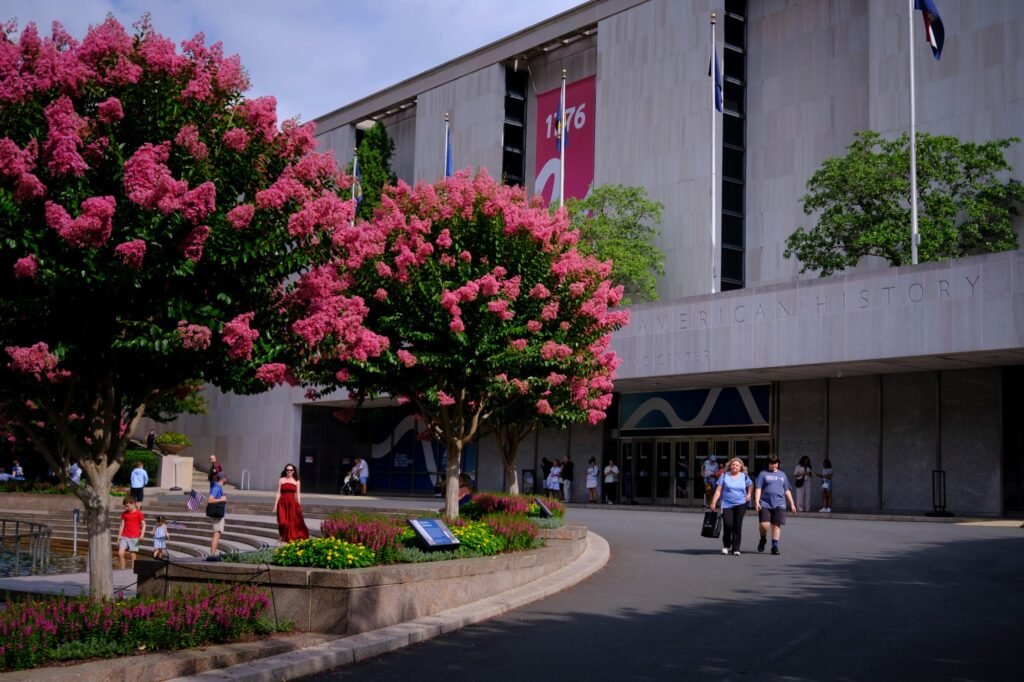
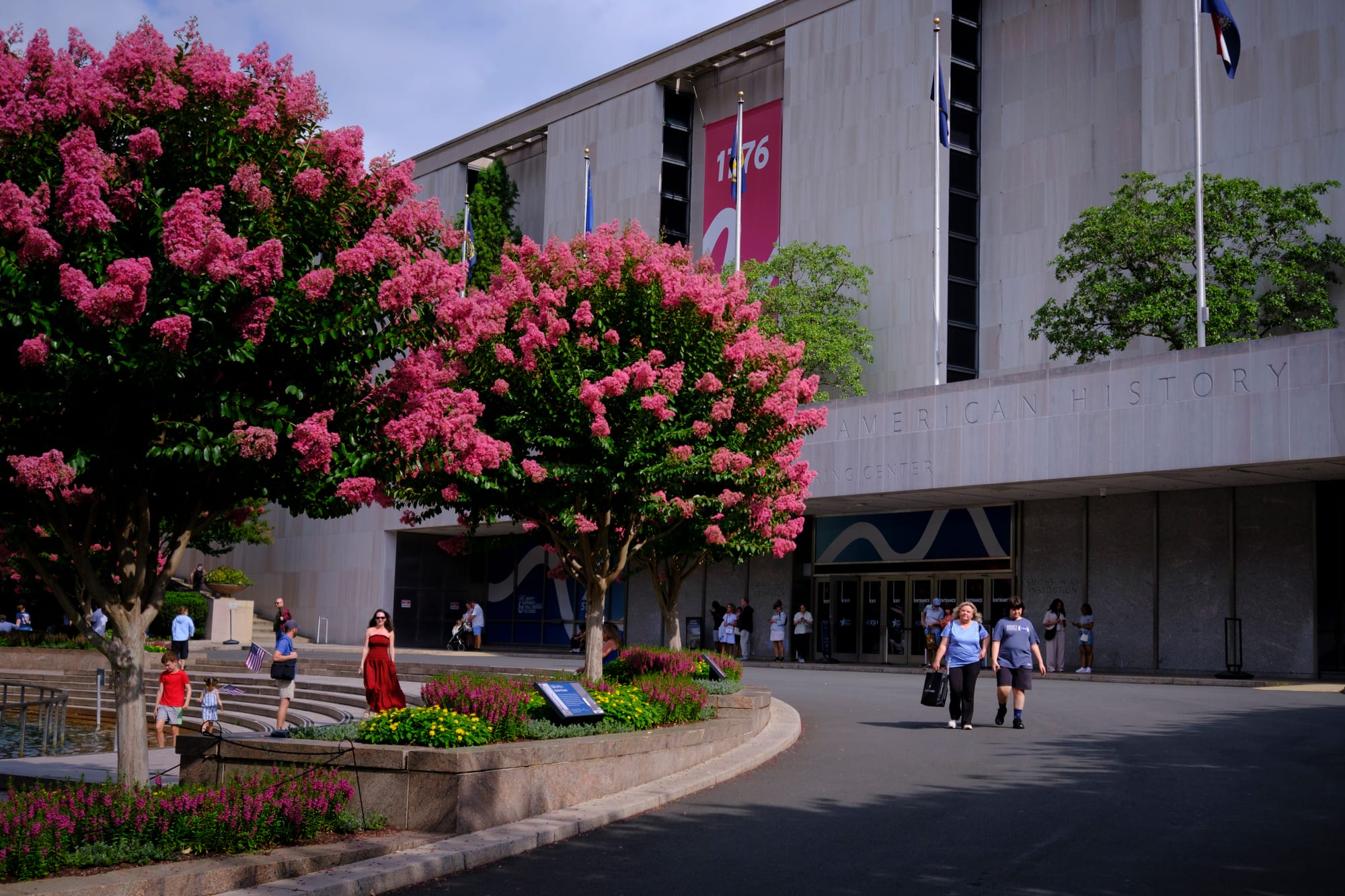
President Trump has ordered federal officials to install content warning labels outside the Smithsonian National Museum of American History (NMAH) after his administration accused the institution of “anti-white” practices.
The order, issued on Friday, July 24, compels the Department of the Interior (DOI) to place “temporary signage along the NPS-maintained sidewalks and walkways used by the public to access the Museum.” The new signage would display the findings from the administration’s recent 162-page report blasting the NMAH for its alleged “extreme political activism.”
A spokesperson for the White House declined to provide information on when those signs would go up. The Smithsonian also declined to respond to Hyperallergic’s request for comment.
Trump’s order is the latest — and most audacious — play in the administration’s ongoing attempt to alter the institution’s exhibits that portray negative aspects of American history, including anti-Latino discrimination, chattel slavery, and the struggle for women’s rights and gender parity.
In his order, the president vowed to “take all available steps to ensure that the issues identified in the Report are addressed,” including a thinly veiled threat to revoke federal funding by evaluating the institution’s compliance with “funding or contract conditions.” The Smithsonian is a public-private organization that receives over $1 billion in federal appropriations each year.
Trump’s mandate also accused the museum of not “appropriately honoring the 56 signers of the Declaration of Independence during this 250th anniversary year.” In response, the president said he would display “temporary exhibits or signage” containing the administration’s preferred information about the signatories.
Friday’s executive order came days after congressional Republicans grilled NMAH director and longtime public historian Anthea Hartig on museum content that the Trump administration finds problematic.
Among the most inflammatory accusations made against the NMAH in the July report was that the museum was promoting “citizenship for millions of illegal aliens” through an exhibition on pluralism in the United States. It also repeatedly alleged anti-White bias within the institution.
Hartig, who oversees only one of the institution’s 21 museums and zoos, found herself testifying in front of the House Subcommittee on Delivering on Government Efficiency on July 21 after she was accused of “advancing an ideological agenda contradictory to the Museum’s founding purpose of fostering patriotism” in the government report.
In a short testimony to the subcommittee, Hartig defended her work at the museum and the NMAH’s mission to “[add] the evidence, voices and objects that earlier tellings left out, so that more Americans can see themselves in the national story.” She also continually denied any partisanship at the museum.
In the over two-hour ordeal, Hartig fielded bizarre questions and remarks from Republican members of the subcommittee, including accusations that the museum sold “Latina power paraphernalia” and was “sexualized” through its display of imagery of drag queen RuPaul.
At one point, Colorado Republican Congresswoman Lauren Boebert asked Hartig where the historian had received the authority to “turn the National Museum of American History into a vehicle for progressive political activism.”
While the current administration and congressional Republicans apply pressure to NMAH to change what the president does not agree with, volunteer groups of citizen historians have documented exhibits and wall texts at the institution — and at National Park Service sites — fearing Trump-ordered changes. One such group, Citizen Historians, has already photographed the museum’s three floors, according to its website.
Yale University American history professor David Blight testified alongside Hartig, as well as right-wing Heritage Foundation fellow Mike Gonzalez and former Heritage Foundation vice president Matthew Spalding.
Taking questions from the first Gen-Z Congress member, Florida Democrat Maxwell Alejandro Frost, Blight speculated that Trump’s actions at the Smithsonian could be modeled after those of the 1937 Degenerate Art exhibition architect, Nazi propagandist Joseph Goebbels.
“Dr. Blight, if Congress or the White House starts deciding historical or political interpretation, how is that different from political censorship?” Frost asked Blight.
“It is political censorship,” Blight responded.
Last week’s Smithsonian attacks came days after the Trump administration replaced an exhibition on slavery in Philadelphia with language that minimized President George Washington’s role in upholding the institution.
The DOI has not yet responded to Hyperallergic‘s requests for comment.
Staff Reporter Anna Lee contributed writing to this report.