President Trump’s Justice Department wants the Supreme Court to believe in a unicorn — something it calls a “regulatory tariff.”
In its brief defending President Trump’s use of the International Emergency Economic Powers Act to impose sweeping tariffs, the DOJ claims the president wasn’t raising revenue, but regulating imports.
For starters, that’s hard to square with the administration’s own statements.
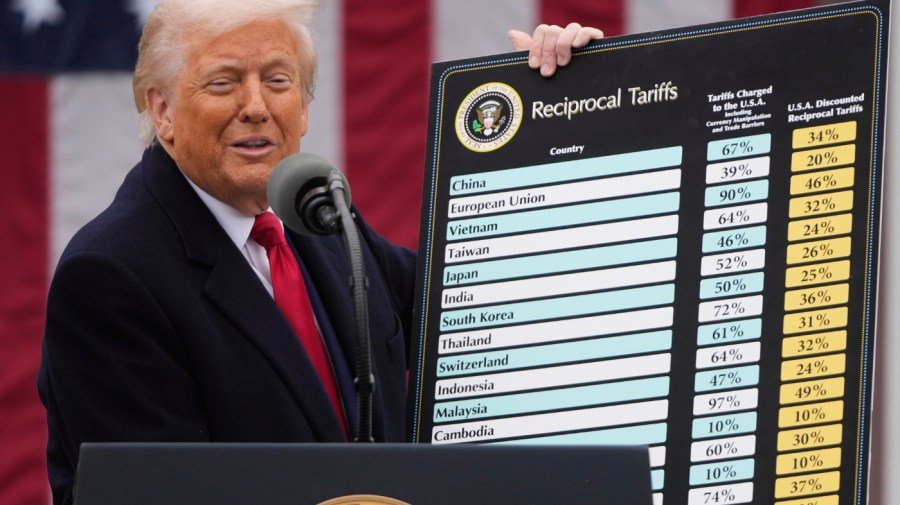
Trump and his cabinet have boasted about the revenue generated by the tariffs. In fact, they’ve proposed scrapping federal taxes and replacing them with the “trillion dollars of revenue” the tariffs have raised. They’ve even warned the Supreme Court not to overturn the tariffs because, in their view, the U.S. will be “destroyed” without this revenue.
Legally, however, it’s easy to understand why Trump’s lawyers are trying to redefine tariffs. This linguistic sleight of hand is meant to shoehorn the tariffs into the statutory language that lets “regulate” or “prohibit” transactions during a national emergency.
But tariffs aren’t regulations: They are taxes, plain and simple. Tariffs are paid by U.S. importers to U.S. Customs, and that money is deposited directly into the U.S. Treasury. Even tariffs enacted for policy reasons — to protect an industry or retaliate against foreign discrimination — are still taxes, by design and by effect.
Tariffs alter prices, generate revenue and change consumer behavior. There’s no meaningful line between a revenue-raising tariff and a regulatory one. Every tariff does both.
Moreover, the administration knows this. The evidence makes clear that Trump’s 2018 tariffs increased the tariff-inclusive price of imports by virtually their full amount, meaning U.S. firms and consumers incurred not only the statutory incidence, but also the economic incidence, of the tax. Early evidence on Trump’s 2025 tariffs indicates that this is equally true today.
That’s why Congress has always treated tariffs as a form of taxation, not regulation. Article 1 of the Constitution gives Congress — not the president — the power to “lay and collect taxes, duties, imposts excises.” It’s also why, when Congress wants to let presidents act on trade, it passes laws with clear limits.
The International Emergency Economic Powers Act was written to control financial flows, not goods. The law’s verbs — “investigate, regulate, or prohibit” — were meant for foreign exchange and credit transfers, not import duties.
The Justice Department’s claim that Trump’s tariffs weren’t revenue-raising but regulatory is a distinction without a difference. It’s like saying a gas tax isn’t a tax because it’s meant to reduce driving. Intent is irrelevant.
That’s why the government distinguishes tariffs from sanctions and asset freezes, which are actually regulatory in the sense that they block specific transactions to change behavior. Tariffs, by contrast, are collected, priced and deposited into federal coffers.
The constitutional stakes are big. Under the Justice Department’s theory, any president could impose new taxes just by labeling them regulatory. A “regulatory income levy” to fix inequality. A “regulatory fuel surcharge” to fight climate change.
Once that door is opened, the constitutional firewall separating the executive’s power from Congress’s authority collapses.
Every tariff dollar collected under the International Emergency Economic Powers Act undermines Congress’s constitutional role. The Supreme Court should see DOJ’s distinction for what it is: an effort to turn an unconstitutional tax into a regulation.
There is no such thing as a regulatory tariff. There are only tariffs as taxes — and under the Constitution, only Congress gets to write them.
Marc L. Busch is the Karl F. Landegger Professor of International Business Diplomacy at the School of Foreign Service at Georgetown University. Nuno Limāo is the Wallenberg Professor of International Business and Finance at the School of Foreign Service at Georgetown University. Rodney D. Ludema is a professor in the Department of Economics and the School of Foreign Service at Georgetown University.