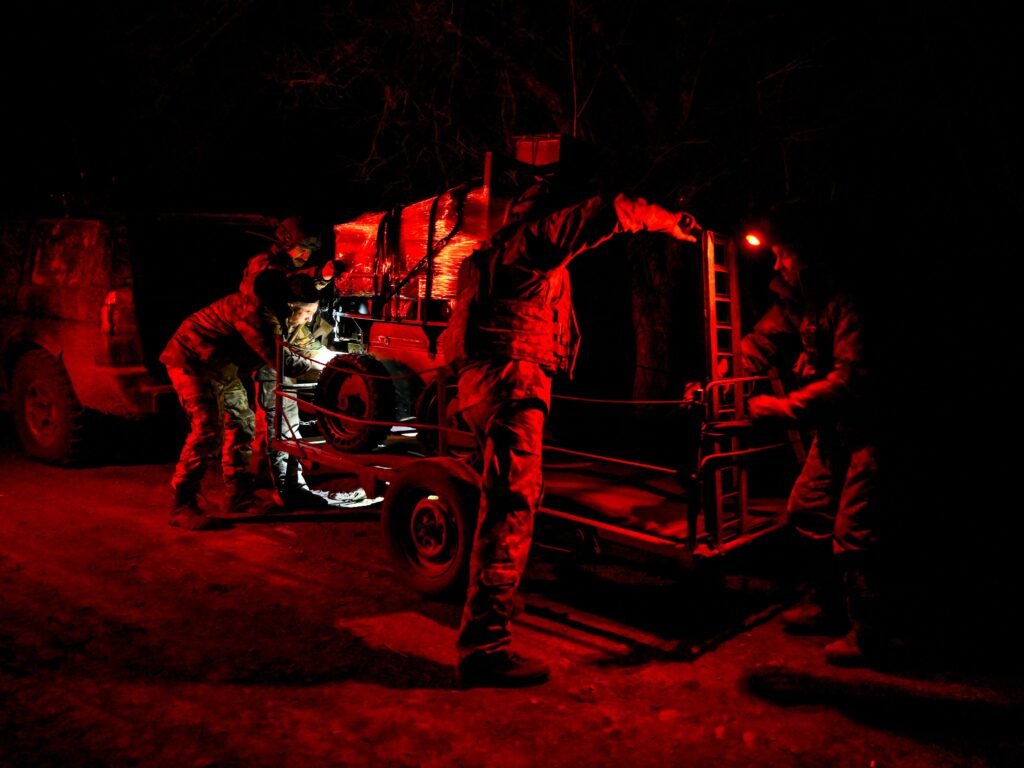
NurPhoto/NurPhoto via Getty Images
- The heavy drone saturation above the battlefield in Ukraine has made casualty evacuation difficult.
- Ukrainian soldiers are changing how they train to deliver medical care to wounded soldiers.
- One battalion is preparing troops and medics for scenarios where quick extraction isn’t possible.
Ukrainian forces are changing how they train to deliver medical care to wounded soldiers as heavy drone saturation increasingly complicates battlefield casualty evacuation.
The area surrounding the front lines has turned into what Ukrainian officials and soldiers describe as a “kill zone,” where drones are constantly watching and targeting anything that moves, including wounded troops and those trying to save them, with precision strikes.
Moving wounded troops off the battlefield was already a daunting challenge. Ukraine’s 1st Separate Medical Battalion, a unit that specializes in front-line casualty evacuation, told Business Insider in translated remarks that the emergence of the kill zone has further upended long-standing theories about how to deal with casualty care on the battlefield.
Casualty evacuation timelines have become even more unpredictable, forcing the battalion to prepare soldiers and medics for scenarios where a quick extraction won’t be possible.
The norm now is what’s called prolonged casualty care. It requires soldiers and combat medics to not only provide initial stabilization but also manage the casualty for an extended period, a spokesperson for the battalion said, asking not to be identified for security reasons.
With this in mind, the battalion now teaches tourniquet reassessment at the basic level to lower the risk of tourniquet-related complications, including reduced blood flow and amputation, that could arise during prolonged evacuation.
Andriy Dubchak/Frontliner/Getty Images
During the wars in Iraq and Afghanistan, US military medics applied tourniquets without ever thinking about removal because wounded troops could be swiftly evacuated to higher care. That’s often not an option in Ukraine. When evacuation isn’t an option, leaving a tourniquet on for too long can be as harmful as the bleed it was meant to stop.
The Ukrainian medical battalion said it is also developing telemedicine to address medical concerns when evacuation is delayed. In these scenarios, a soldier who remains with a casualty can connect remotely with experienced medics for clinical support, the spokesperson said.
They said that the battalion is pivoting from a focus on stabilizing the casualty for rapid evacuation toward a model where soldiers must be prepared to keep the casualty alive for as long as required. Depending on battlefield conditions, that could be days.
For NATO countries, delayed casualty evacuation stands in stark contrast with the traditional medical care of the post-9/11 wars. During those wars, allied forces had air superiority for helicopter medevac and access to sprawling, fully equipped bases. Allies are beginning to realize this might not be the case in future conflicts.
Ukrainian and Western military personnel told Business Insider last year that heavy drone saturation had made it extremely difficult to get wounded soldiers access to medical care within the “golden hour,” the first 60 minutes after a severe injury, where treatment could determine whether they live or die.
Ukrainian soldiers used to rely on the cover of darkness or unfavorable weather conditions to evacuate casualties from the front lines. However, the drone environment has worsened in recent months, making it tougher even in those situations.
Future Publishing/Future Publishing via Getty Images
As the battlefield grows deadlier for humans, Ukraine is increasingly relying on remotely controlled ground robots to evacuate wounded troops from the kill zone, lowering the risk for medical crews who would otherwise be tasked with entering a high-threat environment to administer care.
Brave1, the Ukrainian state-backed innovation platform, launched a program last year for soldiers to earn points by using ground robots to evacuate casualties, which they could then use to purchase military technology from a digital weapons marketplace.
A Brave1 official told Business Insider that the program has created incentives for units to replace humans with ground robots in dangerous missions wherever possible, part of a broader push across the Ukrainian military to do so.
Like other Ukrainian units, the 1st Medical Battalion has also changed its approach to casualty evacuation — moving from pickup trucks and armored vehicles to dismounted teams and now to ground robots.
However, ground robots are an imperfect solution and don’t eliminate the risk entirely for Ukraine. Russia recognizes that these machines are increasingly a cornerstone of Kyiv’s approach to casualty care and logistics missions, making them priority targets, the battalion spokesperson said.
They said that this shift has forced the battalion to continually adapt how it plans missions, selects routes, and uses its ground robots to stay ahead of Russia.