Editors’ Highlights are summaries of recent papers by AGU’s journal editors.
Source: AGU Advances
As the world is soon heated beyond the first, more ambitious Paris target of 1.5°C, the projection of health risks due to the combination of extreme heat and humidity becomes urgent. With a population of 1.5 billion and challenging regional climate conditions, this problem is prevalent in India. Already, inhabitants of the Gangetic Plain are those experiencing these impacts first, and they will be among those with particularly high exposure when global temperatures continue to increase.
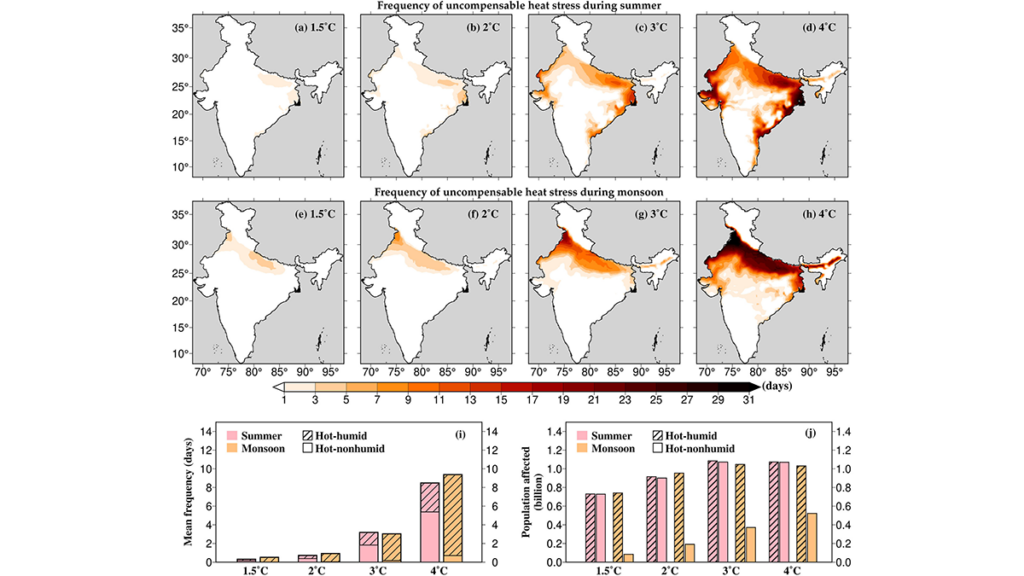
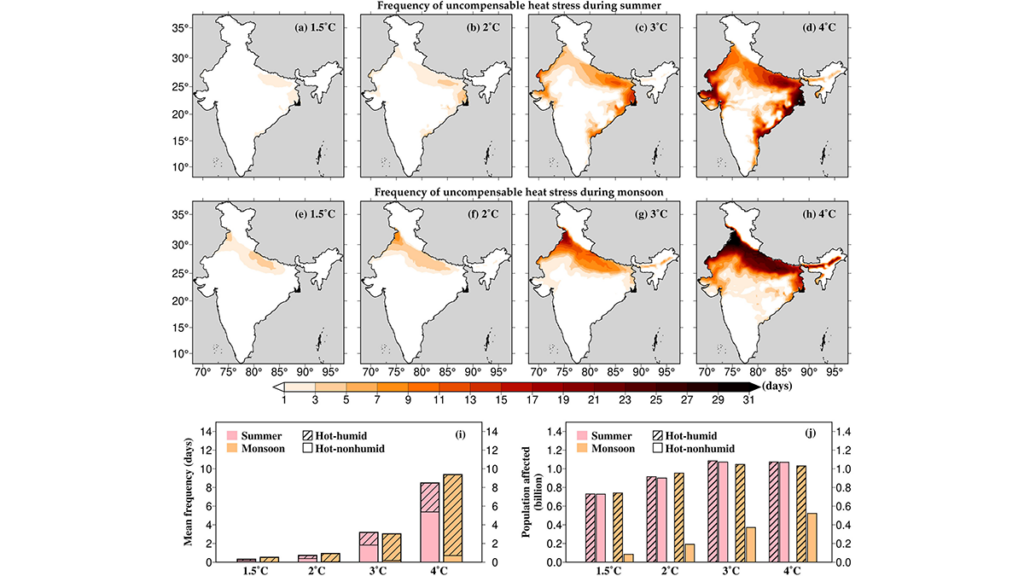
Chuphal et al. [2026] use a physiological indicator of “uncompensable heat stress” that, in addition to the idealized wet-bulb temperature, take into account limits to the human ability to compensate for the extreme heat and humidity, such as partial dehydration or reduced sweating capacity. The physical input is based on six-hourly data; for present-day conditions they come from a standard meteorological product, for the future projections based on model simulations from IPCC’s 6th Assessment Report are used. Combining this with population data and their projections, future exposure is calculated.
The figure above illustrates the rapidly increasing exposure to, and the associated health risk from, the combined extreme heat and humidity. Given that over one billion individuals will be exposed, it is evident that this could potentially become a serious nationwide challenge. The results of Chuphal et al. [2026] are a stark warning of the local and regional impacts that continued global heating engenders. At the same time, this study serves as a guide to adaptation measures that will be necessary. It is therefore part of a growing body of research that together constitutes important pillars of an early climate warning system.
Citation: Chuphal, D. S., Kong, Q., Huber, M., & Mishra, V. (2026). Emergence of uncompensable heat stress during monsoon season in India. AGU Advances, 7, e2025AV001945. https://doi.org/10.1029/2025AV001945
—Thomas Stocker, Editor, AGU Advances

Text © 2026. The authors. CC BY-NC-ND 3.0
Except where otherwise noted, images are subject to copyright. Any reuse without express permission from the copyright owner is prohibited.