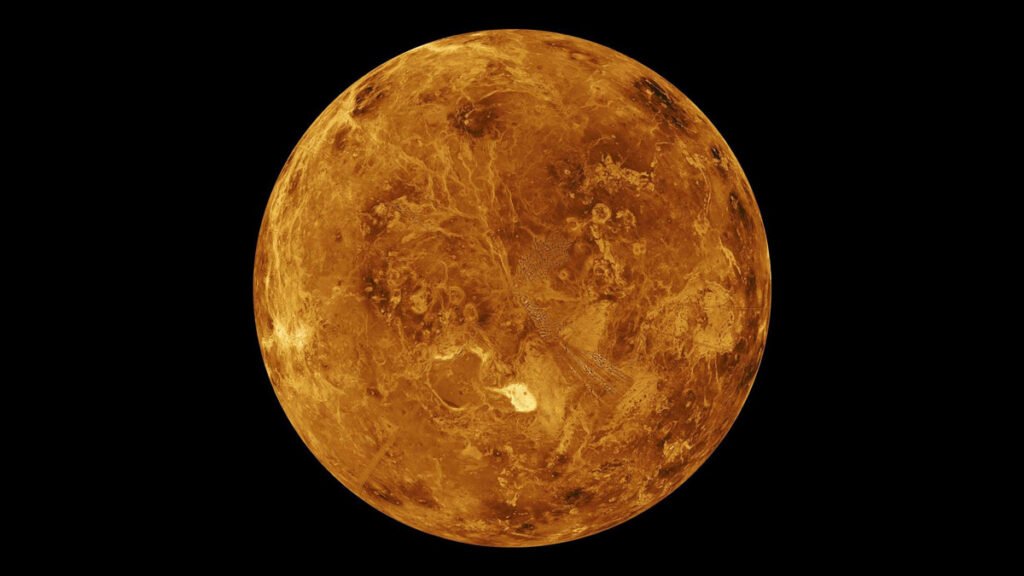
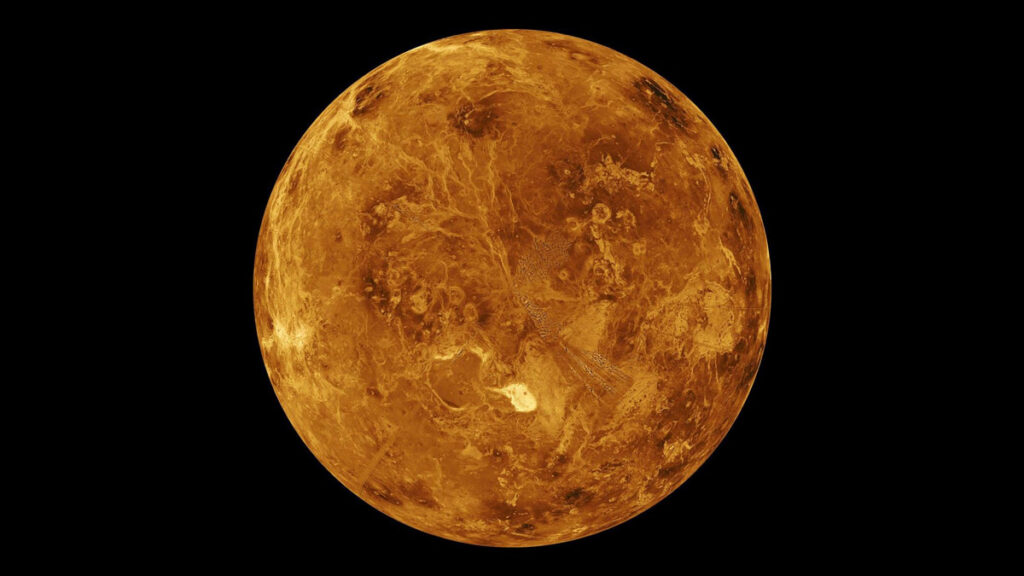
Venus’s pale face enshrouds a hostile reality unfolding beneath its clouds, one that’s inhospitable for life-forms as we know them. Acidic downpours and a crushing carbon dioxide–rich atmosphere lead to blistering surface temperatures of about 467°C (872°F) and atmospheric pressure about 93 times that of sea level on Earth.
Yet the clouds themselves, made almost entirely of sulfuric acid, have held astrobiologists’ curiosity for decades, especially in the upper reaches where the ambient temperature and temperature conditions can host liquids and organic molecules brought by meteorite showers. Some see the clouds as an opportunity to test whether life-forms not only can survive concentrated sulfuric acid but also rely on it instead of on water.
In recent years, Massachusetts Institute of Technology planetary scientist Sara Seager and her team have demonstrated how the chemical bonds in amino acids and nucleic acid bases—the building blocks of proteins and DNA and RNA, respectively—can survive in concentrated sulfuric acid. The more concentrated sulfuric acid gets, the fewer water molecules are present to trigger the hydrolysis that breaks the molecule’s chemical bonds.
“This shouldn’t even be happening, and yet it does.”
In a study published in the Proceedings of the National Academy of Sciences of the United States of America, the team shows some peptides—or chains of amino acids that are a building block of proteins—can also remain intact in concentrated sulfuric acid. But they can go a step further, folding into a distinctive knot shape called an omega loop that could give these chains biological functions.
“This shouldn’t even be happening, and yet it does,” said coauthor Janusz Petkowski, an astrobiologist at Wrocław University of Science and Technology in Poland. He’s a longtime collaborator of Seager’s, who will assume an appointment at the University of Toronto in October.
In finding these shapes, the team have done away with the assumption that concentrated sulfuric acid destroys every peptide it comes in contact with. The finding could mean expanding the search for signs of life beyond Earth to new environments previously considered too hostile to support biological functions.
On Omega Loops
Omega loops are one of many shapes peptides can fold into in nature. But they’re typically known to occur in water-based chemistry. Scientists didn’t think such bonds existed in concentrated sulfuric acid, where the presence of excess protons and hydrogen bonds was thought to inhibit folding or to outright unfurl any 3D structure.
In the new work, researchers tested three synthesized peptides. While in water, the peptides arranged themselves as flat sheets without folding. In concentrated sulfuric acid, they folded into omega loops.
Not every peptide can remain stable in the acid, let alone fold. A few years ago, Seager’s team reported dipeptides degrading in the acid. But the latest study has astrobiologists reconsidering commonly held assumptions about organic compounds’ behavior in the medium.
“The cool part is they find some peptides are stable, some are not,” said Martin Rahm, a quantum chemist and astrobiologist at Chalmers University of Technology who was not involved in the study. Commenting on the omega loop, he said, “Seemingly, this is not like a random coil.”
However, Rahm was “less sure” about interpreting these peptides as bearing omega loops. Researchers used a spectroscopic technique called nuclear magnetic resonance to identify the structures, applying a magnetic field to the peptides and observing their atoms realign. But the researchers’ modeling software wasn’t designed to interpret structures in sulfuric acid–based media.
Though concentrated sulfuric acid is a “severely understudied” solvent, according to Petkowski, he said the team took care to adopt controls to avoid bias in their structural models, finding the three peptides tested bore omega loops of “slightly” different curvatures. The loops reemerged under every assumption they varied and tested for.
Life in an Acid Environment
It may be too early to speculate whether these omega loops have biochemical functions, in part because the study itself doesn’t necessarily point to this. “If they all fold into the same thing (omega loops), that might actually be bad for life,” Rahm said. The reason is that none of the peptides would fold into the other structures necessary for life as we know it, such as sheets and helices.
“From an astrobiological point of view, there could be sulfuric acid in many places and likely on Venus. So then, understanding what could survive in it, what kind of chemistry that can happen, would be important regardless [of] if it’s related to life or not.”
“There is a lot of work ahead of us,” Petkowski said. While he agreed with Rahm about the ubiquity of omega loops not necessarily pointing to life, he noted the team has only just begun experimenting with various peptides, exploring the many possible shapes peptides can fold into and amino acid sequences beyond the ones found in life on Earth. “One of the avenues of research is essentially looking at sulfuric acid as a solvent for life.”
“From an astrobiological point of view, there could be sulfuric acid in many places and likely on Venus,” Rahm said. “So then, understanding what could survive in it, what kind of chemistry that can happen, would be important regardless [of] if it’s related to life or not.”
That way, he added, “we can understand what we find when we go there.”
—Karthik Vinod (@karthikvin2000), Science Writer
Citation: Vinod, K. (2026), Venusian sulfur clouds might not be so inhospitable after all, Eos, 107, https://doi.org/10.1029/2026EO260298. Published on 18 September 2026.
Text © 2026. The authors. CC BY-NC-ND 3.0
Except where otherwise noted, images are subject to copyright. Any reuse without express permission from the copyright owner is prohibited.