As more women join the workforce and gradually gain representation in leadership roles, the lack of resources like affordable childcare and paid maternity leave has become increasingly consequential.
In the first half of last year, the U.S. saw the steepest decline of working mothers with children under 5 years old in 40 years, according to a University of Kansas study, and that decline has continued.
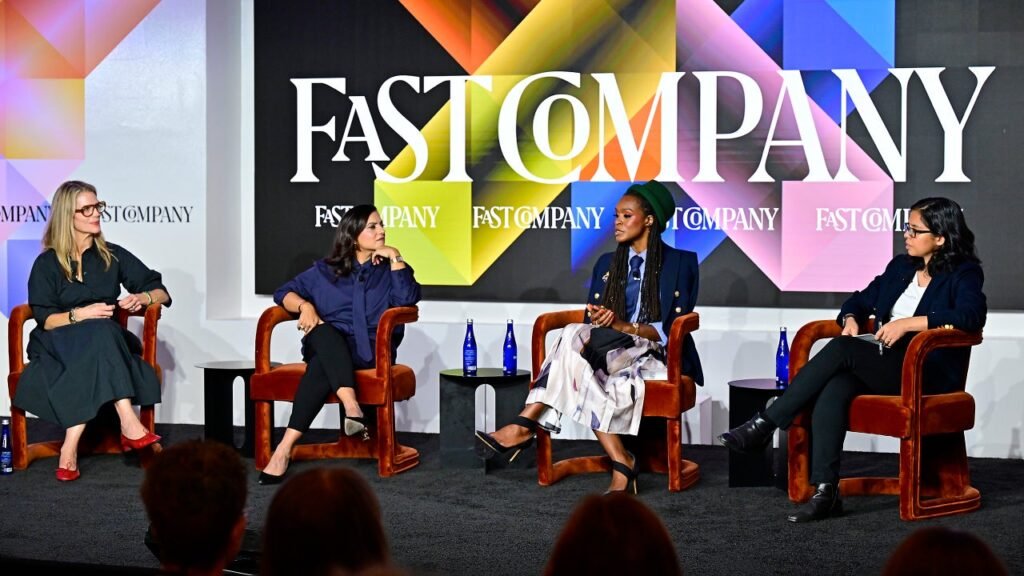
During this week’s Fast Company Innovation Festival, staff editor Shalene Gupta asked several mothers in senior leadership positions how we got here, what mothers need, and how we can improve workplaces and support systems accordingly.
We’ve been here before
Panelists noted that governments and workplaces have already shown that they can adapt.
Girls Who Code founder Reshma Saujani, now CEO of Moms First—an organization that advocates for paid leave and affordable childcare—said that during World War II, the Lanham Act created the country’s first national childcare program, supporting many of the millions of women who suddenly entered the workforce.
“The minute men came back to work, what did we do? We dismantled all those childcare centers,” she said.
At the onset of the COVID-19 pandemic, women lost 1.5 million more jobs than men, according to Indeed’s Hiring Lab; even so, it was a time in which workplaces offered more flexibility for parents, and billions in government childcare funding helped more women enter or remain in the workforce.
Then, those systems were shut down, too, Saunjani said.
Affordable childcare is a broadly popular concept
Families have made it clear that affordable childcare is a priority, she said, referencing New York City Mayor Zohran Mamdani’s emphasis on providing no-cost childcare.
Another thing we learned during the pandemic, and are now seeing in response to AI, is “that companies can get really nimble, really quick” when growth and capital are on the line, said Alison Moore, CEO of Chief, a private membership network for women in leadership.
She said we need to apply that same mindset to human capital—and the changes that we’ve seen so far haven’t been enough.
Outside of the workplace, there are other gaps in available support for mothers, especially new mothers, said Latham Thomas, CEO and founder of the doula-training company Mama Glow and the nonprofit Mama Glow Foundation.
Doulas, for example, provide emotional and physical support and education, she said; but they also work to “ensure that there are systems in place when your baby arrives, so that when they leave, you can actually function.”
They look for gaps in care, Thomas said, and unfortunately, current systems in the U.S. often mean paying people to fill those gaps. The people in those caregiving professions aren’t well taken care of, either, she said.
“They’re underinsured, they’re under-resourced, they’re underpaid,” Thomas said. “And quite frankly, those are the people that we need to be shoring up the most support for financially, and building institutional frameworks for, to ensure that they can be a part of our journey as we advance as women.”
Saujani added that we already know what to do. “The question you’ve got to ask yourself is, why don’t we do it?”
The impossibility of being a working mother in America is due to intentional policy failures, Saujani said, “and every time we get close to fixing these structural failures, we get handed a culture war”—like the false choice between being a tradwife or a girlboss.
Until we get past those divisions, she said, we can’t fix things to “finally build a country that works for mothers.”