Source: Tectonics
Where oceanic crust subducts beneath continental crust, belts of volcanoes known as continental arcs can form. Located around the world, these arcs may undergo episodic magma flare-ups—dramatic surges in the flow of magma into the continental crust at rates up to 20 times higher than normal. However, what triggers these extreme surges, which last tens of millions of years, can be unclear.
By analyzing rocks from the mountains of the North Cascades in Washington, Karmakar et al. constructed a new, high-precision timeline and coupled it with whole-rock geochemical proxies to narrow down what caused a major flare-up that lasted from 79 million to 60 million years ago.
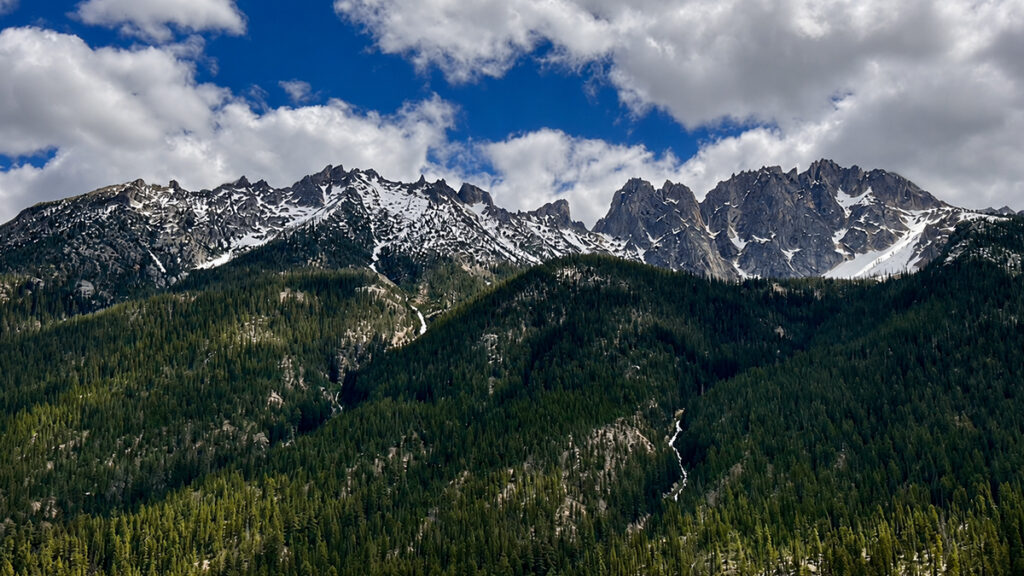
The flare-up occurred along an ancient continental arc that was active from about 150 million to 50 million years ago. During the flare-up, huge bodies of ascending magma cooled and crystallized deep in the continental crust. The North Cascades region is now in a newer era of volcanism that began about 40 million years ago and only very recently produced well-known volcanoes like Mount Rainier and Mount Baker. However, large portions of crystallized magma from the ancient flare-up have been uplifted as part of the collage of rocks that make up the mountains today.
As is typical for flare-ups, the 79-million- to 60-million-year-old event coincided with an increase in the vertical thickness of the continental crust. However, it has been unclear whether that thickening was the result of the flare-up adding magma to the crust or the thickening itself caused the flare-up. At subduction zones, horizontal compression can thicken crust and transport huge amounts of rock to great depths, where they may melt to form magma; in this case, did such dynamics trigger the flare-up?
To address this question, the researchers collected rock samples made of crystallized flare-up magma from the North Cascades and determined their ages with chemical abrasion–isotope dilution–thermal ionization mass spectrometry uranium-lead zircon geochronology—a method for which the uncertainty in age can be as low as 0.05%. They also took whole-rock geochemical measurements for estimating crustal thickness.
Their timeline suggests that crustal thickening did not start until after the flare-up began. During the flare-up, enhanced magma flow and localized thickening appear to be correlated both spatially and temporally. In addition, crustal thickness did not change between this flare-up and an earlier flare-up that lasted from 96 million to 86 million years ago. (Tectonics, https://doi.org/10.1029/2026TC009604, 2026)
—Sarah Stanley, Science Writer

Citation: Stanley, S. (2026), What triggered an ancient magma surge in the North Cascades?, Eos, 107, https://doi.org/10.1029/2026EO260355. Published on 6 November 2026.
Text © 2026. AGU. CC BY-NC-ND 3.0
Except where otherwise noted, images are subject to copyright. Any reuse without express permission from the copyright owner is prohibited.