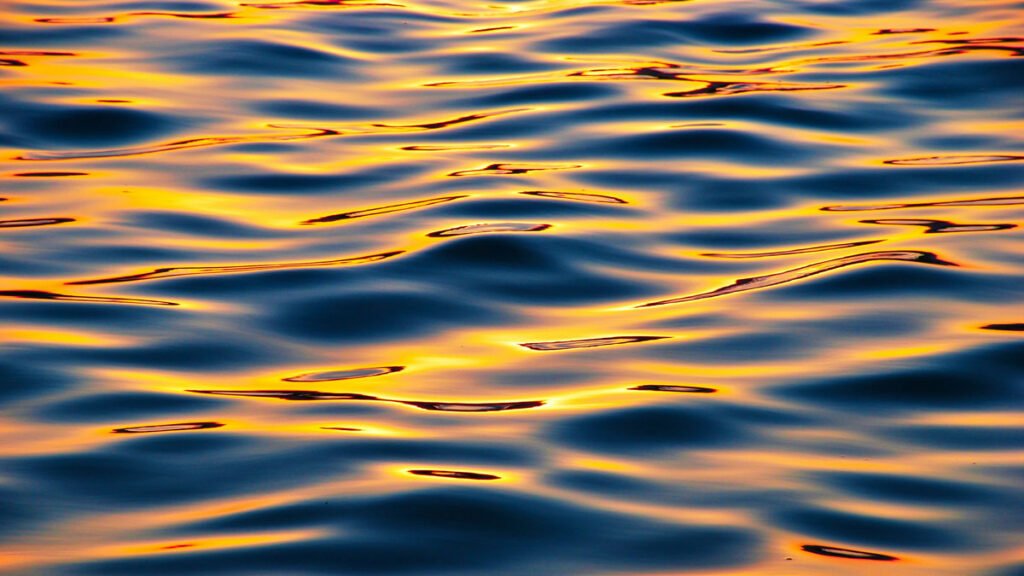
Wind-driven waves on Earth move sediments and shape shorelines. They transport energy between the atmosphere and planetary surface and also mix bodies of liquid, affecting both chemistry and biology. On other worlds with surface liquids, either now or in the past, wind waves would likely perform the same function and so would play a key role in climate and astrobiological potential.
“They’re basically the interface between how the atmosphere communicates with the landscape, especially at the coast.”
New research went back to the fundamentals and explored the conditions that can generate waves on worlds with different physical properties and different liquids, such as Titan, Mars, and select exoplanets.
“Wind waves are really interesting phenomena,” said Una Schneck, a planetary science doctoral student at the Massachusetts Institute of Technology (MIT) in Cambridge. “They’re basically the interface between how the atmosphere communicates with the landscape, especially at the coast.”
The Physics of Waves
Past models of wind generation on other planets struggled because they tended to start from preexisting models of Earth waves. Those models were developed to describe waves in Earth’s specific combination of gravity, atmosphere, and surface liquid, namely, water, said Schneck, who led the new research. Such models were sometimes tailored to describe a particular location and season. Adapting those models for conditions on other worlds, including other liquids like methane and sulfuric acid, always seems to leave traces of Earth behind.
However, the physics of what creates wind-driven waves should be universal, Schneck said, so the team went back to the basics of wave generation. They developed a wave model that explores the relationship between a world’s bulk properties, like gravity and air density, and liquid properties, like surface tension, to determine the wind strength needed to produce a wave.
The team “created this model that went back to the basic physics of waves, instead of just trying to fit to known wave conditions,” said Taylor Perron, an MIT geomorphologist and planetary scientist and coauthor of the research.
The model showed that the threshold wind speed to generate a wave is lower for liquids with less surface tension, which makes it easier to change the liquid’s shape. Higher air density provides more force to push against a liquid’s surface, and lower gravity makes it easier for a wave to rise up—both factors allow a weaker wind to create a wave. The team published these results in the Journal of Geophysical Research: Planets in April.
Waves on Other Worlds
The team first tested their model on the only set of wind and wave data we have—Earth. They used 20 years of wave and weather data for Lake Superior. The model found, correctly, that it takes wind speeds of 2.2 meters per second to generate waves on the lake’s surface and accurately predicted the height of waves for different wind speeds.
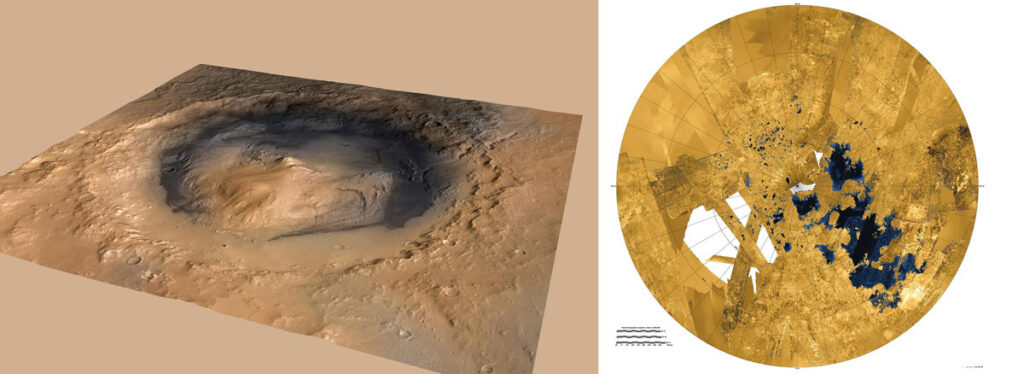
They then used the model to predict wave conditions on other worlds. They started with Mars, which likely had ancient oceans and lakes. Winds of 1.2 meters per second would have created waves in the lake that filled Gale Crater millions of years ago. A wave in Gale Crater would have been taller than a wave on Earth produced by wind of the same strength owing to Mars’s lower gravity.
The story is similar on Titan, the largest moon of Saturn. Waves in Titan’s hydrocarbon lakes would swell with a mere 0.5 meter per second of wind and would rise higher than an Earth wave under similar wind conditions. But they would travel much more slowly than Earth waves and would be spaced farther apart.
“The paper represents our best theoretical understanding of how we expect for waves to behave in a variety of environments,” said Jason Barnes, a planetary scientist at the University of Idaho in Moscow who was not involved with this research. “The movie of Titan waves is particularly awesome—very slow moving for such large amplitudes! Although I don’t expect waves to get that high ever in Titan’s sluggish atmosphere, it’s fun to be able to visualize what they might look like if they did.”
“In theory, this is something that people could do.”
The team also explored wave-generating conditions on three Earth-sized exoplanets. The possible sulfuric acid lakes of the exo-Venus Kepler-1649 b would grow in winds of 5.3 meters per second but would grow to a height similar to that of Earth waves because of its Earth-like gravity. Water lakes on LHS 1140 b would grow in 2.7 meter winds, similar to those on Earth, but would not grow as high because of its higher gravity. And on 55 Cancri e, a lava world, it would take winds of 37 meters per second—a category 1 hurricane—to move tiny waves of molten rock.
“Would you be able to ever detect this? Is this a useful thing to think about, or is it just a fun thought experiment?” Schneck asked. “If the waves are tall enough, you should be able to detect a change in the polarization [of an exoplanet’s light curve] that would not only suggest that there is a liquid surface on that exoplanet, but that liquid surface has waves.…In theory, this is something that people could do.”
Will We See It? Not Soon
Right now, the only world known to have surface liquid other than Earth is Titan, but we don’t have the right observations of Titan to test the new model. The European Space Agency’s Huygens probe landed on the moon in 2005, but nowhere near the northern lake district. NASA’s Cassini mission (of which Huygens was a part) did not detect any waves but did observe a changing lake shore that hinted at wave activity.
It’s possible that Titan’s waves are seasonal and Cassini just didn’t have the right timing, Perron noted. Temperature changes during Saturn’s year could affect wind speeds and also the composition of Titan’s lakes, changing the conditions of wave generation.
Still, the wind speed needed to make a wave on Titan is so low that “it would be very surprising if waves never formed. It just may be difficult to catch them when they’re there,” he said.
“The best way to test this work would be to send a sea probe to float or motor on one of Titan’s big 3 seas.”
“The best way to test this work would be to send a sea probe to float or motor on one of Titan’s big 3 seas—Kraken Mare, Ligeia Mare, or Punga Mare,” Barnes said. “Such a ‘buoy’ probe would be able to simultaneously measure both the sea conditions and the wind conditions, allowing for a comprehensive test of the model.”
Alas, no such mission is in the works, and the upcoming Dragonfly mission won’t travel near any lakes to test this theory either. A future Titan orbiter might provide that information, while a current or future Mars rover might yet gather evidence showing how lakes worked in that planet’s past.
“The improved understanding of waves from this paper might help to constrain the possibilities for wave erosion at the margins of bodies of water…thereby helping us to probe into the past climates of Mars and Titan,” Barnes said.
—Kimberly M. S. Cartier (@astrokimcartier.bsky.social), Staff Writer
Citation: Cartier, K. M. S. (2026), What winds whip up otherworldly waves?, Eos, 107, https://doi.org/10.1029/2026EO260165. Published on 21 May 2026.
Text © 2026. AGU. CC BY-NC-ND 3.0
Except where otherwise noted, images are subject to copyright. Any reuse without express permission from the copyright owner is prohibited.