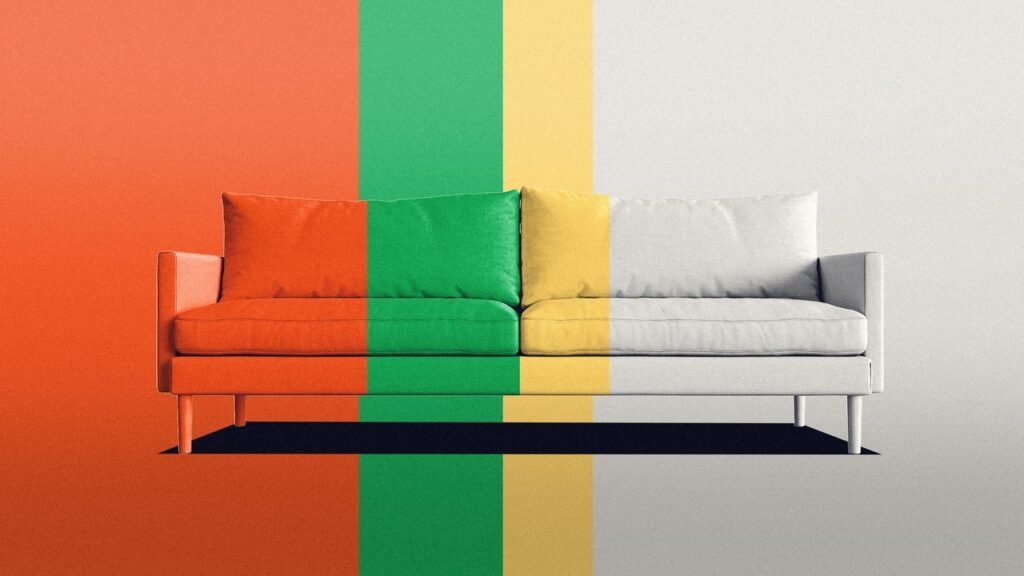
Beige probably rules your room. At least, that’s what a new data visualization reveals.
A chart from the European Correspondent tracks the color of every sofa found in Ikea’s catalogs between 1960 and 2021. The finding? Color washed out of Ikea’s seating in 2011, and didn’t come back.
The data visualization condenses 61 years’ worth of sofas—3,500 to be exact—into a rainbow of lines that get progressively more neutral as the years wear on. By 2013, until the catalog ended in 2021, the most common couch color was either gray or beige.
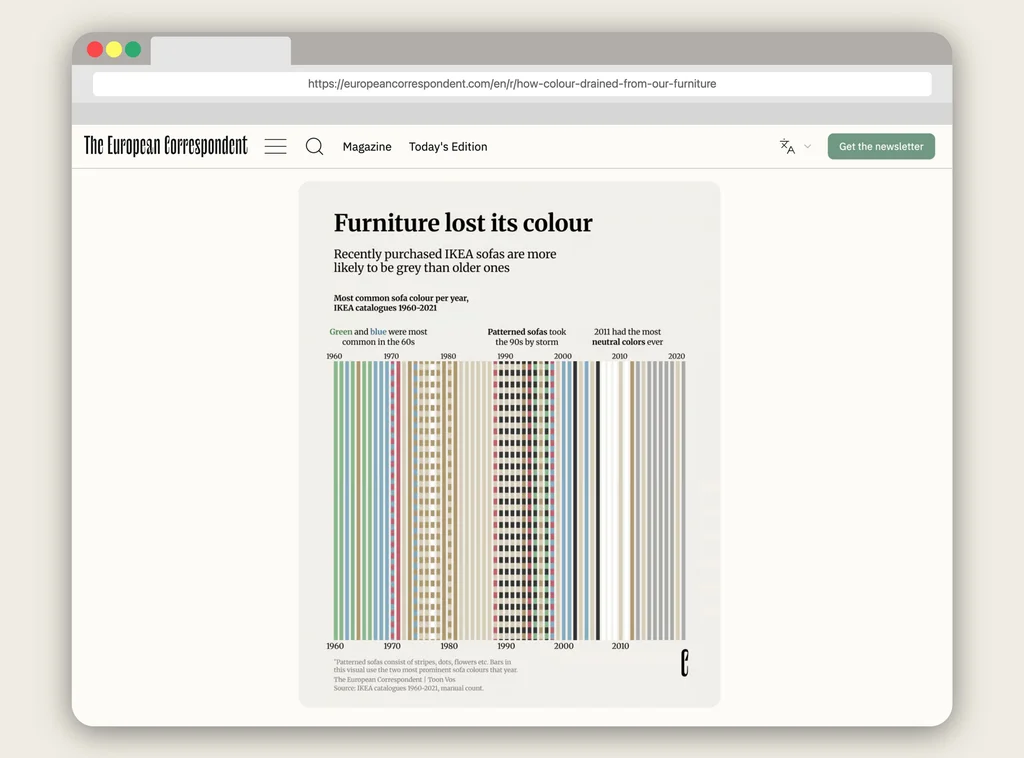
It wasn’t always that way, though. The chart shows green and blue were the most common colors in the 1960s before tan and beige took off in the 1970s and into the 1980s. The 1990s saw the popularity of patterned sofas and colors like black, red, and green. In the 2000s, blue, black, and white were popular. Then the great furniture blanding happened.
Though Ikea discontinued its catalog in 2021, its website today shows that not much has changed. There are 131 gray couches, more than any color, followed by the runner-up, beige, at 120. Blue, with 93 couches, is the third-most popular, though it ranges widely from dark gray-blue to a light pale turquoise blue. That’s followed by brown (93), white (72), black (69), green (67), turquoise (31), yellow (27), red (12), pink (11), and orange (1).
“Our sofa color choices have always been guided by customer preferences and by what people want to bring into their homes,” an Ikea of Sweden spokesperson tells Fast Company. “For several years, muted and neutral tones have been the most popular choice. Today, however, we’re seeing growing interest in more colorful interiors, which is reflected in our range. That’s why we offer bolder options such as blues, greens, yellows, and pinks/reds in some of our most popular sofas like Kivik, Jättebo, Uppåkra, Uppland, and Saltsjöbaden.”
Millennial gray and “influencer beige” have been popularized online thanks to the homes of social media influencers like Kim Kardashian and others. But more broadly, the shift was also in keeping with larger millennial visual movements of the 2010s like blanding, which favored reduced, minimalist, and monochromatic color palettes. Luckily for the life of a couch, such neutral pieces also had a simplicity in keeping with the quiet luxury trend of the early 2020s, which became more prevalent following the HBO series Succession. But beyond aesthetics, they’re also highly functional choices, because neutrals can be a great base for any color.
Even so, there are signs that color could be coming back to couches. Some designers are already over it. Architectural Digest showed sofas in colors like dark green and red on a pair of fall 2025 magazine covers, while Pinterest’s 2026 spring trend report found the “all-white everything” era is coming to an end with an uptick in searches for colors like “moody blue” and “vintage pink.” The trend “grandma core,” for vintage-inspired interiors, is also up, which could signal old trends on their way back.
Despite having more neutral sofas than any other color, Ikea is reviving vintage designs and colors on its own, like its Nytillverkad collection that includes a bright yellow textured sofa and colorful patterned pillows. And a Pinterest-style design inspiration feed on the Ikea homepage under “living rooms” mixes in occasional green, yellow, and blue sofas among its popular neutral models.
“I have a feeling that colors have been on the rise ever since [Ikea ended its catalog],” says the European Correspondent’s Toon Vos, who counted all the Ikea catalog couches.
“Looking at earlier fluctuations in the data, all is not lost, I think,” Vos tells Fast Company. “The ’80s may be remembered for a neon overload, but as far as sofas go, it was beige and tan all the way. Yet the ’90s became the era of the most colorful and outrageous patterns. Color will find its way back into our living rooms over time.”