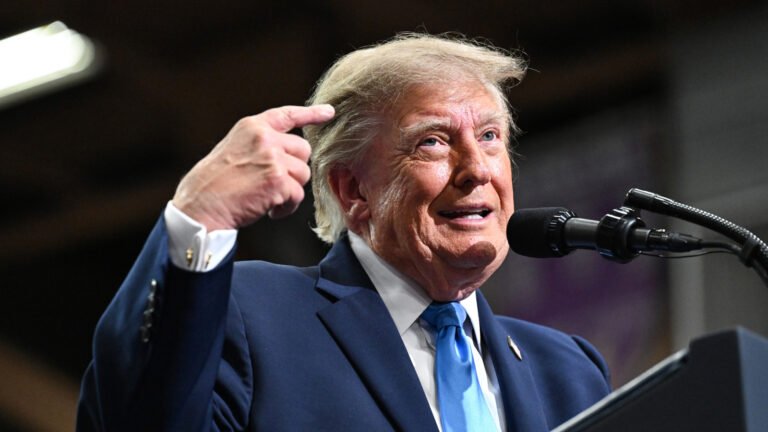
Keeping up with every vector of Trump-generated outrage is like playing a never-ending rigged game of whack-a-mole. For instance, in what might be considered a microcosm of this entire era, much of the backlash to the president’s use of an anti-transgender slur in a Truth Social post on Monday was quickly drowned out by the fuller-throated backlash to the president also seemingly inviting Iran to “take out” a pair of major California cities later that day.
While the unpatriotic stench of Trump glibly wishcasting nuclear attacks on U.S. soil apparently had more media salience (the White House has since pushed back hard against this characterization of his remarks), the president’s use of an anti-trans slur is far more insidious.
This was not just another instance of Trump seeming to relish the transgressive thrill of saying something most people know a U.S. president should not say. Rather, it’s more like the culmination of a concerted effort by MAGA leaders to normalize prejudice against a marginalized community—and declare open season for using slurs against its members.
It’s not at all exculpatory that Trump’s use of the word was directed at a cisgender woman. In his Truth Social message on Monday, he called out Annie Andrews—a pediatrician who is running against Trump’s handpicked candidate for the South Carolina Senate race, Sen. Darline Graham (the late Sen. Lindsey Graham’s sister)—by giving her a nickname consisting of the anti-trans slur that rhymes with her given name. The typically rambling message used the slur three times, touting as justification the idea that Andrews is “in favor of Transgender for Everyone,” whatever that means.
One prominent Republican, former South Carolina Gov. David Beasley, called Trump’s message abhorrent, but the response so far has otherwise been muted. According to right-wing media watchdog Aaron Rupar, Fox News appears not to have even mentioned the incident at all as of Tuesday afternoon. Perhaps the reason for all the silence around a U.S. president using a slur, though, is that the stage had already been set for just such a moment.
How we got here
Although there are many converging reasons why Trump narrowly won the 2024 election, the bulk of which need no re-litigation here, some pundits and think tanks coalesced around one particular explanation. They declared what ultimately swung the election was Team Trump carpet-bombing the airwaves with ads claiming “Kamala is for they/them, Trump is for you.” It wasn’t just a clever bit of wordplay vastly inflating the degree to which most Americans walk around all day worrying that trans people may be living too high on the hog; it was a universally resonant warning that drove voters directly into Trump’s compassionate, normative arms.
Evidence supporting this conclusion remains questionable. Still, conventional wisdom among Republicans and some Dems suggested nothing fires up the base like negative depictions of trans people, and the Democrats who ostensibly support them. (Harris, for her part, had vowed to pass an Equality Act as president, protecting LGBTQ+ Americans from discrimination.) After the election, MAGA officials quickly began acting as though the message of Trump’s anti-trans ad blitz amounted to a mandate—none more so than Rep. Nancy Mace (R-SC).
Within weeks, Mace pushed for a bathroom ban on Capitol Hill, specifically targeting the first openly transgender member of the U.S. Congress, Rep. Sarah McBride (D-DE). The subsequent policy change restricting single-sex facilities in the Capitol remains in place nearly two years later. In the interim, Mace, whose term ends in January and who badly lost a primary run for governor back in June, has taken seemingly every opportunity to use the slur for trans people in public.
In recent weeks, however, a politician higher up the chain of command has eclipsed Mace as the GOP’s leading transphobe: Defense Secretary and testosterone inspector Pete Hegseth.
While Hegseth immediately set about banning trans people from serving in the U.S. military just after Trump’s inauguration, he has become increasingly brazen as the midterms approach about using the slur at large events. He’s deployed it in speeches at the Iowa State Fair, on the campaign trail in Wisconsin, at a Marine base in Virginia, and elsewhere. The naughty delight in using a forbidden word, splashed all over his face, could easily be interpreted by Hegseth’s “anti-woke’ acolytes as an invitation to take the slur out for a spin themselves.
And that was before Trump picked up the problematic baton.
Why this is unprecedented
For most of modern American history, politicians have stood downstream from changes in everyday language. Culture establishes or revokes the viability of certain words, then politicians later discover which once permissible vocabulary has newly fallen out of favor.
It was a long, grueling struggle to get majority buy-in among Americans that the word is, in fact, a slur—no thanks to Christian Siriano or Blake Lively. The word used to appear somewhat reliably as a punch line on late-night talk shows and in movies, not to mention in casual conversation. But the 2010s brought about increased trans visibility, and with it, a broader understanding that the term was dehumanizing (something no trans person needed to be taught).
The Cambridge Dictionary now defines it as “an extremely offensive word” for trans people. For well over a decade, the word had been confined to the nether realm of polite society; a settled issue. Among a certain set of anti-woke citizens, the slur may have never gone out of fashion, with many still proudly hurling it in street confrontations, but it remained on the fringes until recently. Now that increasingly high-ranked leaders in the halls of power have validated the combative impulses of their most bigoted supporters, those folks may now feel empowered to use the slur with confidence even in professional settings
If that were to happen, it would be an unprecedented development. This is not, after all, a case of a slur gradually creeping back into acceptability due to a shift in public opinion. Instead, it’s the U.S. government openly attempting to effect change in the culture. Trump and his cronies are broadcasting a new linguistic norm to millions of people, without waiting for any of the traditional arbiters in media and pop culture to get there first. They aren’t responding to a widely noted and agreed-upon reversal of a taboo; they’re trying to reverse the taboo by force.
What happens now
So far, the word has only reached permissibility among a political subculture, especially within the slimy walls of Elon Musk’s barely moderated X. What remains to be seen is what it will take for it to break containment, reaching the broader internet and infiltrating office kitchen hangs. How many more slur-accented speeches will Hegseth have to strut through to close the deal?
Like many other unsettled issues around the direction the U.S. is headed in, perhaps we’ll know more after the midterms.
Considering the slur only reached Trump’s desk with less than a month until votes are counted, it seems as if certain White House advisers believe another anti-trans cultural panic will be their electoral ace in the hole (just in case the bribes and attempts at voter suppression don’t work).
Also sending that signal is Musk, who reportedly dumped $100 million into midterm ads for GOP candidates, with the money focused almost exclusively on trans-related attacks. Musk’s targeting of trans people highlights a glaring discrepancy in the narrative that all the hand-wringing is mostly about fairness in women’s sports. Instead, Musk has confirmed that he only became active in far-right politics after his daughter, Vivian Wilson, came out as trans, due to being “lost to the woke mind virus.” (For her part, Wilson claims that Musk got into far-right politics for any number of other reasons.)
In any case, if the midterms go well for Republicans, it won’t matter whether or how much the anti-trans messaging meaningfully contributed to the outcome. MAGA will inevitably tout the victory as validation for all this messaging. It will make trans people somehow even more marginalized than they’ve become throughout Trump 2.
On the other hand, if the midterms end up going the way polls broadly forecast, a sweeping victory for Democrats, it just might send the message that the dignity and rights of a community that represents about 1% of the country is perhaps not the most destructive factor at play in the U.S. right now. It might also convince Dems, once and for all, that anti-trans messaging does not win votes, and bowing to that narrative was and remains both politically and morally indefensible.
A blue wave election will ultimately suggest that while Trump’s words were giving his supporters permission to use slurs, his actions were giving them permission to finally go rogue, and a corrective was sorely needed.